
Radio Still Needs People Who Care. Do You?
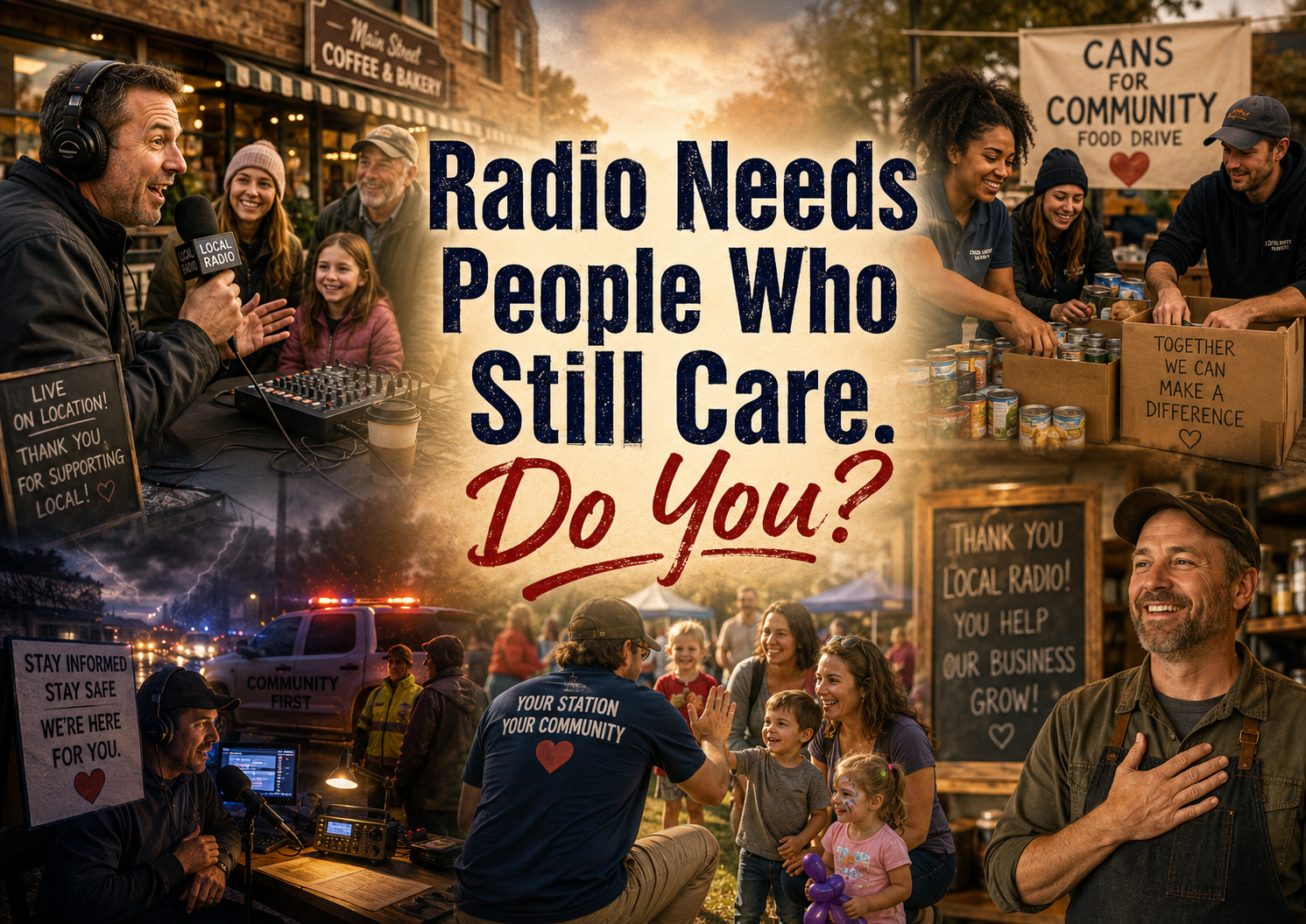
When the biggest companies keep cutting, consolidating, centralizing, automating, and calling it “innovation,” the answer is not for the rest of radio to become a smaller, cheaper imitation of the same broken model.
The answer is to remember what radio actually is. Radio is not just a job. In most places, it does not pay enough to make a killing.
Yes, talented sellers can do well. Great talent can do well. Smart owners can build real businesses. But most people who have given their lives to radio did not get into this business because it was the safest financial bet.
They got into it because something happened.
A spark.
A voice coming out of a speaker late at night when they should have been asleep.
A local morning show that made their town feel bigger, funnier, warmer, and more alive.
A song intro hit perfectly by a jock who sounded like they were talking directly to them.
A ballgame on a Friday night.
A storm warning when the power was flickering.
A fundraiser that actually changed somebody’s life.
For me, radio was transformative. It lit a light in me that has never gone out. Not after downsizings. Not after watching good people walked out of buildings they helped build and having it happen to me countless times for bogus reasons. Not after taking less and less compensation while somehow being expected to gain more and more skills. Not after seeing the industry I love treat experience like a liability and passion like a line item.
I still care.
That may sound sentimental. Good.
Radio could use a little more sentimentality right now. Not fake nostalgia. Not “let’s pretend it’s 1989.” Not a refusal to embrace digital, podcasting, video, streaming, AI tools, data, or modern sales strategy. I believe in all of that.
But technology is not a soul. A hub is not a community. A voice track is not a relationship. A generic social post is not local service. And a building full of empty studios is not “efficiency.” It is surrender.
Radio needs people who care.
We need owners who care. Sellers who care. On-air people who care. Traffic people who care. Production people who care. Engineers who care. Promotions people who care. Receptionists who know the names of listeners and business owners. Managers who understand that a radio station is not just an audio delivery system. It is a civic institution with a sales department attached to it.
We need people who understand what great radio does for communities.
Great radio does not just play songs and run spots. Great radio shows up.It shows up when a tornado warning is issued. It shows up when a family loses everything in a fire. It shows up when a local school needs help. It shows up when the high school team makes a run. It shows up when a small business is trying to survive one more month and needs an idea that cuts through. It shows up when a city is hurting, celebrating, grieving, arguing, laughing, voting, rebuilding, and becoming itself again.
That is not romantic fluff. That is the product. That is the difference between a signal and a station.
And here is the part the corporate spreadsheet people never seem to understand: people still want this.
They have not abandoned radio. Nielsen’s 2026 Audio Today report says radio reaches 93 percent of U.S. adults monthly. It reaches 89 percent of adults 18 to 34. Among Black adults, monthly reach is 93 percent. Among Hispanic adults, it is 94 percent.
In other words, after years of layoffs, consolidation, debt games, and local abandonment, the audience is still there. Think about that.
Radio has been bruised, neglected, over-leveraged, under-staffed, and treated like a declining asset by people who often did not understand its real value — and it still reaches almost everybody.
That should humble us. It should also infuriate us.
Because the problem is not that radio stopped mattering. The problem is that too many companies stopped acting like it mattered.
Radio still dominates ad-supported audio. Nielsen and Edison’s Share of Ear data show radio with 61 percent of daily ad-supported audio listening time among adults 18-plus in late 2025, far ahead of podcasts, streaming audio, and satellite radio. Radio remains especially powerful in the car, where more than 80 percent of all ad-supported audio time goes to AM/FM radio.
So please, let’s stop talking like this medium is dead. It is not dead.It has been stripped for parts.There is a difference.
The Telecommunications Act opened the door to a level of consolidation that changed the soul of this business. Then the debt-driven, venture-capital, private-equity mindset came in and treated radio less like a public trust and more like a stack of assets to be milked.
Stations became clusters. Clusters became spreadsheets. Markets became “cost centers.” People became “headcount.” And somewhere along the way, too many licensees forgot what a broadcast license is.
These frequencies do not belong to us. They belong to the public. Licensees are not kings. They are trustees. That is not my opinion. That is the foundation of American broadcasting.
The FCC has repeatedly stated that broadcasters operate in the “public interest, convenience, and necessity.” A 2026 FCC public notice reminded broadcasters that the award of a broadcast license is a public trust, and that broadcasters have an obligation to offer programming responsive to the needs and interests of the local communities they are licensed to serve.
That matters. Because if a company owns a station in a town, but most of the meaningful programming is created somewhere else, most of the decisions are made somewhere else, and most of the people on the air could not find the local hospital, courthouse, high school, or emergency shelter without GPS, then we need to ask a serious question:Is that company truly serving the local public interest?
I am not against national talent. Great national talent has always had a place in radio.I am not against syndication. Some syndicated shows are excellent. I am not against technology. We need technology.
But I am absolutely against using technology as an excuse to abandon the local communities that made these licenses valuable in the first place. It is time for new rules.
Radio stations should be required to originate a meaningful percentage of their programming in and about the local markets they are licensed to serve. Not just a public file report. Not just a weekend affairs show buried at 6 a.m. Not just liners saying “your local station” between songs scheduled by someone hundreds of miles away.
Real local programming. Local voices. Local issues. Local emergencies. Local sports. Local businesses. Local interviews. Local production. Local service. Local accountability.
If you want the privilege of using the public’s airwaves, then serve the public. If you want to own dozens or hundreds of licenses, then prove that those communities are getting something in return besides a transmitter, a tower, and a national feed with a local logo slapped on it.
The argument for local radio is not just emotional. It is strategic. A local seller with a great idea can do more for a business than a dashboard ever will. A local talent who knows the town can create moments no algorithm can invent. A local station that actually shows up can build loyalty no national brand can buy. A production person who cares can turn a struggling advertiser’s message into something memorable enough to move customers through the door.A traffic person who catches a detail can save a client relationship.An engineer who keeps a signal alive during a storm is not just maintaining equipment.
They are maintaining trust. Radio needs people who care. If you care, you belong here. If you understand what it means to make a difference for listeners and businesses in your community, you belong here.If you stayed up too late as a kid listening to radio and dreaming about being part of that magic someday, you belong here. If you have been knocked down by this business and still find yourself wanting to create, serve, sell, write, produce, entertain, inform, and connect, you belong here.
But if you see radio only as inventory, only as leverage, only as a platform to aggregate, automate, and strip down to the lowest possible operating cost, then maybe it is time to step aside.
Because radio is everything it always was. We just let the wrong people convince us it was less.
Radio is still companionship.
Still immediacy.
Still imagination.
Still community.
Still the voice in the car.
Still the soundtrack of the workday.
Still the place people turn when something happens.
Still one of the most powerful advertising vehicles ever created.
Still a miracle when the right people are behind the microphone, behind the console, behind the sales call, behind the log, behind the transmitter, and behind the mission.
The future of radio will not be saved by people who merely operate stations. It will be saved by people who love them.People who care.
And I still do.