
STOP SAYING RADIO COMPETES WITH TIKTOK. START LEARNING FROM IT.
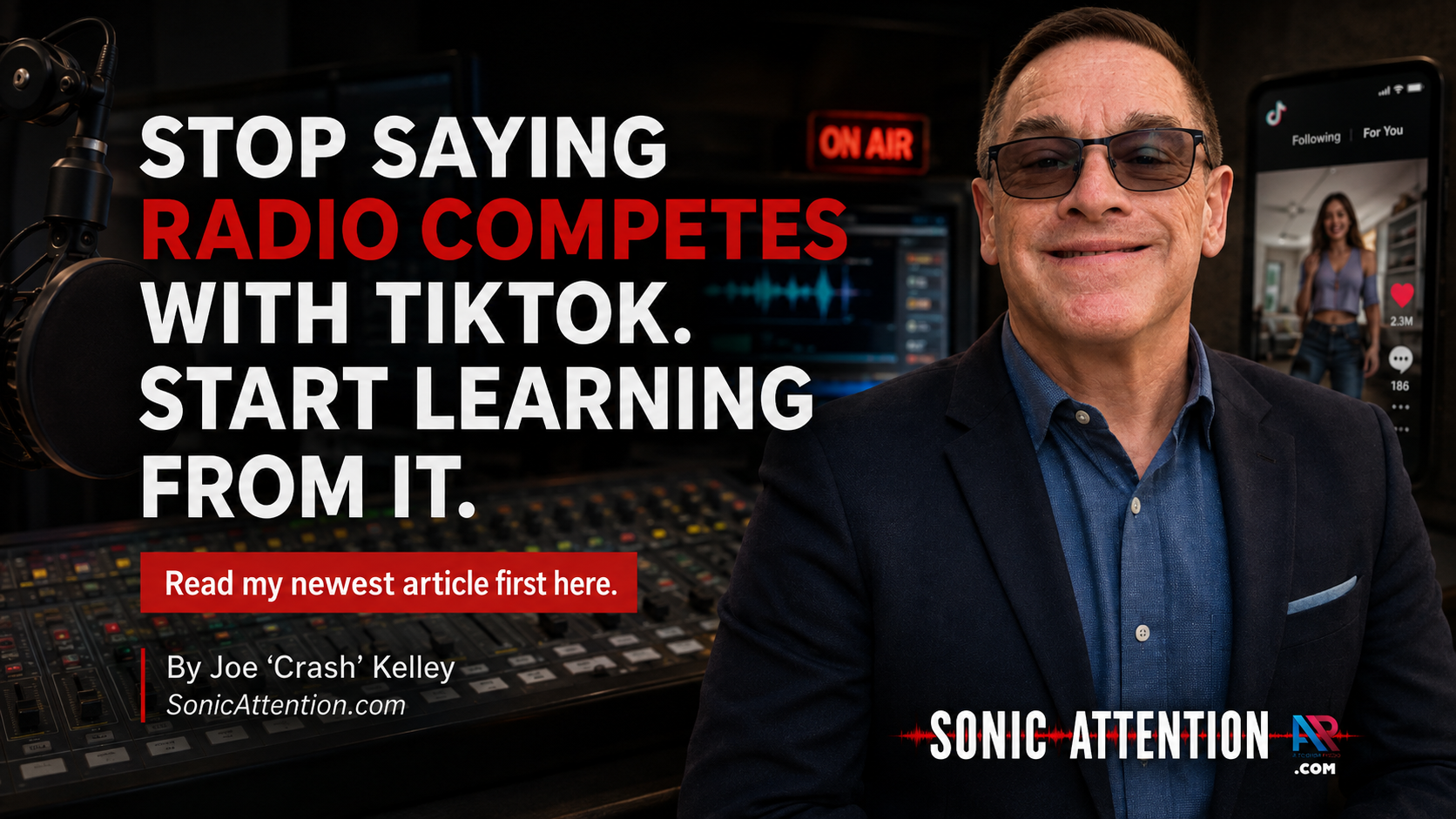
TikTok is not replacing radio in most of the situations where people use radio. But its relentless discipline about earning the next few seconds of attention is something our industry can no longer afford to ignore.
By Joe "Crash" Kelley
I keep seeing smart, experienced radio people make the same declaration in professional forums: Radio is competing with TikTok.
The statement is repeated so often that it has almost become industry doctrine. TikTok is capturing younger audiences. TikTok is changing attention spans. TikTok is influencing music discovery. Therefore, the argument goes, radio needs to become faster, shorter, more visual and more like TikTok.
I have never been completely comfortable with that conclusion.
It is not because TikTok is unimportant. Pew Research Center found that 37 percent of American adults use the platform, including roughly half of adults under 30 who say they visit it at least once a day.[1] Any platform with that kind of reach and cultural influence deserves our attention.
But a large audience does not automatically make two products direct competitors. The more useful question is not whether radio and TikTok compete for some portion of a person's day. Of course they do. Nearly everything competes for time. The useful question is whether they satisfy the same need, in the same situation, at the same moment.
Most of the time, they do not.
That does not mean radio has nothing to learn from TikTok. In fact, I think there is plenty to learn. The mistake is believing we have to turn radio into TikTok before those lessons become useful.
NOT EVERY FORM OF ATTENTION IS THE SAME
The phrase "we are all competing for attention" sounds profound until you think about it for more than a minute.
If radio is competing with anything that occupies someone's time, then radio is also competing with church, golf, television, gardening, sleep, Little League baseball, cooking dinner and mowing the lawn. At that point, the word competition becomes so broad that it no longer helps us make a single programming decision.
Media researchers have long examined competition through what is commonly called uses-and-gratifications or media-niche theory. The basic idea is that people actively choose different media to satisfy different needs, and that two forms of media compete most directly when they deliver similar benefits under similar circumstances.[2]
That makes sense to me.
A person may open TikTok because he wants novelty, humor, distraction, product information, music discovery or a highly personalized stream of visual entertainment. That same person may turn on the radio because he wants companionship, local information, music, traffic, weather, a familiar personality or something that can play in the background while he does something else.
There is certainly some overlap. Both can entertain. Both can introduce music. Both can distribute news and commentary. Both can connect audiences with personalities.
But overlap is not the same thing as complete substitution.
Nobody gets into the car at seven tomorrow morning, looks at the radio and says, "I think I'll watch vertical videos instead while I drive to work." The realistic alternatives in that situation are AM/FM radio, a podcast, Spotify, satellite radio, an audiobook, a personal playlist or silence.
Those are radio's immediate competitors because they can occupy the same listening occasion.
Edison Research's first-quarter 2026 Share of Ear findings make that distinction fairly clear. AM/FM radio still accounts for 55 percent of Americans' in-car audio time, compared with 16 percent for streaming audio. Even among people ages 13 to 34, AM/FM receives 46 percent of in-car audio time, while streaming receives 30 percent.[3]
Radio should not look at those numbers and become complacent. Streaming is growing, dashboards are becoming more complicated, and radio is no longer guaranteed the prominent position it enjoyed in every vehicle for generations. But the closest threat on the dashboard remains other audio.
TikTok competes with radio for portions of people's overall media lives. Spotify, podcasts and Bluetooth compete with radio when someone reaches for something to hear.
That is an important distinction.
THE AUDIO AUDIENCE DID NOT DISAPPEAR
One of the strangest things about the panic surrounding radio is that people are consuming an enormous amount of audio.
Nielsen reported that Americans spent nearly four hours a day with audio during the first quarter of 2026. Within the ad-supported audio universe, AM/FM radio and podcasts together captured 82 percent of daily listening time. Ad-supported streaming music services accounted for 16 percent.[4]
The demand for listening is alive and well. Podcasting has grown. Audiobooks have grown. Streaming has grown. People have filled their homes, cars and phones with more audio choices than any previous generation could have imagined.
Our problem is not that people suddenly lost the ability or desire to listen. Our problem is that radio no longer owns listening by default.
That means we have to give people a reason to choose us.
Radio's advantages are not particularly mysterious. It is easy to access. It is free. It does not require a subscription, a password, a search, a download or ten minutes of scrolling through a menu. It can provide a shared experience. It can be live, local and immediately responsive to what is happening in a community.
Jacobs Media's Techsurvey research is conducted largely among existing radio users and should be understood within that limitation. Still, the findings are instructive. In its 2026 "Why Radio?" results, seven in ten respondents pointed to easy access in the car, while more than six in ten cited the fact that radio is free.[5]
Techsurvey 2025 also found that 57 percent considered radio part of their habit, while 76 percent said they felt a real sense of connection with a favorite station.[6]
Those are not minor advantages. They are the foundation of a product people can incorporate into their lives without stopping everything else they are doing.
TikTok wants your eyes, your fingers and your active participation. Radio can ride beside you while you drive, work, clean the house, repair an engine, sit behind a desk or spend the afternoon on a tractor.
Radio's ability to coexist with life is not an outdated weakness. It is one of the most valuable things we have left.
SO WHAT IS TIKTOK ACTUALLY DOING BETTER?
This is where I think the radio-versus-TikTok discussion becomes useful.
TikTok is not simply a collection of short videos. Its real advantage is the recommendation system underneath those videos. The platform watches what users like, share, comment on, replay, finish and skip. TikTok says completion of a longer video can carry more weight than weaker signals such as location or device information. Every interaction helps influence what appears next.[7]
Radio cannot replicate that level of individual personalization. Everyone listening to a station at 8:17 hears the same song, commercial, contest promo and personality break.
But we can study the discipline behind the system.
TikTok continually asks whether a piece of content earned another moment of attention. Radio should ask the same question.
That does not mean every personality break should last twelve seconds. It means every second should have a reason for being there.
There is a difference.
THE SCIENCE IS CONCERNING, BUT LET'S NOT TURN IT INTO A SLOGAN
The article that helped sharpen my thinking on this subject described TikTok as a machine built to deliver rapid rewards to the brain. There is legitimate research behind concerns about short-form video and attention, but radio people should be careful not to turn an evolving area of science into another oversimplified programming rule.
A 2025 systematic review and meta-analysis published in Psychological Bulletin examined 71 studies involving more than 98,000 participants. Greater short-form-video use was associated with poorer cognitive outcomes, with the strongest relationships involving attention and inhibitory control. The researchers found similar patterns among younger and adult users and across several short-form-video platforms.[8]
That is significant and worth taking seriously.
It does not prove that TikTok has permanently reduced every human attention span to eight seconds. Association is not the same as causation, and the researchers noted that several cognitive areas remain understudied. The type of content, the amount of use, individual differences and pre-existing behaviors may all matter.
Radio has already spent years making decisions based on broad declarations that "nobody has an attention span anymore." Sometimes those declarations are used to improve pacing. Other times they become an excuse to remove personality, eliminate context and reduce every idea to a liner card.
Listeners will stay with a compelling story. They will sit through a thoughtful interview. They will follow a funny conversation or an emotional moment when they care about the people involved.
They do not reject everything long. They reject things that waste their time.
A bad twenty-second break can feel endless. A great ten-minute conversation can feel too short.
RADIO'S PROBLEM IS OFTEN FRICTION, NOT LENGTH
This may be the most valuable lesson TikTok can teach us.
TikTok usually begins with the thing.
Radio often begins with housekeeping.
We identify the station, mention the sponsor, explain what happened yesterday, reset the premise, read a phone number, tease what will happen later and eventually arrive at the reason the microphone was turned on.
That is not always storytelling. Sometimes it is paperwork being performed out loud.
The first sentence of a personality break should give the listener a reason to care about the second. That does not require shouting, artificial urgency or speaking so quickly that nobody sounds human. It simply requires us to stop wandering toward the point and start closer to it.
There is no reason a contest promo should require an instruction manual. There is no reason every station promotion needs four qualifying phrases, three sponsor mentions and a detailed explanation of the rules before the listener hears why the prize is exciting.
There is also no reason to tease ordinary material as though the President is about to address the nation.
"Coming up in twelve minutes, you will not believe what happened when we looked outside this morning."
It was raining.
Listeners learn from that. Every weak tease makes the next tease less credible.
TikTok's best content establishes tension, curiosity or value almost immediately. Radio can do the same without becoming frantic, shallow or disposable.
Get to the reason faster, then make the reason worthwhile.
IMAGING SHOULD BEHAVE MORE LIKE CONTENT
Radio imaging may be another area where TikTok's influence can be helpful.
Too much imaging exists only to announce the station's position. It may be technically impressive. It may have twenty layers, enormous impacts and every available effect. But the listener has already heard the same claim six times during the hour.
What if more imaging behaved like content?
A surprising observation. A funny local reference. A strange piece of audio. A familiar listener's voice. A moment from the morning show. A cultural reference that sounds like it belongs to this week instead of a generic promo package created three years ago.
Imaging should still establish identity. That is its job. But identity can be created through personality and surprise, not just repetition.
TikTok understands that the audience does not know exactly what the next piece of content will bring. Radio used to have more of that unpredictability. We had unusual callers, spontaneous bits, surprise songs, local characters, unexpected promotions and personalities who were occasionally allowed to color outside the format lines.
In our effort to eliminate every possible tune-out, we may have eliminated some of the reasons to stay.A strong radio station should feel familiar without becoming completely predictable.
WE CAN CREATE MICRO-CONTENT WITHOUT MAKING THE ENTIRE STATION MICRO
Radio should absolutely develop short, memorable pieces of content.
A ten-second comment can be funny. A fifteen-second listener clip can be powerful. A fast local observation can give a station more life than a fully produced sixty-second promo. A personality should be able to deliver a complete thought without turning every break into a monologue.
That does not mean every idea must be microscopic.
Micro-content should be another tool, not the entire toolbox.
Think about how a great show moves. There are quick moments, longer conversations, callbacks, running characters and occasional stories that deserve room to breathe. The variety creates pace. A show made entirely of eight-second bursts would eventually become as predictable as a show where every break lasts four minutes.
TikTok's lesson is not simply "shorter."
The lesson is movement.
Something happens. Something changes. Something is revealed. The listener is rewarded for staying.
A long break with several turns can still feel fast. A short break that repeats information the listener already knows can feel slow.
RADIO NEEDS BETTER FEEDBACK LOOPS
TikTok also has a powerful advantage in the amount of behavioral information it collects. It does not have to ask users whether they might enjoy a certain type of video. It watches what they actually do.
Radio does not have the same data, but we have more information than we use.
Streaming starts and stops can show where digital listeners leave. Podcast completion rates can reveal which topics hold attention. Social-video retention can tell us whether the audience stayed beyond the opening seconds.
Website traffic can show which local stories and promotions generated interest. Texting platforms, contest databases and app behavior can provide additional clues.
None of those measurements should be worshipped blindly. A station can become just as generic by chasing every data point as it can by ignoring all of them.
But too many decisions are still made because a feature has always aired at 7:20, a promo has always been written that way or someone in a conference room believes listeners need to hear the station name three times in twenty seconds.
TikTok responds quickly when behavior changes. Radio sometimes waits for the next ratings book and then argues about what happened months earlier.
We may never have an algorithm capable of rebuilding an individual hour for every listener. We can still become more curious about where attention is being earned and where we are throwing it away.
DO NOT CONFUSE THE LISTENER BATTLE WITH THE ADVERTISING BATTLE
Radio and TikTok do compete directly in one important area: advertising revenue.
A local business may compare radio with TikTok, Facebook, Google, direct mail, television, connected TV, billboards and dozens of other choices. BIA Advisory Services revised its 2026 local advertising forecast to $184.5 billion and pointed to stronger performance in mobile advertising, particularly social media, as one of the factors driving growth.[9]
Radio is absolutely battling social platforms for local advertising dollars. That means we need stronger creative, clearer attribution, better digital products and a more persuasive explanation of radio's value.
But that is a different decision from the one a listener makes when choosing what to hear during the morning commute.
We keep blending those conversations together.
An advertiser compares platforms based on reach, targeting, response and return on investment. A listener chooses based on what fits the moment. The fact that a car dealer may consider both TikTok and radio does not mean the afternoon personality should start sounding like a vertical video.
Radio needs to compete with TikTok as an advertising platform while learning from TikTok as a content platform. Neither requires radio to surrender its own identity.
TIKTOK SHOULD EXTEND THE STATION, NOT REPLACE IT
Radio should be using TikTok and other short-form platforms aggressively.
A funny morning-show exchange can introduce the personalities to someone who has never heard them. A clip from a charity event can demonstrate community involvement more effectively than a press release. A backstage interview, contest reaction, local news moment or unusual caller can travel far beyond the station's existing audience.
That is smart distribution.
But the clip is not the show.
A movie trailer is not the movie. A photograph of dinner is not the meal. A thirty-second video of a personality is not the relationship that develops when listeners spend months or years with that person.
Social media should provide another door into the station. Once someone walks through the door, there must be something worth finding.
A station with no original content cannot clip its way into relevance. A generic syndicated break does not become local because someone added captions. A personality who has been given no preparation time, no promotional support and no freedom to create cannot manufacture magic simply because management demands three videos a day.
TikTok can amplify what is interesting. It cannot make something interesting merely because it was uploaded.
THE BIGGEST THREAT MAY STILL BE BAD RADIO
Here is the part of the conversation that makes people uncomfortable.
Sometimes radio is not losing to TikTok, Spotify or an algorithm.
Sometimes radio is losing to radio.
An eight-minute commercial break filled with forgettable creative is not a TikTok problem. A station that sounds exactly like twenty other stations is not an algorithm problem. A contest that requires six steps and three passwords is not a short-attention-span problem.
A morning show with no local knowledge is competing against itself. A music station that offers nothing beyond songs available somewhere else without commercials is making itself replaceable. A personality who is expected to produce a show while also handling production, social media, appearances, website content and three other jobs is eventually going to sound unprepared.
Radio has spent years eliminating promotions departments, reducing local staffing, cutting marketing budgets and consolidating programming. Then we look at the weakening connection with the audience and blame a phone app.
Jacobs Media reported a potentially troubling finding in Techsurvey 2026. The share of core listeners who strongly agreed that their favorite station was well connected to the local community fell by 11 percentage points from the previous year. Fred Jacobs appropriately warned that one year could represent a statistical fluctuation or a difference in participating stations, but he described the result as a warning light that deserves attention.[10]
I agree.
That should concern us more than whether every air personality understands the latest social-media trend.
TikTok cannot attend the Chamber breakfast. It cannot stand in a flooded neighborhood and tell people which road is open. It cannot broadcast the high school championship game with voices the community knows. It cannot shake a listener's hand at a fundraiser or spend a morning helping a family that lost everything in a fire.
Radio can.
The problem is that too many stations have stopped doing those things consistently.
CONNECTION WITH MORE VELOCITY
The strongest argument I have heard in favor of studying TikTok is not that radio should copy the platform. It is that TikTok has mastered velocity while radio has too often tolerated wasted motion.
That is a fair criticism.
Radio should move with more purpose. We should get to the tension sooner, write tighter promos, eliminate unnecessary instructions, build better payoffs and create more moments of surprise. We should study actual audience behavior and become more willing to change things that are no longer working.
But velocity without connection is just noise.
Radio's greatest strength remains the human relationship. The familiar voice. The shared moment. The feeling that someone is speaking from a real place, to real people, about something happening right now.
TikTok can teach us how to reach the moment faster.
Radio still has to make the moment mean something.
That is the balance I think our industry has been missing. TikTok is not a substitute for radio in most of radio's strongest listening occasions, but it may be one of the most useful places to study friction, discovery, pacing, surprise and attention.
We should stop pretending TikTok does not matter. We should also stop pretending radio's future depends on becoming a pale imitation of it.
Use TikTok to introduce the personalities. Use it to distribute the best moments. Use its discipline to sharpen our writing, improve our pacing and force us to earn the listener's next few seconds.
Then use radio to do what radio can still do better than almost anything else: keep someone company, connect a community and turn a voice coming through a speaker into a familiar part of another person's life.
Radio does not need TikTok's identity.
It needs some of TikTok's urgency.
SOURCES AND RESEARCH NOTES
[1] Pew Research Center, "Americans' Social Media Use 2025." Pew found that 37 percent of U.S. adults used TikTok, 24 percent used it daily, and roughly half of adults ages 18 to 29 visited the platform at least once a day.
https://www.pewresearch.org/internet/2025/11/20/americans-social-media-use-2025/
[2] John Dimmick, Yan Chen and Zhan Li, "Competition Between the Internet and Traditional News Media: The Gratification-Opportunities Niche Dimension," Journal of Media Economics, 2004. The study examines media competition according to the needs and opportunities different forms of media satisfy.
https://www.tandfonline.com/doi/abs/10.1207/s15327736me1701_2
[3] Edison Research, "Radio Continues to Dominate In-Car Listening," April 8, 2026. Q1 2026 Share of Ear data placed AM/FM at 55 percent of total in-car audio time and streaming audio at 16 percent. Among listeners ages 13 to 34, AM/FM accounted for 46 percent and streaming for 30 percent.
https://www.edisonresearch.com/radio-continues-to-dominate-in-car-listening/
[4] Nielsen, "The Record: Q1 U.S. Audio Listening Trends," 2026. Nielsen reported nearly four hours of daily audio consumption and said radio and podcasts captured 82 percent of daily ad-supported audio time.
https://www.nielsen.com/insights/2026/the-record-q1-us-audio-listening-trends/
[5] Fred Jacobs, Jacobs Media, "For Radio, It's Simple: Free and Easy," April 2, 2026. The Techsurvey discussion notes that seven in ten respondents cited easy access in the car and more than six in ten cited radio's free availability. Jacobs also emphasizes that the study is primarily conducted among existing radio listeners and fans.
https://jacobsmedia.com/for-radio-its-simple-free-and-easy/
[6] Fred Jacobs, Jacobs Media, "The Secret to Making a Great Podcast-and Great Radio," 2025. Techsurvey 2025 found that 57 percent cited habit as a main reason for radio use, while 76 percent agreed they felt a connection to a favorite station.
https://jacobsmedia.com/the-secret-to-making-a-great-podcast-and-great-radio/
[7] TikTok Newsroom, "How TikTok Recommends Videos for You." TikTok says its system considers user interactions, video information and account settings, with stronger behavioral signals such as completing a video receiving greater weight than weaker signals. This is TikTok's own description of its system and should be understood as a platform-provided explanation.
https://newsroom.tiktok.com/en-us/how-tiktok-recommends-videos-for-you
[8] Lan Nguyen and colleagues, "Feeds, Feelings, and Focus: A Systematic Review and Meta-Analysis Examining the Cognitive and Mental Health Correlates of Short-Form Video Use," Psychological Bulletin, 2025. The analysis included 71 studies and 98,299 participants and found associations between greater short-form-video use and poorer cognition, particularly attention and inhibitory control.
https://pubmed.ncbi.nlm.nih.gov/41231585/
[9] BIA Advisory Services, revised 2026 U.S. local advertising forecast. BIA projected $184.5 billion in local advertising revenue and attributed part of the revision to stronger mobile advertising, particularly social media.
https://bia.com/press-releases/bia-revises-2026-local-ad-forecast-total-spend-to-reach-184-5-billion-2/
[10] Fred Jacobs, Jacobs Media, "The Cultural Power and Impact of Radio," June 30, 2026. Jacobs reported an 11-point year-over-year decline in the share of Techsurvey respondents who strongly agreed that their favorite station was well connected to its community, while cautioning that additional years of data are needed to determine whether the result represents a lasting trend.
https://jacobsmedia.com/the-cultural-power-of-radio/