
WHAT IF WE CONSOLIDATED EVERYTHING EXCEPT THE RADIO?
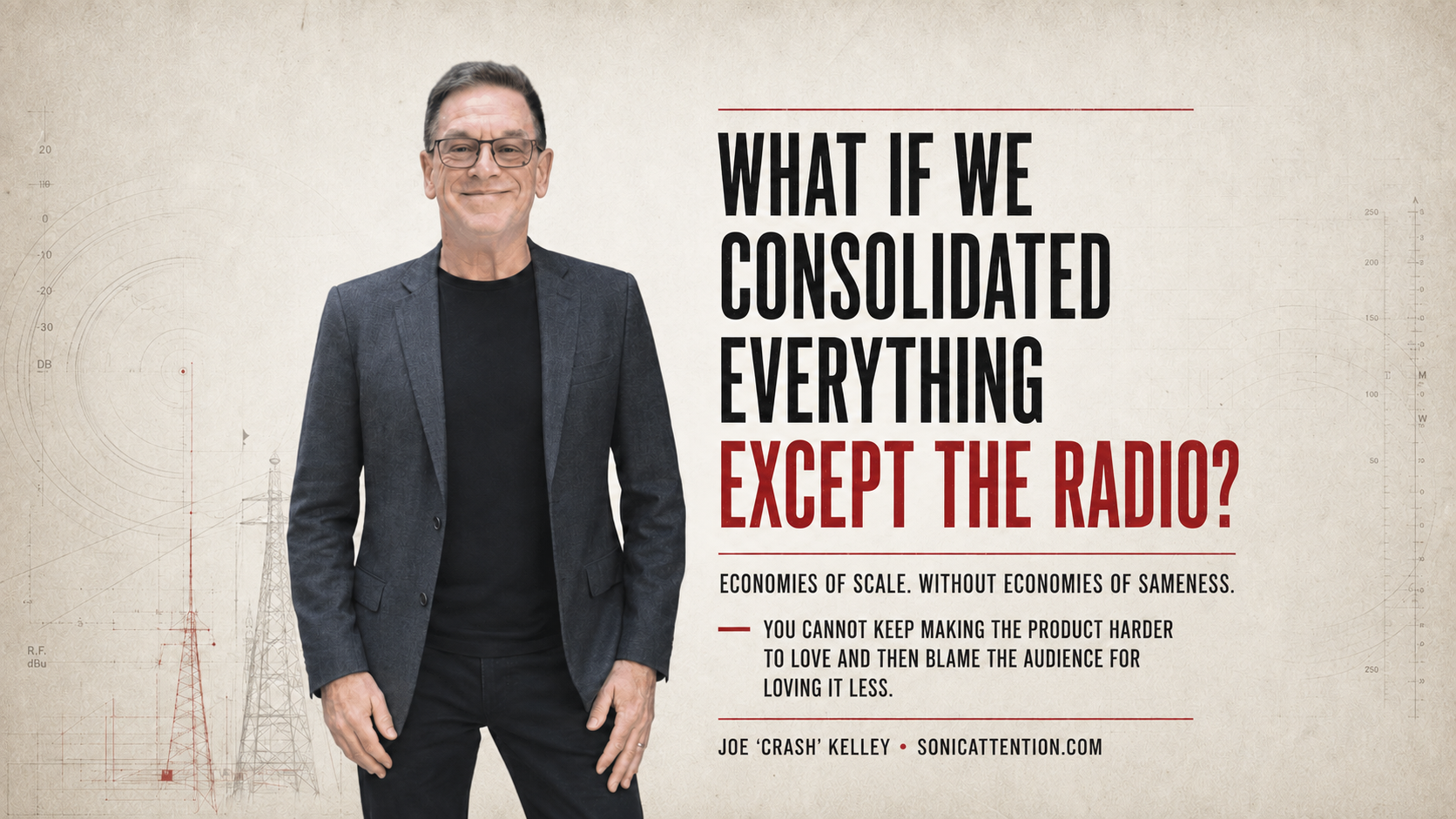
A thought experiment about building a national local-media company with economies of scale—without economies of sameness.
By Joe “Crash” Kelley | SonicAttention.com
Let me start with a disclaimer. I am not announcing a new radio company. I don't have a private-equity fund behind me, and I'm not pretending I have solved every financial, regulatory or operational obstacle involved in buying broadcast properties.
And before the know-it-alls arrive: if you're reading this only to build an indictment of my naïveté—to tell me that station acquisitions require capital, FCC approval, securities attorneys, due diligence and a hundred other complexities I haven't addressed in the first three paragraphs—move on.
I already know. I know what I know, and I know what I don't.
What I know is radio. I know what a great local product can sound like. I know what happens when talented people are given the tools and authority to do their jobs, and I know the difference between efficiencies that make an operation stronger and cuts that simply make the product smaller. I also know enough to know that a company like the one I'm about to describe could never be built by broadcasters alone. It would require people who understand capital, acquisitions, securities, FCC law, corporate structure and plenty of other disciplines better than I do. That's not a weakness in the idea. That's what building the right team means.
At the end of the day, I'm just someone who loves this industry and thinks about it—a lot. I want it to succeed. I see the extraordinary people we've lost, I see what still works, and I can't help wondering whether there might be another way to put those pieces together. So don't read this as a prospectus, a securities offering or a claim that I have every answer. This is a what if. And after watching this business shed an extraordinary amount of talent, I can't stop wondering whether some of the people who have been displaced could become the people who build what comes next.
What if experienced broadcasters—programmers, sellers, engineers, air talent, production people, managers and operators—joined with equally talented digital professionals and a group of investors to build the kind of local-media company many of us wish somebody else would build? What if the people supplying the capital expected a return, but also understood something fundamental: when you buy a specialized business, there is value in letting people who actually understand that business operate the product?
And what if the broadcasters and digital professionals weren't simply hired after the money arrived? What if they had a path to become owners too—not only by investing whatever cash they could afford, but by earning equity for the real work they contribute to building the company? That changes the idea considerably. This is no longer a story about finding rich people to buy radio stations and then asking them to please hire better broadcasters. It becomes a story about capital, talent and ownership coming together around a different operating philosophy:
Centralize the infrastructure. Decentralize the radio.
CONSOLIDATION WASN'T THE ORIGINAL SIN
Consolidation itself was never necessarily the enemy. There are enormous advantages to scale, and pretending otherwise won't make a credible business plan. A group of stations should not have to independently duplicate every piece of accounting, technology, cybersecurity, research, legal support, benefits administration, engineering purchasing, digital development or specialized creative expertise. A five-station cluster shouldn't have to build its own sophisticated programmatic platform. A great production director in one market shouldn't be invisible to every other station in the company. An engineer dealing with a transmitter emergency shouldn't be left alone because the other company engineers are hundreds of miles away and have never been encouraged to work as a team.
Scale can solve those problems. The mistake comes when companies apply the same efficiency philosophy to the thing the audience actually consumes: the product.
So imagine a company built around a very simple rule. At the corporate level, pool the things that genuinely become more efficient when shared: finance, HR, FCC compliance, technology, cybersecurity, traffic and billing systems, research, major purchasing, insurance, training, specialized production, digital infrastructure and engineering support. Then stop. Programming decisions belong close to the market. Promotions belong close to the market. Local news and information belong close to the market. Personalities should know the streets, restaurants, schools, teams, charities, businesses, frustrations and celebrations of the people listening to them. Local sellers need actual relationships with local businesses, not just a rate card and a list of corporate products they have been told to push.
The parent company should exist to make each local operation stronger, not to make each local operation identical: one company, shared resources, local decisions. Or, put another way: economies of scale without economies of sameness.
ARE WE MAKING THE CASE FOR OUR OWN TRIVIALIZATION?
This is the part of the current radio conversation that frustrates me most. The large broadcast corporations keep downsizing, consolidating jobs and reducing local resources, and eventually the cuts themselves begin to create the impression that radio must be a less valuable business. Fewer people must mean fewer listeners. Less local programming must mean the audience doesn't care anymore. Less investment must mean the medium no longer deserves investment.
But that's a dangerous circular argument. Cut the personalities, thin out the local content, reduce promotion, combine jobs, stretch the engineers, eliminate creative resources and make the local product less distinctive. Then, when engagement or revenue becomes harder to grow, point to the weakened performance as justification for another round of cuts. At some point the industry risks managing radio into the diminished product it then cites as proof that radio has diminished.
I'm not naïve enough to argue that every problem in radio is self-inflicted. Digital competition is real. Advertising has fragmented. Consumer choices have exploded. Technology changed the marketplace permanently. Those realities have to be confronted, but so does our own history.
Some of the financial pressure associated with major radio companies didn't begin because listeners suddenly stopped consuming radio. The consolidation era included enormous transactions supported by enormous amounts of capital and debt. One of the most consequential examples is Clear Channel's 2008 take-private transaction, valued at approximately $24 billion.[6] Ten years later, iHeartMedia entered Chapter 11, and when the company emerged in 2019, its own SEC filing said iHeartCommunications' debt had been reduced from approximately $16 billion to $5.8 billion.[7]
Those are facts about financing and capital structure. They are not evidence that Americans stopped wanting radio. In fact, the consumer evidence tells a very different story about radio's continuing place in the audio business. Nielsen and Edison Research reported that in the fourth quarter of 2025, radio still accounted for 61% of all daily time spent with ad-supported audio in the United States.[8] Edison also reported in 2025 that AM/FM represented the largest single slice of total daily audio listening among Americans 13+, at just over one-third of all listening time when over-the-air and station streams were combined.[9]
So before we use every layoff, consolidation or declining revenue line as evidence that the medium itself has become trivial, maybe we should separate two very different questions: What is radio worth to its audience? And what happens to a radio company when the financial structure above the product becomes unsustainable? Those are not the same question.
You cannot keep making the product harder to love and then blame the audience for loving it less. You cannot endlessly remove the very things that differentiate local radio—personality, community presence, creative promotion, strong local sales relationships and talented people—and then use the resulting weakness as evidence that those things never mattered. And you certainly shouldn't confuse the consequences of a balance sheet with a referendum on consumer demand.
That distinction is central to this entire “what if.” Maybe the opportunity isn't to rescue a medium nobody wants. Maybe the opportunity is to operate a still-massive medium without repeating the financial and operational decisions that helped trivialize its value in the first place.
WHAT WOULD ACTUALLY BE SHARED?
This part matters, because “shared resources” can become a pleasant phrase for “fewer resources” very quickly.
I would build true centers of excellence. Engineering could operate in regional teams, giving markets backup, specialized expertise, emergency support and greater purchasing power while still maintaining people close enough to understand the facilities. A company-wide creative group could include elite commercial writers, producers, imaging specialists, designers and video people available to every market. The objective wouldn't be to eliminate the local production department. It would be to make the best talent in the entire company available to it.
Finance, payroll, benefits, compliance, legal support, research, IT infrastructure and cybersecurity are natural shared functions. Training should be another. Imagine new sellers being taught by the best salespeople in the company, new programmers having access to the strongest programmers, and young production people learning directly from veteran producers instead of reinventing every wheel by themselves.
Ideas should travel, too. If a market in Iowa develops a promotion that produces extraordinary local business, why shouldn't a market in Georgia be able to adapt it? If a seller in North Carolina develops a brilliant automotive package, why shouldn't the rest of the sales organization learn from it? If one station finds a new way to turn a community event into audience growth, digital traffic and advertiser revenue at the same time, that knowledge should move through the company immediately.
That is what corporate should mean: a resource center, not a command center.
DIGITAL WOULDN'T BE AN AFTERTHOUGHT
This is where I would push the concept beyond a traditional radio group. The people around the table shouldn't just be broadcasters. Bring in great digital people—web developers, programmatic specialists, search experts, designers, video creators, social strategists, data and attribution specialists, people who understand first-party data, and people who know how to help a local business turn digital attention into an actual customer.
Then give those digital professionals something most standalone local digital companies would love to have: a powerful local megaphone called radio.
Townsquare Media is already demonstrating part of the opportunity. Its current business combines local broadcast advertising with Townsquare Ignite, which includes programmatic technology and owned digital properties, and Townsquare Interactive, which provides small and medium-sized businesses with services including websites, SEO and other digital tools.[1]I
I wouldn't simply copy Townsquare. What I would borrow is the recognition that broadcast and digital can make each other more valuable. My non-negotiable would be that growth in digital cannot become an excuse to starve the broadcast product that gives the entire local ecosystem its reach, personality, creative power and promotional muscle.
The goal isn't to become a digital company that happens to own transmitters. It is to become a local media company in which broadcast and digital deliberately make each other stronger.
LOCAL DIGITAL—WITH A BROADCAST MEGAPHONE
Think about this from the advertiser's side rather than from ours. A local HVAC company doesn't necessarily need “radio” or “digital.” It needs customers. A restaurant needs people in seats. A dentist needs appointments. A car dealer needs qualified buyers. We hurt ourselves every time we force those clients to choose between products based on which department inside our own building happens to get credit for the sale. What if one local account lead could bring the entire toolbox?
Radio creates awareness and frequency. Great creative makes the business memorable. A trusted local personality can provide familiarity and credibility. Search captures people when interest becomes intent. Programmatic and social can extend the message to targeted audiences. Retargeting continues the conversation. Video can demonstrate the product. A strong landing page can convert interest into action. Measurement and attribution can give the seller something far more useful to discuss with the client than whether all 42 spots aired. Then those results inform the next campaign.
The Radio Advertising Bureau's research makes the broader point that broadcast audio provides enormous reach and attention while modern digital tools bring addressability, targeting and attribution.[2] Instead of treating those capabilities as competing departments fighting for the same local budget, why wouldn't we design them to operate as one advertising system?
The relationship also works in the other direction. A station's digital presence should not be a warehouse for generic national clickbait that happens to have a local call sign at the top. It should be an extension of that market: local information, useful weather and emergency coverage, high-school sports, events, local personalities, local businesses, meaningful video, contests, newsletters and community resources people actually have a reason to use.
Radio can promote that content in a way a startup local website would spend a fortune trying to duplicate. Digital can keep the station connected to the audience when the listener leaves the car, provide advertisers with products radio cannot provide alone and generate first-party audience relationships the station can continue to develop.
Radio promotes digital. Digital extends radio. Both create more value for the advertiser.
THE PEOPLE WHO BUILD THE VALUE SHOULD HAVE A PATH TO OWN SOME OF IT
This may be the part of the idea that interests me most. Look at the people radio has lost. Some were making very good salaries and have resources. Others were eliminated unexpectedly and are trying to protect every dollar they have. A brilliant programmer who has been out of work for six months may not be able to write a $25,000 investment check. An engineer may have knowledge worth far more to the company than the $1,000 he can afford to invest. A production person may be able to contribute hundreds of hours developing the sound of the first cluster but very little cash. Why should ownership recognize only the person who brings money?
Cash matters. We can't buy transmitters, pay employees or close an acquisition with enthusiasm. Outside investment would still be necessary, and people from inside the industry who can afford to invest—even at relatively modest levels—should have an opportunity to participate alongside larger investors if the eventual legal structure permits it. I would want the capital strategy to explore lawful ways to make room for smaller industry investors rather than designing an offering that assumes every meaningful participant can write a five- or six-figure check.
There's another group I'd invite to the table: the broadcasters and former owners who built enormous value in radio the first time around.
Some of the people who created great local radio companies eventually sold during the consolidation era, when buyers were willing to put extraordinary values on broadcast properties. Selling wasn't a betrayal of radio. If somebody offered you a life-changing price for the business you had spent decades building, taking the deal may have been the most rational decision in the world. But twenty or thirty years later, I wonder how many of those people miss it. I wonder how many look at what happened to some of the stations they built and think, I would love one more chance to do this the right way.
They could become a fascinating part of this new company. Some might have the ability to provide significant investment capital. Others might not want to run a station every day anymore but could serve as directors, advisers and mentors. They know what it feels like to make payroll, build a sales department, hire a morning show, negotiate an acquisition, survive a bad quarter and look a local business owner in the eye. That experience has value that doesn't appear on a balance sheet.
Think about the combination: experienced owners who built successful radio businesses before consolidation; displaced broadcasters who still know how to create the product; younger broadcasters ready for their opportunity; digital professionals who understand where local media is going; and outside investors who recognize the potential return in putting all of them together.
Suddenly this isn't merely a pool of money looking for stations. It's a pool of capital, experience and unfinished ambition.
But I would also want a defined operator equity pool—a way for people doing meaningful work to earn a piece of what they are helping create. Not vague promises and not “we'll take care of you when this works,” but real written agreements, real vesting, real milestones and real accountability.
A veteran programmer might earn equity by helping develop the programming architecture and successfully launching a market. An engineer might contribute to acquisition due diligence, facility design and the creation of the company's engineering systems. A digital specialist might help build the technology and product platform. A sales leader might create the training and local-business strategy. A production expert might develop the creative workflow and sonic standards used across the company.
Their contribution isn't a donation. It is investment made in another currency: expertise, time and execution.
That equity would have to be valued and structured fairly. Nobody should receive a permanent ownership stake merely for having a good idea or attending meetings. Vesting matters. Deliverables matter. Continued contribution matters. And outside cash investors deserve clearly defined rights and protections too. The point is alignment.
If the people building the stations own part of the company, a remarkable thing happens: they stop thinking only about their next paycheck and begin thinking about enterprise value. A market manager who owns equity cares about client retention differently. A programmer who owns equity understands that ratings and revenue are connected. A digital developer who owns equity has a reason to build a system that works for every market, not just finish a project and move to the next client.
There are established securities-law frameworks for certain compensatory equity at eligible private companies; SEC Rule 701, for example, addresses certain securities issued to employees, consultants and advisers as compensation.[4] Broadcast ownership also has its own FCC attribution and reporting rules, meaning the exact voting, ownership and management structure would need to be designed from the beginning by qualified broadcast and securities counsel.[5]
This is an idea, not a securities offering. But the underlying principle deserves to be part of the idea from day one:
The people who help build the value should have a path to own some of the value.
THIS COULD BECOME A SECOND CHANCE—WITHOUT BECOMING A MUSEUM
I don't want this to sound like a plan to gather a group of fifty- and sixty-something broadcasters and recreate radio from 1997. That would miss the entire point. Experience is valuable, and so is new thinking. The dream team would combine people who understand why great local radio works with people who understand how audiences and advertisers behave now. A twenty-eight-year-old digital strategist and a sixty-year-old programmer may approach a problem from completely different directions. Good. Put them in the same room.
The displaced veterans bring institutional knowledge, storytelling, sales instincts, brand-building, promotion, production, engineering and an understanding of the emotional relationship between a station and a listener. Digital professionals bring capabilities around data, conversion, programmatic advertising, search, social, video, user experience and measurement that traditional broadcasters may never have been trained to use.
Neither group should be subordinate to the other. The company gets stronger when the knowledge combines.
And pooled talent should never become a euphemism for stripping people out of markets. A national production specialist should make the local producer better, not make the local producer disappear. A corporate programmer should be a coach and resource, not somebody 800 miles away choosing every song and promotion. Central digital tools should give local sellers more solutions, not turn them into order takers for a corporate product catalog.
That is the guardrail: shared expertise must raise the quality of the local product, not merely lower its cost.
HOW WOULD WE CHOOSE THE FIRST MARKET?
I wouldn't start by drawing fifty dots on a map and announcing a national footprint. The first acquisition would need to prove the operating philosophy.
The target would need more than a cheap price. Are the signals good? What engineering work is coming? Are the tower sites secure? Is there a viable base of local advertisers? How concentrated is the revenue? Why are clients leaving? Is the current weakness a market problem or an operating problem? Does the cluster have brands worth rebuilding? Are there strong local personalities or sellers who should be retained? Where are the obvious digital opportunities? Is there enough scale in the market to support a real local operation after shared expenses are moved where they belong?
I would also care about geographic strategy. Some functions can be shared nationally, but engineering, emergency response, recruiting and even sales knowledge benefit from regional density. A smart company might eventually operate across the country while still building groups of neighboring markets that can genuinely support each other.
And the first market would have its own measurable scorecard. Revenue and cash flow obviously matter, but so do advertiser retention, new local direct business, digital revenue growth, audience performance, employee retention, community engagement and the percentage of clients buying integrated solutions rather than one isolated product.
If the experiment works, don't immediately buy twenty more stations. Document why it worked, fix what didn't and then acquire market number two.
WOULD INVESTORS BUY IT?
Maybe. But I think the pitch has to be different from “help us save radio.” I love radio. An investor doesn't have to.
The business proposition is that fundamentally viable local media assets can become more valuable when unnecessary duplication is removed without removing the product, when specialized expertise is shared, when modern digital revenue is built around the local customer base, and when experienced operators have financial reasons to think like owners.
Outside capital provides the fuel. Operators provide the domain expertise. Digital professionals expand the addressable business. Shared infrastructure creates efficiency. Strong local products protect the audience relationship that makes the entire machine work.
The board and investors should absolutely demand budgets, targets, reporting and return on capital. Local operators should absolutely be accountable for revenue, expenses, ratings, client retention and growth. “Let broadcasters run the radio” cannot mean “don't ask us about the numbers.” Financial accountability and product expertise are not mutually exclusive.
Nobody would buy a chain of successful restaurants and tell the accountants to rewrite the recipes. Yet media companies have repeatedly behaved as though knowing the spreadsheet qualifies someone to make every decision about what comes out of the speakers. The alternative isn't financial irresponsibility. It's financial discipline in service of a better product.
WHAT IF WE PROVED IT ONCE?
There is already evidence that decentralized local operation can exist inside a scaled broadcast company. Saga Communications describes its strategy as developing strong decentralized local management responsible for day-to-day operations, community engagement and advertiser relationships.[3] Townsquare demonstrates that sophisticated digital advertising and digital services can live beside a large portfolio of local radio stations.[1] So the pieces aren't imaginary.
The “what if” is whether they could be assembled differently: a holding company with patient investment capital, meaningful operator ownership, shared professional resources, sophisticated digital capabilities and a written cultural commitment that local product decisions stay close to the communities those stations are licensed to serve.
Start with one market. Put exceptional people in charge. Give them more resources than a standalone operator could afford but more local authority than a giant centralized company normally permits. Build broadcast and digital together. Let the people doing the building earn a stake in the thing they are creating. Measure everything, and prove it.
If it works, buy the second market. Then the third. Over time, you might build something that sounds contradictory on paper but makes perfect sense when you hear it:
A national company built to make local media more local.
Maybe the next great radio company isn't created by another conventional round of consolidation. Maybe it's built by gathering some of the extraordinary people consolidation discarded, adding a new generation of extraordinary digital minds, giving both groups modern tools, shared resources and a genuine ownership opportunity, and letting them build something together.
Not nostalgia. Not charity. Not an excuse to ignore profitability. Great local products. Strong local businesses. Useful local digital platforms. Stronger communities. Shared expertise. Accountable operators. Investors who make money because the company creates value instead of simply extracting it—and employees who have the chance to become owners because their expertise helped create that value in the first place.
Crazy? Maybe. But here's the question I can't stop thinking about:
What if the next great radio company were built not by people trying to get more out of radio—but by people who still understand how much more can be put into it?
Joe “Crash” Kelley is a broadcaster and the founder of SonicAttention.com, creating custom audio branding, jingles and creative for radio stations and local businesses.
Sources
- Townsquare Media, Inc., Form 10-Q for the quarter ended March 31, 2026: https://www.sec.gov/Archives/edgar/data/1499832/000149983226000031/tsq-20260331.htm
- Radio Advertising Bureau, State of Radio / THIS is Radio: https://www.rab.com/thisisradio/Studies/StateofRadio-study.pdf
- Saga Communications, Inc., 2025 Annual Report: https://www.sec.gov/Archives/edgar/data/886136/000114036126015649/ny20063050x3_ars.pdf
- U.S. Securities and Exchange Commission, Employee Benefit Plans—Rule 701: https://www.sec.gov/resources-small-businesses/exempt-offerings/employee-benefit-plans-rule-701-0
- 47 CFR § 73.3555, FCC multiple-ownership and attribution rules: https://www.ecfr.gov/current/title-47/chapter-I/subchapter-C/part-73/subpart-H/section-73.3555
- Clear Channel Communications, Inc., July 30, 2008 announcement of completed approximately $24 billion transaction, filed with the SEC: https://www.sec.gov/Archives/edgar/data/1400891/000119312508161448/dex992.htm
- iHeartMedia, Inc., May 2019 Form 8-K describing Chapter 11 emergence and reduction of iHeartCommunications debt from approximately $16 billion to approximately $5.8 billion: https://www.sec.gov/Archives/edgar/data/1400891/000119312519135182/d723957d8k12g3.htm
- Nielsen, The Record: Q4 U.S. Audio Listening Trends, January 2026, powered by Edison Research Share of Ear: https://www.nielsen.com/insights/2026/the-record-q4-audio-listening-trends-2/
- Edison Research, How Do Americans Spend Their Day with Audio?, July 23, 2025: https://www.edisonresearch.com/how-do-americans-spend-their-day-with-audio/