
Give Me One Radio Station—and I’ll Show You What This Business Has Forgotten
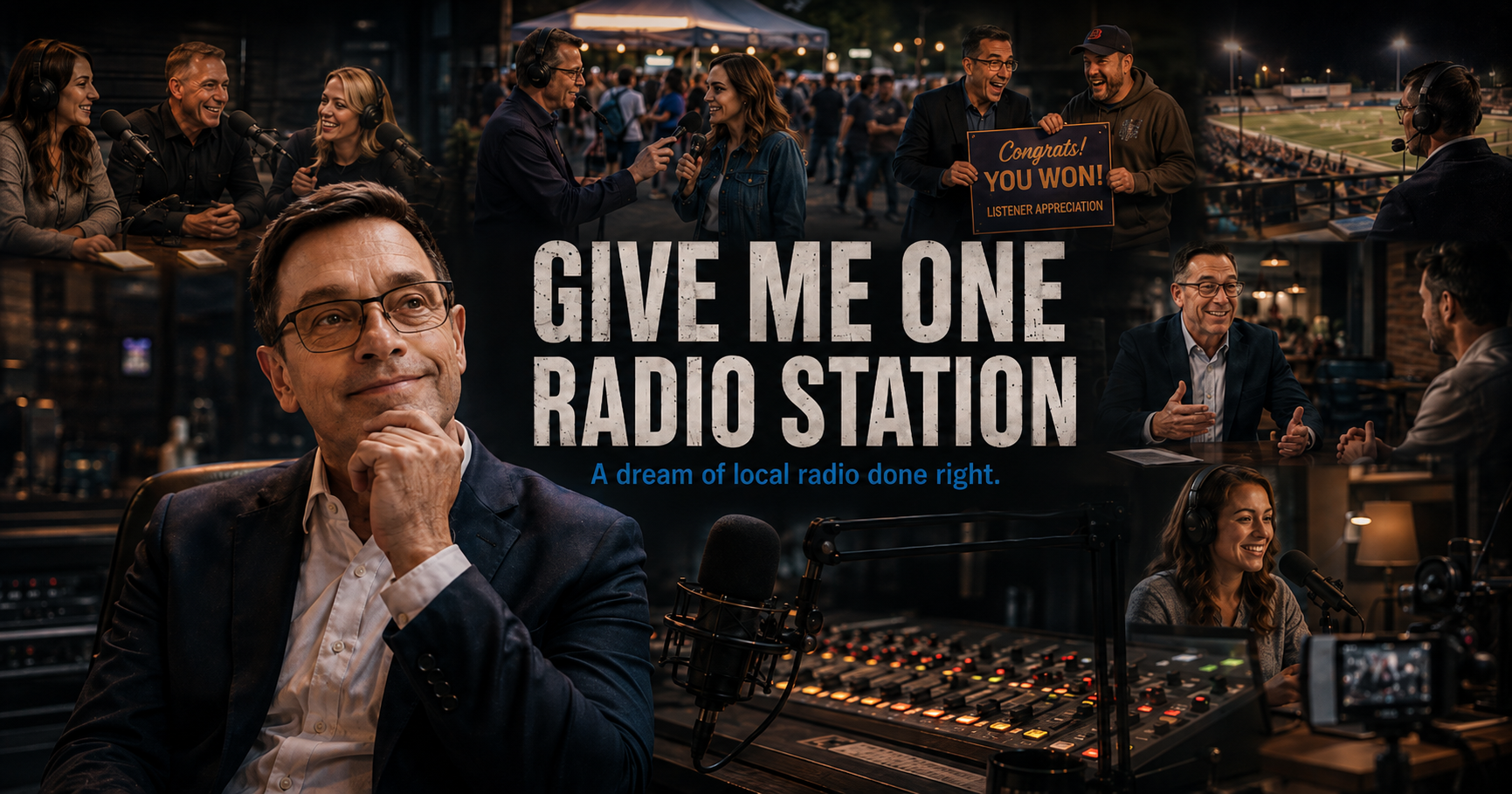
After many decades in radio, I still believe serving, entertaining and inspiring a local audience is not only a mission. It can still be a winning business plan.
Some nights, after working thirteen hours as the solo programmer and operations person for a five-station cluster, I lie awake for a while before finally drifting off to sleep. My mind is still racing through music logs, production orders, promotions, staffing problems, client needs, technical issues and everything else that comes with trying to keep five radio stations moving forward. Somewhere in the middle of all of that, I usually find myself returning to the same dream I have carried for years:
What would I do if I owned a radio station of my own?
I do not imagine it as an easy retirement project, and I am not dreaming about putting my name on the front door so I can call myself an owner. I think about the sound of the station. I think about the people I would hire, the personalities I would develop, the contests we would create, the clients we would help and the role the station would play in its community. I think about what it would feel like to build a station where something interesting could happen at any moment, where the staff would be excited to come to work and where listeners would feel that the station genuinely belonged to them.
Most of all, I become genuinely enthusiastic when I think about how successful and profitable a station like that could be.
I am no stranger to the overhead involved in running radio. After nearly fifty years in this business, I know the transmitter does not power itself and the bills do not disappear simply because the owner loves broadcasting. There are licensing fees, music rights, electricity, engineering, insurance, equipment, software, vehicles, buildings, towers, maintenance, payroll and a long list of unexpected expenses that seem to arrive at exactly the wrong time. Before the first commercial is sold, there is already a substantial cost involved in keeping a station legal, reliable and competitive.
Even knowing all of that, I believe it can be done.
In fact, I believe this may be one of the best times in years for a smart local broadcaster to compete successfully. Corporate radio may have enormous resources, national brands and impressive technology, but it has also become vulnerable in ways it may not fully recognize. Decisions are frequently made far away from the market. Approval can take too long. Creativity becomes standardized. People responsible for dozens of stations cannot possibly feel every change taking place in every local community.
I am not naïve about the strengths of the major radio companies, either. They have developed extraordinary music research, scheduling systems, digital platforms, audience data, sales tools and operational efficiencies. I would not buy a station and immediately throw out everything they have learned simply because it came from corporate radio. I would study the best of it, use what works and improve on it locally. In many ways, their relentless passion for profit—sometimes at the expense of the product—can help provide the blueprint for the success of my entire venture. They have shown us how to operate efficiently, extend a radio brand across digital platforms, measure results and create multiple sources of revenue. They have also shown us what happens when the pursuit of profit begins to overwhelm the product that created the value in the first place.
I would take their discipline without adopting their distance. I would use their technology without surrendering the station’s humanity. I would combine the music-programming strength and research capabilities of companies such as iHeart with the digital development and local marketing capabilities demonstrated by companies such as Townsquare. Then I would add the speed, creativity, personality and personal accountability of a true local operator. The large companies have taught us a great deal, including exactly where the openings are for someone willing to put the audience and the product back at the center of the business.A corporate competitor can schedule a meeting to discuss what is happening.
A local owner can walk out the door and become part of it.
When something happens in the community, we can be there. When listeners begin talking about something, we can put it on the air while it is still fresh. When a local business needs an idea, we can sit across the table from the owner, understand the problem and begin creating. When a competitor becomes predictable, we can become spontaneous. When it sounds distant, we can sound unmistakably local. When it becomes merely functional, we can become fun.
But none of it would begin with the question, “How can I extract the most profit from this station?”
It would begin with a different question:How can this station serve, entertain and inspire the people who live here?
Profit would matter because the station must survive, reinvest and grow. But profit would not replace the mission. It would come from fulfilling it.
The Human Connection Radio Was Built to Provide
There has probably never been a time when people had access to more content, yet research continues to document how disconnected many people feel. The United States Surgeon General has identified loneliness and social isolation as serious threats to individual and community health. Pew Research Center has also found that barely more than half of Americans say they feel close to people in their local communities.
That is not simply a social problem. It is an enormous opportunity for radio.
Radio, when it is done properly, provides something an algorithm cannot fully duplicate. A familiar voice appears at the same time every morning. That personality knows the weather, the roads, the schools, the teams, the stores and the peculiarities of the community. The listener may be driving alone, working alone or sitting in a quiet house, but for a few minutes that person does not feel completely alone.
Research from Edison Research and NPR has identified a significant group of listeners who use radio specifically for company and human connection. Jacobs Media’s Techsurvey research has repeatedly shown that personalities are one of the primary reasons core listeners continue using broadcast radio. Jacobs has also found that many listeners feel a real emotional connection with their favorite stations and would like opportunities to meet their favorite personalities.
Those findings should stop every broadcaster in the country.
People are not asking radio to become a less convenient version of Spotify. They already have Spotify. They are not asking us to build a giant jukebox with commercials. They already carry millions of songs in their pockets and can hear them without waiting for a disc jockey to stop talking.
What radio can give them is companionship, shared experience and a sense of belonging to a specific place.
That does not mean personalities should ramble endlessly or believe every thought that crosses their minds deserves eight minutes of airtime. Great companionship requires preparation. A good friend does not dominate every conversation. A great communicator understands timing, listens, notices details and knows when to be funny, serious, helpful or quiet.
My personalities would receive coaching. We would talk about storytelling, observation, brevity and how to turn an ordinary local experience into something listeners recognize from their own lives. They would be expected to know the market, attend events, answer messages and meet the people who make up the audience.
They would also be allowed to be human.
Something Should Be Capable of Happening
Too much radio today sounds as though every potential surprise has been removed from it.
A song plays. A liner fires. A commercial break runs. Another song begins. The station may be technically correct, cleanly scheduled and perfectly executed, but it rarely feels alive. There is no possibility that the person listening at 8:17 on Tuesday morning will hear something that could only have happened at 8:17 on that particular Tuesday morning.
That possibility used to be one of radio’s greatest strengths.
The best personalities did not simply announce records. They created running stories. They invented characters. They made unexpected telephone calls. They reacted to what was happening in town. They turned listeners into participants. Occasionally, they walked out of the studio because the most interesting thing happening that morning was somewhere else.
Great radio made listeners wonder what might happen next.
I would bring that possibility back.
Not reckless radio. Not undisciplined radio. Not irresponsible stunts designed to humiliate people or place anyone in danger. We know better now, and some promotions from the past should remain in the past.
What should return is the imagination behind them.
Radio Once Knew How to Create Theater
Radio’s golden age of promotion was filled with contests and stunts that made stations feel larger than the buildings and transmitters that housed them. The prizes were sometimes huge, but the real power came from the presentation. The station created anticipation, mystery and a payoff listeners did not want to miss.
In the 1950s, Todd Storz used quizzes, guessing games, giveaways and citywide treasure hunts to build attention around his stations. Storz understood that listeners would return repeatedly when a story was developing. The contest was not a brief interruption in the programming.
The contest became programming.One of the most famous examples came from KCBQ in San Diego in 1972. “The Last Contest” offered an almost unbelievable collection of extravagant prize packages and teased a secret telephone number listeners would eventually need to call. The production was enormous. The presentation was enormous. The personalities treated it as an enormous event, and listeners responded accordingly.
The lesson is not that every station should try to give away a mountain of prizes or overwhelm a telephone system. The lesson is that KCBQ understood theater. It understood anticipation. The station made people feel that something important was happening and that they needed to keep listening so they would not miss it.
Today, stations frequently give away prizes worth more than some of the old promotions but make them sound like administrative instructions.
“Text this word. Standard data rates apply. Winner selected at random.”
That may be efficient. It may generate entries for a database. But it rarely creates wonder
.I would still collect the data. I would still use the station app, website, database and text platform. But I would build a show around the promotion.
Georgia Radio Once Turned Promotions Into Community Experiences
The history of Georgia radio includes wonderful examples of stations moving beyond the control room and becoming part of the lives of their listeners.
Georgia State University’s broadcasting archives document events such as WSB’s Snapper Derby, a WGUS taco-eating contest, WSB’s Singing Dog competition and a WALG marathon dance right here in Albany. The prizes were frequently supplied by local businesses, allowing the station, audience and advertiser to participate in the same shared experience.
Think about that for a moment.
WALG did not merely air a liner saying it served Albany. It created something people attended, watched and discussed. The personalities were not imported voices appearing between songs. They were part of the event and part of the community.
In 1968, WSB and an Atlanta automobile dealer created the “Buick Ball Game.” Listeners visited the dealership to estimate the number of soccer balls and baseballs placed inside a Buick Skylark, with the car itself awarded as the grand prize. The promotion drove people to the sponsor’s physical location while creating a visual spectacle, an on-air guessing game and a legitimate reason to keep listening.
WSB later partnered with a bank, an airline and a hotel for a promotion offering European trips. WQXI sponsored a Bike Day that brought listeners, bicycles, local businesses and station personalities together in the streets of Atlanta.
These promotions generated attention, but they also generated connection.
Listeners met one another. They met the personalities. They saw the sponsors. They became part of the story rather than passive recipients of programming.
That concept may be even more relevant today, when so many people are searching for companionship and real human experiences.
How I Would Rebuild Creative Contesting
I would not attempt to recreate 1972 exactly. I would take the mechanics that made those promotions compelling and combine them with digital tools, modern safety standards and today’s audience expectations.
A citywide “Fugitive” promotion could still work beautifully. A recognizable local personality, community celebrity or costumed character could disappear into the market, appearing at sponsor locations and public landmarks while delivering clues on the air, through the station app and in short-form social videos. Listeners could follow the story, visit local businesses and work together to determine the final location.
A local treasure hunt could involve a physical token hidden legally and safely at a participating business, public event or approved community location. Each clue could include a piece of local history, giving listeners an entertaining reason to learn more about their own community.
We could create a “Local Legends” tournament in which listeners nominate teachers, coaches, nurses, first responders, restaurant employees, volunteers and other people who make the community better. The audience could vote through successive rounds, but every nominee would receive attention. Sponsors could support individual categories, and the final celebration could become a sponsored community event.
We could create a “Take Over the Town” day in which one listener helps choose the music, joins the morning show, records station imaging, visits sponsor locations, gives away prizes and raises money for a favorite local cause. That person would not merely win something. The listener would become part of the station for a day.
Mystery sounds, secret words and appointment-listening contests could return, but the presentation would be built around suspense. Instead of treating the contest as a liner, the personality would talk with the players, learn their stories and celebrate the winners. The audience should feel something when someone wins.
Even a familiar caller contest can become a continuing game when contestants select from mystery envelopes, numbered doors, treasure chests or local landmarks. Some choices might contain cash, concert tickets, sponsor prizes, extra chances or nothing at all. The mechanic creates suspense and gives personalities something to react to.
The key is not necessarily inventing a contest nobody has ever imagined. The key is presenting it with enough enthusiasm, production, personality and local texture that listeners care what happens next.
I Would Bring Back Spontaneous Local Fun
Creative contesting would be only part of the personality strategy.
. morning show could decide that the first warm day of spring deserves an unofficial citywide holiday and broadcast from a local park. An afternoon personality could hear that a neighborhood child is operating a lemonade stand and turn that stand into the busiest business in town for an hour.
A station could challenge a rival town to a food-drive competition, with the losing mayor wearing the winning school’s colors. A personality could take a listener’s grandmother to her first rock concert, help a nervous teenager prepare for a first job interview or surprise a local teacher with an entire classroom of supplies.
A station could declare a struggling local restaurant its “Official Lunchroom” for a day and invite listeners to fill every table. It could organize an impromptu parade for a championship youth team, put a listener on the air to reunite with an old friend or help a local family finish a project that has become overwhelming.
Not every moment would need weeks of planning or a giant budget.
The magic would come from noticing what is happening and acting.The content would begin on the radio, but it would not end there. The best moments would become video, social posts, podcast segments, website stories and email content. A spontaneous act of local service could reach far beyond the original broadcast while remaining rooted in a real human experience.
That is how digital should work with radio.It should expand the experience, not replace it.
The Station Would Be on the Streets Again
A station cannot claim to be local while remaining invisible.
We would be at the football games, festivals, school programs, charitable events, business openings and community celebrations. We would also be present when things were difficult—during storms, emergencies, searches, closures and moments when reliable local information mattered.
Not every appearance would need to be an expensive four-hour remote with a giant package price that frightens away all but the largest advertisers. I would keep live-broadcast costs reasonable, charge an appropriate talent fee and build a modest package around the appearance.
The client would receive far more than a personality sitting under a tent and interrupting the music several times an hour. The appearance could include advance promotion, interviews, social videos, photographs, website content, email exposure, database messaging, a contest and recorded follow-up material the client could continue using after the event ended.
Every appearance would have a digital extension.Every promotion would create content.
Every strong piece of content would create another opportunity to serve the audience and deliver measurable value to the advertiser.
The station would earn revenue.
The business would receive genuine marketing value.
The audience would receive an experience worth attending.Those objectives are not mutually exclusive.They strengthen one another.
Local Broadcasters Are Still Proving It Can Work
Most locally owned radio companies are privately held, so their complete financial statements are not publicly available. I am not going to invent profit margins or claim that longevity alone proves every station is thriving.
There are, however, documented examples of local broadcasters combining strong community service, local programming, advertiser relationships and financial durability.
WOOF AM and FM in Dothan, Alabama, have been cited as profitable local operations built around personalities, community interaction, high-school sports and live broadcasts. Management has identified remotes and local sports as consistent revenue sources. Owning its land, building and transmitter has also helped the company maintain financial discipline.
That is not a glamorous Wall Street strategy. It is disciplined local radio. Know the community. Maintain the assets. Sell local businesses. Create programming the market values. Stay visible. Avoid unnecessary debt.
WATD in Marshfield, Massachusetts, has demonstrated the durability of a full-service local approach with live programming, local news, public affairs and extensive community participation. Owner Ed Perry has publicly discussed the station’s financial success and strong billing.
Georgia-Carolina Radiocasting has long focused on local news, sports, weather, community information and listener-driven features. Owner Art Sutton has previously discussed the significant sales and cash flow generated by a small local station that made community involvement central to its identity.
Those publicly discussed numbers came from an earlier period and should not be represented as current financial results. The broader lesson remains important: a small local station can create meaningful cash flow when it becomes part of the daily information and social structure of its community.
WCON in Cornelia, Georgia, is another example of durable local broadcasting. Habersham Broadcasting has operated WCON as a family-owned company for more than seven decades. Its staff has remained involved in parades, races, fairs, Chamber activities and local sports while the company continued upgrading its studios, equipment, streaming, podcasting and video capabilities.
The exact profit is private, but a family business does not survive for more than seventy years, reinvest in facilities and continue expanding its service by ignoring financial reality.
The common denominator is not that these stations reject technology.The common denominator is that technology has not replaced their reason for existing.
I Would Build a Local Media Ecosystem
I would still own and operate a radio station, but I would not define the company solely by its transmitter.
The transmitter would remain the center of the operation because radio still provides reach, familiarity, immediacy and a shared audience. Research continues to show that radio commands a major share of daily ad-supported audio consumption, particularly in the car.
That reach would power everything else.Every morning-show feature could become an on-demand audio segment. The best moments could be edited into short videos. Local interviews would be archived as podcasts. Community calendars could become email newsletters. Sports coverage could include streaming, video highlights, sponsor-supported score alerts and searchable local archives.
The radio station’s website would not be a neglected page containing a player, a contest form and several stories copied from somewhere else.
It would become a genuine local destination.
We could create dependable local news updates, business features, school information, community calendars, weather coverage, sports pages, local video and searchable directories. The station could become the easiest place in the market to discover what is happening and why it matters.
I Would Invite Local Creators Into the Building
Radio sometimes treats podcasters, YouTube personalities and digital creators as competitors.
I would treat the right ones as potential partners.
There are talented local podcasters, sports commentators, streamers, musicians, community personalities and niche content creators who have built loyal audiences but may lack the promotional reach, production experience, sales structure and credibility a respected local radio brand can provide.
I would invite appropriate creators into the station’s ecosystem.
Some might become regular morning-show contributors. Others could produce specialty podcasts, local sports programs, entertainment features or community interviews. Some could appear on the air while maintaining their independent digital identities.
The station could provide promotion, production, sales support and access to a broad local audience. The creator could provide specialized content, fresh ideas and connections with people the traditional station may not currently reach.
Not every podcaster belongs on the radio. Not every online personality understands broadcasting. But the strongest local creators should see the radio station as the community’s leading audio and content platform, not as an aging institution that resents their existence.
Radio should stop acting as though it owns the only microphone in town.
It should become the place where the best local voices come together.
Nontraditional Revenue Should Grow From the Mission
I would not chase every fashionable digital product simply because someone used the phrase “revenue diversification” during a convention panel.
Every new revenue stream would need to fit the station, the market and the needs of local businesses and listeners.
The opportunities are still substantial.
Digital Marketing Services
Many local businesses are confused and frustrated by digital marketing. They receive calls from distant companies selling search, social media, geofencing, websites, streaming video and dozens of other products with very little local accountability.
A trusted local station can become the company that helps businesses put those pieces together.
Townsquare Media has demonstrated how local advertiser relationships can support a significant digital marketing business. Digital has grown to represent more than half of Townsquare’s total revenue and segment profit. Townsquare’s overall financial picture is more complicated than that one statistic, but the digital operation proves local media relationships can support services far beyond traditional radio commercials.
Saga Communications has also expanded paid search, targeted display, streaming advertising, social advertising, video and local digital news products while continuing to rely heavily on local advertising relationships.
One station would not recreate Townsquare or Saga overnight. I would begin with a few services we could deliver exceptionally well, whether that meant social video, email marketing, website creation, streaming audio, targeted advertising or creative campaign development.
We would not pretend to be experts in everything.
We would become genuinely good at the services we offered.
Community Events
Events can generate sponsorships, vendor fees, ticket revenue, database growth and digital content, but only when the event itself serves a real audience need.
A station could produce a local business expo, outdoor festival, holiday market, high-school sports celebration, food festival, bridal event, home show, family expo or “Best of the Community” awards night.
The decision would depend on what the local market wanted, not on what another station happened to sell successfully three states away.
A successful event would not be treated as a one-day transaction. It would generate months of stories, interviews, sponsor features, social videos, contests, email marketing and on-air promotion.
The event would become content, and the content would make the event more valuable.
“Best Of” Programs
A properly managed “Best of the Community” program can combine local pride, business relationships, sponsorships, voting, first-party data, publications and a final awards event.
Bryan Broadcasting in Texas operates “Best of the Brazos Valley” while also producing magazines, digital advertising, podcasts, local sports and community events. The company does not define itself solely as a group of transmitters. It has built a broader local media organization around the trust and reach of its stations.
The integrity of the voting would matter. Awards could never become something businesses simply purchased. The community recognition would have to remain credible or the entire program would lose its value.
The station could still sell sponsorships, enhanced promotional packages, event participation, commemorative materials and advertising around the program while protecting the legitimacy of the results.
Local E-Commerce
Federated Media has operated local-deals platforms selling discounted certificates from area businesses. The merchant receives promotion through the stations, websites and email platforms. The listener receives genuine savings and discovers local businesses. The broadcaster earns revenue when the certificates are sold.
That is a natural extension of a radio company’s relationships.
The station has promotional reach. The merchant has products and services. The audience receives value. It is not a random online store attached to a radio logo. It grows directly from the station’s role in the local economy.
Podcasts and Sponsored Local Shows
A local sports podcast, restaurant program, real-estate show, community interview series or business-development podcast can create new sponsorship inventory without displacing the core on-air format.
The strongest segments could air on the station while the full episodes remain available online. A sponsor could receive an integrated package including broadcast promotion, preroll and midroll messages, social clips, email inclusion and live-event opportunities.
The content would still need to be worth hearing. I would not create twenty empty podcasts simply to place them on a sales sheet.
A bad podcast is no more valuable than a bad radio show.
Creative Services and Sonic Branding
This is one area where I know I could create immediate value.
Local businesses do not only need airtime.
They need ideas people will remember.My station would offer campaign development, copywriting, spec commercials, original jingles, sonic logos, branded music, video scripts and promotional concepts. Some of those services could be included in larger annual advertising agreements. Others could become standalone production revenue.
The creative department would not be treated as the final stop after a salesperson promised something impossible and submitted the order ten minutes before airtime.
Creative would be part of the first client conversation.
We would ask what the business is trying to accomplish. What makes it different? Who needs its product or service? What should a listener remember after the commercial ends?
We would help local businesses develop memorable campaigns, stronger slogans and sonic identities people could actually recognize.The goal would not be to fill a commercial break.The goal would be to help a local business win.
Affordable Live Broadcasts That Deliver More
I would also rethink the traditional remote broadcast.
Too many stations have made live appearances so expensive and complicated that many small businesses can no longer justify them. I would use a talent fee combined with a reasonable package cost and concentrate on delivering real value.
The talent would not simply sit at a folding table and announce that there are refreshments inside.The personality would engage with customers, interview the owner, tell the business’s story, create social video, capture photographs, distribute prizes, gather testimonials and give listeners a compelling reason to visit.
The live appearance could be supported by advance commercials, personality endorsements, email marketing, website content and follow-up video. A single event could produce material the client continues using for weeks.
The station would still be compensated fairly.
The client would receive much more than four breaks from a parking lot.
That is how we make live local radio affordable without making it cheap.
AI Would Multiply the Staff Without Replacing the Soul
I would use artificial intelligence aggressively, but I would use it with purpose.
AI can assist with research, transcription, organization, video editing, graphic concepts, production elements, content repurposing, routine writing variations, sales preparation and many of the repetitive tasks that consume valuable staff time.
That matters because I understand the financial reality of operating a station. I would not buy one and immediately hire fifty people while hoping the revenue eventually appeared.
A talented employee equipped with the latest tools can accomplish work that once required several departments.
But AI would not become the personality of the station. It would not be used to remove every human being and create an endless imitation of local radio.
Technology would handle repetitive machinery so people could spend more time doing the work only people can do well: building trust, developing ideas, meeting listeners, helping clients, telling stories and responding emotionally to what is happening in their community.
AI should give the staff more time to be human.
I Would Treat Advertisers as Partners
Local businesses do not need another media representative dropping off a rate card.
They need ideas.
They need campaigns that stand out. They need stronger commercials, memorable slogans, useful promotions, consistent branding, digital support and honest guidance about what will give an advertising schedule the best chance to work.
My salespeople would not merely sell units.
They would learn the client’s business.
What is the business trying to sell? Who needs it? Why should someone choose it? What makes the story worth remembering? What problem can the station help solve?
Then our creative operation would turn those answers into advertising people notice.
We would use spec commercials, original jingles, personality endorsements, promotional partnerships and community events to demonstrate possibilities instead of merely describing them.
When the advertiser succeeds, the station succeeds.That is how annual relationships are built. It is how businesses become long-term partners instead of names that appear for two weeks in a commercial log and disappear forever.
I Would Measure Whether We Were Becoming Essential
Naturally, I would measure revenue, expenses, collections, renewals, margins and cash flow. I would know what every event cost, what every digital service produced and whether every new initiative deserved to continue.
But I would also measure things that often disappear from corporate dashboards.Are listeners talking about us?Are they sharing our local content?
Are people showing up when we hold an event?
Do community organizations call us when they need help?
Do local officials consider us a dependable source of communication?
Are our personalities receiving meaningful interaction rather than empty impressions?
Are advertisers renewing because something we created produced results?Are our email lists, digital audiences and community relationships growing?
Are we developing younger talent?
Are we making the market more informed, entertained, connected and hopeful?
You cannot save your way into becoming essential.
Efficiency can keep a company alive. It cannot make people love one.
Why I Still Believe I Could Make It Work
I have spent nearly fifty years learning what makes radio connect—and watching what happens when it stops connecting.
I have seen a talented personality turn an ordinary morning into something listeners talked about all day. I have seen a good promotion make a modest prize feel enormous. I have watched a local business grow because someone cared enough to write a better commercial. I have seen communities embrace stations that showed up consistently and responded when people needed them.
I have also watched creativity become viewed as an unnecessary expense. I have watched local decisions move farther away from the people affected by them. I have watched experienced employees eliminated while companies wondered why the product sounded increasingly empty and interchangeable.
That creates an opportunity for someone who still believes.Give me one station.
Give me a workable signal, a committed staff and a community that deserves something better.
I would combine disciplined music programming with genuine local personality. I would combine modern digital execution with street-level community involvement. I would combine artificial-intelligence efficiency with human creativity. I would invite the best local creators into the building. I would treat advertisers as partners whose success mattered to us. I would bring back theater of the mind, creative contesting, spontaneous fun and the larger-than-life local sound that once made radio impossible to ignore.
Most importantly, every significant decision would begin with one question:
Will this help us serve, entertain or inspire the people in our community?
When the answer is yes, the audience benefits. When the audience benefits, the station becomes more valuable. When the station becomes more valuable, advertisers receive better results. When advertisers receive results, revenue grows. When revenue grows, the station gains the resources to serve the community at an even higher level.
That is not a conflict between mission and profit.
It is a cycle.
After nearly fifty years in this business, I still believe love, creativity, passion, service and hard work can win. In fact, I believe they may be more powerful now because so many people in our industry have stopped believing they matter.
Give me one radio station—and I will show you what this business has forgotten.
One More Thing—Just in Case
And now, since I have already gone this far, let me end with a slightly tongue-in-cheek proposition.
Maybe you are a successful capitalist who still loves what radio used to be. Maybe you owned stations years ago, sold when the multiples were high, did very well and told yourself you were finished with the business. But every now and then, you still miss it.
You miss the energy of a great morning show. You miss the sound of a station firing on every cylinder. You miss the excitement of a promotion taking over a town and the satisfaction of watching a local business grow because the station created something that truly worked.
Maybe a small part of you would like to go around one more time—not to recreate the past, but to show people what this medium is still capable of when modern technology, disciplined business practices and old-fashioned passion are finally placed under the same roof.
Maybe you have the capital, understand the realities and are willing to let someone who has spent nearly fifty years learning this business bring everything he knows to the table.
Well…you know.We should probably talk.
I am only half kidding.
Because somewhere out there, there may be a good station, a strong signal and a community waiting for someone to believe in radio again.
There may also be someone with the resources, the memories and just enough unfinished business to take one more swing.
And when it succeeds, wouldn’t it make a great story?
A group of underdogs takes something much of the world has written off and turns it into a level of success almost no one thought possible. It sounds like a blockbuster movie waiting to be made, because nearly all of us understand some part of that story. We have been doubted. We have been overlooked, cast aside or told that what we know no longer matters. Some of us have even been called irrelevant by people who never took the time to discover what we could still accomplish.
Maybe, just maybe, if a lifelong radio dreamer can help take one station, transform what local broadcasting can be and remind an entire industry of what it has forgotten, the story could mean something beyond radio.
Maybe it could remind anyone who has ever felt marginalized, underestimated or left behind that the final chapter has not necessarily been written.
Hey, you never know.