
DEAR RADIO: NOBODY ASKED FOR ANOTHER 8-MINUTE STOPSET
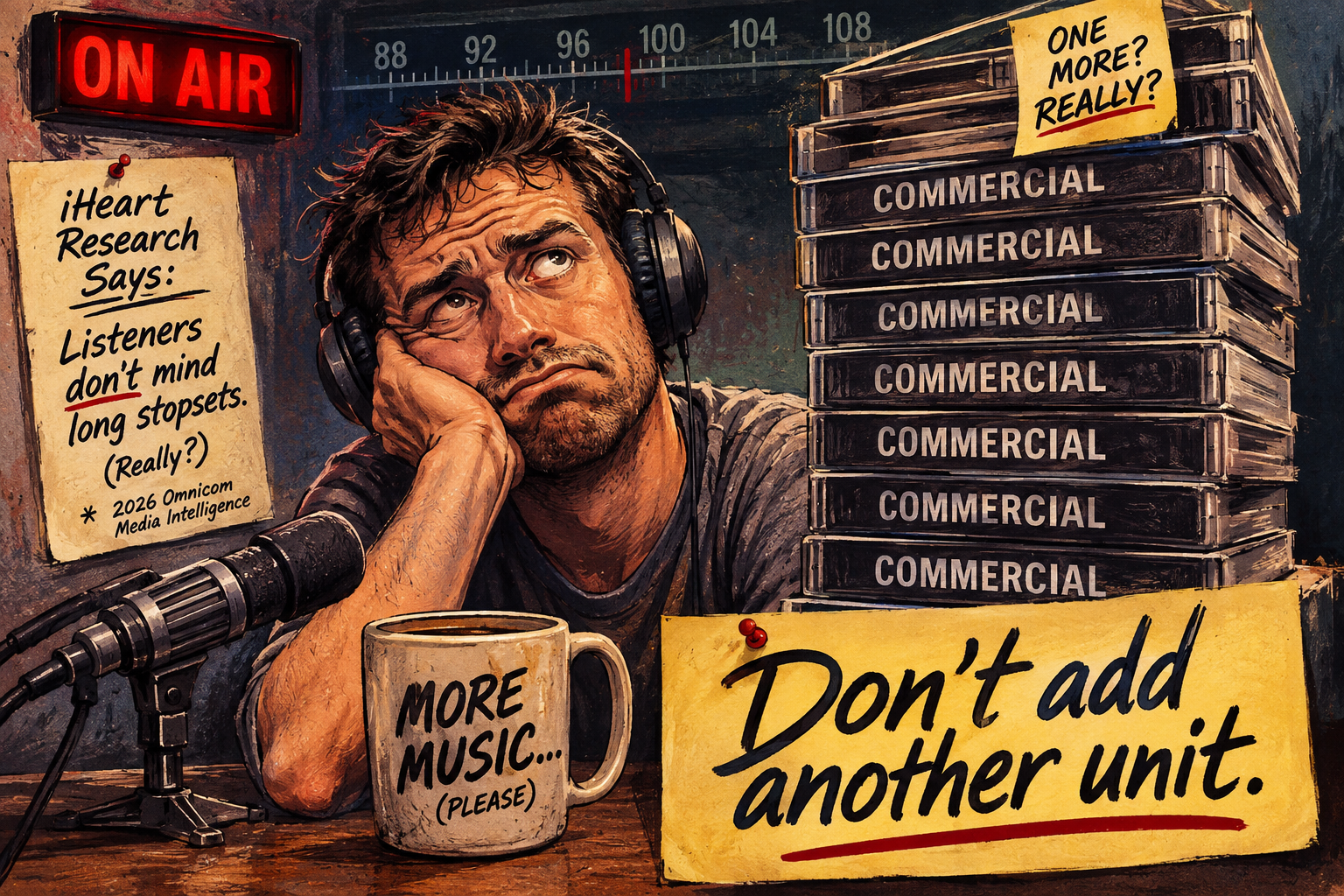
There are a lot of things radio likes to blame when people stop listening. Spotify. Podcasts. YouTube. TikTok. SiriusXM. The dashboard. The smartphone. The connected car. Alexa. Young people. Old people. Attention spans. Algorithms. Technology. Probably solar flares if we can find a consultant willing to build a PowerPoint about them. Almost everything, in other words, except the possibility that sometimes we might be making radio unnecessarily difficult to listen to.
Consider the commercial stopset. I am very much not part of the commercials are killing radio” crowd. Commercials are supposed to be there. They pay salaries, keep transmitters running, fund personalities and promotions, pay for newsrooms and football broadcasts, cover streaming bills, websites and apps, and hopefully leave enough money for whatever is left of the station Christmas party. I love advertisers. I would simply prefer that listeners still be present when we play their commercials.
Somewhere along the way, commercial radio developed a fascinating solution to the problem of interruption. Rather than interrupt the listener several times for shorter periods, we occasionally decided to place every mattress store, car dealer, injury attorney, HVAC company, hospital system, home-improvement contractor and station promo in the tri-state area into one enormous audio convoy. Then, with a completely straight face, we came back and said “more music.” Technically, I suppose it is. Eventually. ◆
BUT WAIT. RESEARCH SAYS YOU’RE STILL LISTENING.
Whenever radio people start complaining about gigantic stopsets, somebody eventually produces research saying listeners don't actually leave commercial breaks nearly as often as programmers believe. There is real research behind that claim, and some of it is impressive. In 2011, Arbitron, Media Monitors and Coleman Insights released What Happens When the Spots Come On?, a study encompassing roughly 18 million commercial breaks, nearly 62 million minutes of advertising, 866 stations and all 48 U.S. markets then measured by Portable People Meter technology.[1]
This headline finding was wonderful news for anybody walking into a sales meeting. The average commercial break retained more than 93 percent of the audience level it had going into the break. Two-minute breaks delivered 99 percent of the lead-in audience level, three-minute breaks delivered 96 percent, four-minute breaks came in around 92 percent, and five-minute breaks held approximately 87 percent. Even commercial breaks lasting six minutes or longer reportedly delivered about 85 percent of the audience level that had been there before the commercials started.[1]
Eighty-five percent after six-plus minutes! Ladies and gentlemen, apparently we have solved radio. Quickly, somebody add another spot.
Well, maybe not quite yet. The distinction that sometimes gets lost when those numbers are repeated is that the study measured audience delivery. It compared the average audience during the commercial break with the audience level immediately preceding it. That is extremely useful information if you are demonstrating radio's advertising delivery, but it is not necessarily the same question as asking whether the same individual listener who entered the stopset remained happily glued to the station until it ended.
In fact, the original discussion of the findings talked about radio continuously replenishing its audience. Some listeners may leave while others arrive. Coleman Insights President Warren Kurtzman also included a warning that somehow never became quite as popular as that wonderful 93-percent headline: while immediate tune-out may be considerably smaller than conventional wisdom assumed, excessive commercial inventory could still damage a station's brand and long-term performance.[1] Funny how that part never made it onto quite as many sales sheets.
THE SUBWAY THAT MAY HAVE LOST A FEW PASSENGERS
A subsequent industry discussion of the research produced an even more revealing analogy. An Arbitron representative compared a radio station during commercials to a New York subway. The train pulls into a station, some passengers get off, other passengers get on, and when the train leaves there may still be roughly the same number of people aboard. When specifically asked whether the famous 93-percent figure necessarily represented the same listeners who had entered the commercial break, the answer was essentially no; the primary purpose of the analysis was measuring aggregate audience delivery.[2]
That is not a criticism of the study. It is a question about what conclusions we choose to draw from it. Suppose I own a restaurant and have 100 customers sitting at tables at 7 p.m. Over the next hour, 30 become irritated and leave while 27 new customers walk through the door. At 8 p.m. I march proudly into the kitchen and announce, “GOOD NEWS! WE RETAINED 97 PERCENT OF OUR CUSTOMER LEVEL!” My accountant might appreciate the statistic. My marketing director might have a couple of follow-up questions.
Maintaining an average audience level during a commercial break does not automatically demonstrate that individual listeners enjoy long stopsets, tolerate them indefinitely, hear every commercial or experience no cumulative change in the way they feel about the station. It tells us something extremely valuable about audience delivery. It does not necessarily answer every question about listener experience. That is where some of the other research gets considerably more uncomfortable.
THEN SOMEBODY ACTUALLY ASKED THE LISTENERS
Edison Research approached the issue from another direction by asking listeners what actually makes them want to leave. Its research found that 59 percent said simply hearing the beginning of a commercial break could be a reason to change stations, while 66 percent cited hearing too many commercials as a reason they might tune out.[3]
Edison also conducted what may qualify as one of the more delightfully cruel experiments in the history of radio research. Participants were played an actual segment from a highly rated major-market station containing almost eleven minutes of commercials, mixed with just over two minutes of noncommercial material. Researchers observed listeners fidgeting and reaching for their phones, and reported that participants said they would have changed stations had they been allowed to do so.[3] The methodology could almost be summarized as: “Here. Listen to this stopset and tell us when you lose the will to live.”
Researchers then asked listeners to imagine an hour containing eight total minutes of commercials and choose how they would prefer those minutes distributed: one eight-minute break, two four-minute breaks or four two-minute breaks. Fewer than one-quarter preferred the giant single break.[3] That is rather different from saying listeners don't mind long stopsets. They may not always leave, but that doesn't mean they're sending them Valentine's cards.
THE LONG-TERM DATA MAY BE EVEN MORE IMPORTANT
A 2024 study published in the Journal of Advertising Research examined radio advertising avoidance using Portable People Meter-derived data. Researchers found mechanical avoidance—changing stations, muting or otherwise escaping the advertising—peaked at around the fourth advertisement in a break. The authors concluded that lower-clutter environments can reduce the opportunity for avoidance and recommended shorter commercial breaks when other factors are equal.[4]
Then there is a huge real-world experiment involving Pandora. Researchers studying nearly 35 million listeners randomly varied advertising levels and followed the results for 21 months.[5] That lengthy measurement window is important because the effects of advertising did not look nearly as dramatic in the short term as they did over time. Listener sensitivity to increased advertising over the long run was roughly three times greater than a short observation period would have suggested. Higher ad loads eventually affected listening hours, listening days and even the likelihood that people would continue using the service.[5]
That may be one of the most important pieces of this discussion because short-term ratings measurement can tell us whether somebody punched another preset during Tuesday afternoon's stopset. It may tell us considerably less about whether twelve months of repeatedly encountering the same experience gradually teaches somebody to use something else. That isn't necessarily immediate tune-out. That is habit erosion, and habit erosion may be considerably more dangerous because by the time you see it clearly, the listener may already have changed behavior.
Interestingly, when the Pandora researchers separately varied the number of interruptions and the number of advertisements packed inside those interruptions, listeners demonstrated a slight preference for more frequent but shorter breaks.[5] In other words, the assumption that listeners universally prefer one giant stopset so we can brag about “fewer interruptions” deserves at least a little more scrutiny.
NOW LET’S TALK ABOUT THE PEOPLE PAYING FOR THIS
There is another participant in this conversation who sometimes gets forgotten: the advertiser. Imagine paying real money to create a professionally produced commercial, only to have it air sixth in a seven-minute stopset. Congratulations. You have purchased the audio equivalent of a billboard placed directly behind six other billboards.
Research suggests the sheer number of individual commercials may matter as much as total duration. A controlled experiment published in the Journal of Broadcasting & Electronic Media increased the number of individual advertisements while holding the total commercial time constant. Listeners demonstrated greater cognitive disengagement, perceived those breaks as longer and developed more negative attitudes toward the commercial experience.[6]
That creates a question worth asking in every radio sales department: Are we selling inventory, or are we selling attention? A traffic system can certify that a commercial aired at 3:42 p.m. It cannot certify that anybody's brain was still in the room. If the real product being purchased by the advertiser is access to human attention, then clutter isn't merely a programming issue. It is potentially an advertiser-value issue too.
EVEN iHEART'S OWN RESEARCH POINTS TOWARD BETTER CREATIVE
This is where the discussion becomes particularly interesting because more recent iHeartMedia advertising research does not suggest that longer audio is inherently bad. Its 2026 work with Omnicom Media Intelligence found stronger recall for longer host-read executions among certain high-intent listeners.[7] That is a finding worth paying attention to, but it is also very different from proving that listeners prefer seven or eight minutes of unrelated commercials stacked together.
A trusted personality telling an entertaining sixty-second story about a local restaurant is not necessarily experienced by the listener the same way as seven produced commercials parked bumper-to-bumper. One is content carrying a commercial message; the other can become inventory carrying more inventory. If anything, those findings strengthen the argument for better commercial experiences rather than simply more commercial minutes.
And since radio loves research, maybe we should occasionally ask a few questions about methodology before turning a statistic into scripture. What exactly was measured? Aggregate audience or individual retention? Immediate behavior or long-term behavior? A compelling host-read message or an eight-minute block of unrelated recorded spots? Research is valuable, but research answers the question it was designed to answer. The trouble begins when the industry quietly changes the question after the results arrive.
MAYBE COMMERCIALS SHOULD SOUND LIKE RADIO AGAIN
Somewhere in radio's past, commercials were actually allowed to be entertaining. They had characters, hooks, stories, comedy, music, theater of the mind, memorable voices, local references, sound effects and jingles people could sing ten years later. Sometimes the commercial was every bit as entertaining as the programming surrounding it.
Today we possess technology capable of producing audio faster, cleaner and more creatively than at any point in broadcasting history, yet a shocking amount of local commercial inventory still sounds as though somebody opened Microsoft Word, typed 117 words and told an announcer to “get it all in.” Then we stack six or seven of those masterpieces together and wonder why the listener isn't enjoying the experience. Perhaps technology isn't radio's biggest creative problem. Maybe boring is.
Imagine a commercial environment filled with stronger production, real personality endorsements, fifteen- and thirty-second executions when sixty seconds isn't required, better sonic branding, sponsored features that genuinely fit the station, and advertiser stories that sound like they belong inside the product rather than interrupting it. Maybe radio could deliver fewer commercial minutes while generating more commercial impact. Maybe an advertiser whose message actually stands out would value that environment more than the privilege of being spot number nine.
THIS IS NOT AN ANTI-REVENUE ARGUMENT
Whenever this conversation comes up, somebody inevitably says, “That's easy for programming to say. Sales has to make budget.” Of course it does. I want sales departments to make budget. I would like them to obliterate budget. Salespeople should make money, stations should make money, owners should make money and advertisers should get measurable results. That's how commercial broadcasting works.
The uncomfortable possibility is that maximizing the number of units we can sell today may not automatically maximize the value of the audience carrying those units tomorrow. If the listening experience gradually teaches consumers that terrestrial radio means six songs followed by an audio hostage situation, we should not be shocked when some of them discover alternatives. Even the celebrated 2011 commercial-retention research included the warning that excessive inventory can damage the long-term brand.[1]
That raises a much bigger business question. If radio needs additional revenue, does the answer always have to be another commercial?
MAYBE WE NEED MORE REVENUE — NOT MORE COMMERCIALS
Radio has sometimes behaved as though the words revenue and commercial inventory mean essentially the same thing. They don't. If a station needs another $100,000 in revenue, the answer does not automatically have to be another thirty-second unit shoved into the same already crowded stopset.
Radio owns—or at least has access to—far more than thirty-second commercials. Stations have personalities, websites, streaming audio, mobile apps, social audiences, email databases, podcasts, video capability, local relationships, promotional infrastructure and the ability to physically gather people together. Each one of those can potentially become part of the advertiser relationship when there is genuine value behind it.
Digital is an obvious example, provided we stop using the word digital as though it magically transforms a bad sales idea into a good one. If a local advertiser is already investing in a radio campaign, the relationship might also include relevant streaming inventory, a sponsored article, useful video content, an email sponsorship, social integration, a podcast feature or a measurable lead-generation component. The advertiser is no longer simply buying thirty seconds. The advertiser is buying access to the station's broader audience ecosystem.
And then there are events, where radio still possesses a tremendous advantage in an increasingly virtual media environment: radio can get people to show up. A station can build concerts, food festivals, home shows, bridal events, job fairs, high school sports packages, community celebrations, listener parties and other experiences that make sense for its particular audience. Those events create sponsorship opportunities and advertiser relationships without requiring another unit in the 3:20 stopset. Spotify may have millions of users, but it probably isn't standing at the county fair Saturday afternoon shaking hands with your local listeners.
Personality endorsements, podcasts, specialty programs, newsletters, branded video and community content provide other possibilities. None of these should become excuses to sell junk merely because it carries a fashionable label, and no station needs to become a digital agency, concert promoter, television studio, podcast network and county fair operator by next Tuesday. Trying to do seventeen things badly isn't diversification. It's exhaustion.
But there is a powerful idea buried here. If an advertiser is paying the station in four or five different ways, perhaps the station doesn't have to extract the entire value of that relationship through thirty- and sixty-second commercials. A client might buy terrestrial audio, streaming, a personality endorsement, an event sponsorship and a digital component. The advertiser receives more touchpoints, the station earns more from the total relationship, and the terrestrial commercial environment can potentially become less cluttered and therefore more valuable.
Put another way, radio keeps trying to monetize the same six minutes harder when maybe it should be monetizing the other fifty-four minutes smarter.
That isn't an argument for less revenue. It is an argument for changing the architecture of revenue. Instead of selling more interruptions, perhaps radio should become better at selling more solutions.
THE PRODUCT AND THE REVENUE MODEL HAVE TO PROTECT EACH OTHER
Programming and sales sometimes behave as though they sit on opposite sides of the table, but the two functions are completely dependent on one another. Programming needs revenue. Sales needs audience. Programming cannot build an immaculate station nobody can afford to operate, and sales cannot monetize the product so aggressively that eventually nobody wants to consume it.
The healthiest strategy probably lives somewhere between those extremes. Protect the listener experience enough that the audience remains valuable. Build commercial environments where individual advertisers can actually be noticed. Use personalities as commercial assets without destroying their credibility. Develop digital products that solve legitimate client problems. Create events around real community relationships. And perhaps stop asking the terrestrial commercial stopset to carry the entire economic burden of the radio station.
That's a considerably more interesting business conversation than arguing about whether commercial number eight should run before or after the weather promo.
RADIO'S GREATEST ADVANTAGE IS STILL RADIO
For all of the industry's problems, radio still possesses extraordinary advantages. It is immediate, intimate, local and mobile. It has personalities with whom listeners can develop genuine relationships. It can talk about what is happening right here, right now, place an advertiser inside a community conversation, get people to physically show up somewhere, make a local business feel important and create shared experiences in a market. Those things have real value.
We should protect them because the answer isn't commercial-free radio. Commercial-free audio already exists, and there is plenty of it. The challenge is making commercial radio better at being commercial radio—better advertising, better creative, better placement, better environments, smarter use of personalities, stronger digital extensions, better events and more meaningful ways for advertisers to participate in the station's relationship with its audience.
So yes, somebody can show me research demonstrating that an impressive percentage of the aggregate audience remains during a six-minute commercial break, and I'll believe it. But if the person who entered that stopset listening to my station has left, somebody else arrived halfway through, neither heard the advertiser's complete message, both increasingly think my station is irritating, and six months later one of them has established a new listening habit somewhere else, I'm not sure I want to declare victory just yet.
Revenue matters. Advertising matters. Advertisers matter. So does the product carrying all that advertising.
And if we're already six minutes into the stopset, please, for the love of radio—Don't add another unit.
FOOTNOTES
[1] Arbitron, Media Monitors and Coleman Insights — What Happens When the Spots Come On? 2011 Edition. The study analyzed approximately 17.9 million commercial breaks on 866 stations across 48 PPM markets and reported average audience delivery of roughly 93% of lead-in audience levels overall and about 85% for breaks of six minutes or longer. Coleman Insights also cautioned that excessive commercial inventory could damage station branding and long-term performance.
◆[2] Industry interview regarding the Arbitron commercial-break research. An Arbitron representative subsequently explained the results using a subway analogy: listeners can enter and leave during a break while the aggregate audience level remains relatively stable. The research was principally designed to measure audience delivery rather than individual listener retention through an entire stopset.
3] Edison Research — The Secret to Longer TSL. Edison reported that 59% of respondents considered the beginning of a commercial break a possible reason to change stations, while 66% cited excessive commercials. In a separate exercise distributing eight commercial minutes within an hour, fewer than one-quarter of respondents preferred a single eight-minute break.
◆[4] Michelon et al. — “Why Shorter Advertisement Breaks Reduce Radio Advertisement Avoidance: When It Comes to Radio Advertising, Less Is More,” Journal of Advertising Research, 2024. Using PPM-derived behavior, researchers found mechanical avoidance peaked around the fourth advertisement and concluded that lower-clutter commercial environments can reduce opportunities for avoidance.
◆[5] Goli, Huang, Reiley and Riabov — Measuring Consumer Sensitivity to Audio Advertising: A Long-Run Field Experiment on Pandora Internet Radio. The randomized experiment involved nearly 35 million listeners followed for 21 months. The researchers found substantially stronger long-term effects from advertising load than short-term measurement would suggest and observed a slight preference for more frequent but shorter interruptions.
◆[6] Robert F. Potter — “Double the Units: How Increasing the Number of Advertisements while Keeping the Overall Duration of Commercial Breaks Constant Affects Radio Listeners,” Journal of Broadcasting & Electronic Media, 2009. The experiment found that increasing the number of individual advertising units while keeping total duration constant could increase cognitive disengagement, make breaks feel longer and create more negative attitudes toward the commercial experience.
◆[7] iHeartMedia / Omnicom Media Intelligence audio research, 2026. The research reported stronger message retention for longer host-read executions among certain high-intent listeners. That finding concerns the performance of individual host-read advertisements and should not be interpreted as evidence that listeners prefer long commercial blocks containing numerous unrelated advertisements. ◆