
Invasion of the Bad Homemade Jingles: Just Because It Sings Doesn’t Mean It Sells
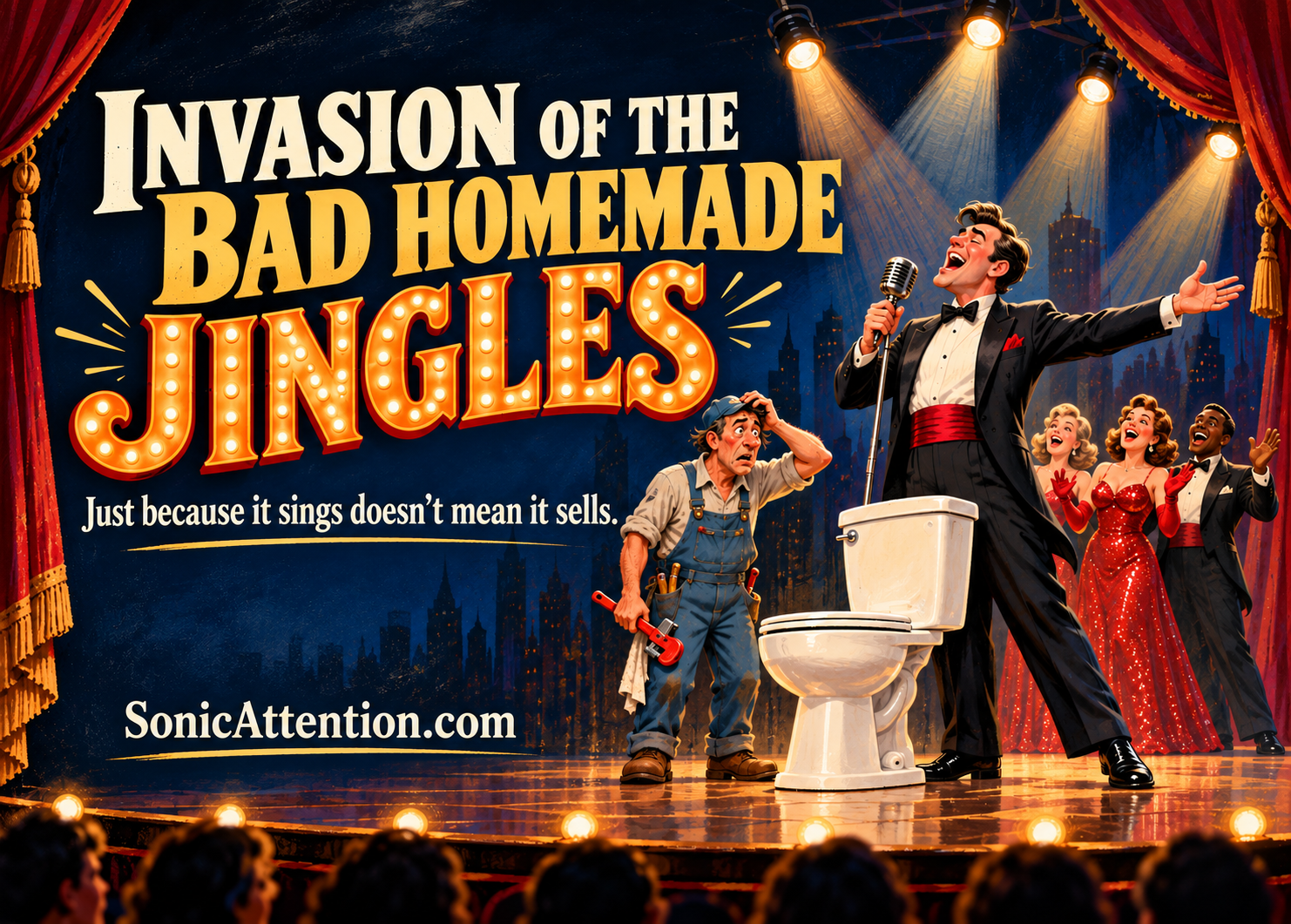
They’ve escaped the laptop and reached the airwaves. Your client’s business deserves better.
By Joe “Crash” Kelley | SonicAttention.com
We’ve all heard them. Somewhere, a perfectly respectable plumbing company has acquired a theme song that sounds like a cruise ship talent show during a software malfunction. The lead singer is experiencing feelings no human has ever had about drain cleaning. A choir arrives to assure us the service is “second to none.” Then comes a key change. Apparently, the toilet is being repaired on Broadway.
You know the rest. The lyrics promise “quality you can trust” and “service that’s a must.” The company’s name is stretched across nine notes, with the emphasis on a syllable nobody has emphasized since the business opened. By the time the singer finishes the last heroic vowel, we have forgotten what they sell.
But somebody in the office is thrilled: “Listen! It sings our name!”
Yes. And now we need to discuss what it is doing to your name.
I’m hearing more of these homemade jingles, including some that are making their way onto the radio. People discover Suno or another music generator, type in a business name and a few instructions, click Create, and get the astonishing experience of hearing a song materialize. I understand that excitement. These tools are remarkable. For a business owner who thought a custom jingle was financially out of reach, that first playback can feel like Christmas.
The danger arrives when the excitement of making something becomes the standard for deciding whether to air it.
A jingle has a job to do
A jingle should help people recognize a business, remember something useful about it, and attach the right feeling to its name. That takes decisions about the customer, the promise, the language, the melody, the voice, the pacing, and the way all of it fits inside an actual commercial.
“Make something catchy” is a starting request. A producer still has to decide what should be catchy. The business name? A meaningful promise? A phrase that gives someone a reason to choose this advertiser? If the memorable part is a spectacular vocal run on the word “today,” congratulations: we have successfully advertised Tuesday.
Here is a test I use: substitute a competitor’s name. If the entire thing still works without changing another word, I start asking how much of the client’s identity actually made it into the writing. “Friendly people, great selection, prices you will love” could describe half the businesses in the commercial break. Adding harmony does not make those claims more specific.
And a slick mix can hide weak thinking. Huge drums, glossy vocals, and a cinematic ending can make a generic idea sound expensive. The client still needs an idea that belongs to their business.
What the research actually tells us
There is evidence behind taking these decisions seriously. In two studies using specially produced radio advertisements, Adrian North and colleagues found that music suited to the advertised brand improved recall of products, brands, and claims. It also improved ad liking and reported purchase likelihood. Voice fit helped with claim recall and those attitude measures as well.[1] That is a reason to choose the musical personality deliberately. A sound that excites the person pressing Create may communicate something entirely different about the business.
Short musical signatures can also influence how an advertisement feels. In two experiments, Shawn Scott, Daniel Sheinin, and Lauren Labrecque found that sonic logos affected emotional responses and attitudes, and that placement within the ad mattered. Happy and sad versions produced different effects.[2] My practical takeaway: those few seconds deserve the same care as the copy. A dental practice asking for trust should think carefully before adopting the entrance music of a professional wrestler.
Memorability requires more judgment than “keep it simple,” too. A 2026 study by Sebastian Silas and colleagues tested 90 sonic logos with 1,860 participants. Greater melodic complexity tended to help recognition while making the melody harder to sing back.[3] Recognizing a sound and reproducing it from memory involve different demands. For a local advertiser, I want a hook with enough character to be recognizable and a business name listeners can comfortably carry with them. A vocal obstacle course rarely tops my list.
Ipsos offers another useful perspective. Its analysis of more than 2,000 pieces of video advertising linked distinctive brand assets with stronger branded attention, highlighting the value of sonic brand cues. Research closer to our own medium comes from Audacy and Veritonic: their 2023 study examined 113 radio and podcast ads, surveyed more than 330 consumers, and followed up to check recall. Their recommendations centered on sonic branding, music, voice, and message.[4] These are commercial research findings about advertising responses, rather than guarantees of sales from a particular jingle.
SoundOut's 2025 Index makes another useful distinction: recognizing that you have heard a sound before and correctly identifying the brand behind it are measured separately.[5] My takeaway for a local event is simple. If listeners remember the song but cannot tell you which event it promoted, the singer got the publicity. The event did not. The event's name needs to earn a place in that memory.
And grabbing attention is only part of the job. In an experiment published in the Journal of Marketing, James Kellaris and colleagues found that greater attention to the music helped people receive the advertising message when the music brought to mind ideas that fit that message.[6] My practical rule: every flourish has to help the listener get somewhere useful. A thirty-second musical fireworks display still needs to tell people why they should care.
These studies examine different aspects of advertising and sound; they do not directly compare SonicAttention with homemade Suno jingles. Together, they give us reasons to judge fit, emotion, musical structure, and the connection to the advertiser. A generated file still needs someone qualified to make those decisions.
Same event. Two jingles. Hear the difference.
Here is a real example. First, you will hear a locally created jingle promoting an event. Then you will hear my SonicAttention jingle promoting that exact same event. Both have the same job: make people remember the event and give them a reason to show up.
LISTEN: The Original Local Event Jingle, Followed by the SonicAttention Version
▶ Listen to the before-and-after comparison on SoundCloud
As you listen, pay attention to the event name. Does it land clearly and naturally? Does the music capture the kind of experience being promoted? Does the energy make you want to be there? After the audio stops, what do you remember?
Listen for the writing, too. Is there a reason to attend, or a collection of rhymes with the event name dropped in? Does the melody help you remember that name? Would the hook still work in a short reminder spot as the event gets closer?
Same event. Two very different first impressions. Listen to both and decide which one makes the event feel worth putting on your calendar—and which one you are still humming afterward.
There is a copyright catch
There is another reason to be careful with the assumption that clicking Create produces an asset you can fully protect.
Under U.S. Copyright Office guidance, purely AI-generated material is not copyrightable, and prompts alone generally do not supply the necessary human authorship. Sufficiently original human-written lyrics, melodies, or creative arrangements and modifications can receive protection, but that protection covers the qualifying human contribution.[7]
The human-authorship requirement also survived the Thaler v. Perlmutter appeal. The D.C. Circuit upheld the denial of registration for a work attributed solely to a machine in March 2025; the Supreme Court declined to review the case in March 2026.[8]
Suno itself distinguishes commercial-use permission from copyright protection. Its help center says a paid subscription’s commercial rights do not guarantee copyright protection, and it does not promise that the Copyright Office will accept a generated song.[9] Being allowed to use a track in an advertisement and having copyright protection for its expressive content are separate matters. Suno's terms also say its output may not be unique and that other users may receive the same or similar output.[10] Clicking Create does not come with a promise of a sound nobody else can receive.
So I would never claim every homemade jingle is uncopyrightable. A person working at home can write an original song. An AI-assisted production can contain protectable human work. The question is what a human actually authored. The same standard applies at SonicAttention; professional production and a purchase price do not automatically make every AI-generated element copyrightable.[7]
That is one more reason to put real writing into the work from the beginning.
The person making the decisions matters
I use AI in my production process. I also bring decades of radio experience to the decisions that determine whether a jingle is ready for somebody’s advertising campaign.
At SonicAttention, I develop the concept and write the lyrics, melody, and hook around the advertiser. I think about how the business name falls against the beat, where the natural word stresses belong, what the listener needs to understand, and how the piece will work when somebody places it in a commercial. Modern tools help me realize that direction. I listen, revise, edit, and make the production choices the business deserves.
Sometimes the most valuable decision is removing something. The extra verse. The unnecessary adjective. The flourish that buries the name. The rhyme that forced us to say something no customer would ever say. Experience helps you hear the moment when a production starts showing off at the expense of the advertiser.
For an event, I also think about the rest of the commercial. Where do the date, location, admission information, and invitation to attend fit? Is there room for an announcer? Can the hook work in a fifteen-second reminder and still sound like the same campaign? Those are decisions I want made while the jingle is being built. Nobody should have to cram the directions underneath a singer's thirty-seven-syllable farewell.
A business owner may love the first version because it is the first time anyone has sung about the business. My job is to keep working until there is a better reason to love it.
And consider where that file is going. A jingle that cost almost nothing to generate can become the centerpiece of a paid advertising campaign. Every airing repeats the same creative choices. I want the advertiser's investment carrying a clear name, a useful message, and a reason to respond.
And the audition costs nothing
For radio sellers, agencies, and businesses, here is the offer: let me create a custom SonicAttention spec jingle at no cost and with no obligation to purchase it. Give me the business, the audience, the selling point, and what you want people to remember. I will put an actual creative idea in front of you and your client.
You pay only $100 if your client decides to buy it. If the client passes, you owe nothing.
That makes trying a custom spec risk-free financially: no upfront production charge and no obligation to purchase. You can hear the work before deciding. The finished purchase includes commercial usage rights for the advertiser’s promotional use.
The affordable tools are here. So is the opportunity to give local businesses better advertising than they could previously afford. We should be raising expectations for what reaches the air.
Before another homemade musical emergency goes into rotation, let me take a shot at it. Bring me the advertiser and the challenge. Listen first. Decide second. Pay only if your client buys.
Request your free custom jingle spec at SonicAttention.com or email joecrashkelley@sonicattention.com.
Please. Let’s get that toilet off Broadway.
Sources and notes
1. North, A. C., MacKenzie, L. C., Law, R. M., & Hargreaves, D. J. (2004). “The Effects of Musical and Voice ‘Fit’ on Responses to Advertisements.” Journal of Applied Social Psychology, 34(8), 1675–1708. Two studies of specially produced radio ads; purchase likelihood was self-reported, not measured sales. Publisher abstract and DOI.
2. Scott, S. P., Sheinin, D., & Labrecque, L. I. (2022). “Small sounds, big impact: sonic logos and their effect on consumer attitudes, emotions, brands and advertising placement.” Journal of Product & Brand Management. Two experiments using happy and sad sonic logos; the findings do not establish one universally appropriate musical mood. University of Rhode Island research record · DOI.
3. Silas, S., Robinson, M., Baker, D. J., Harrison, P., Jacoby, N., & Müllensiefen, D. (2026). “The Recall and Recognition of Sonic Logos.” Psychology of Aesthetics, Creativity, and the Arts. Peer-reviewed accepted manuscript: 90 logos, 1,860 participants. Recognition and sung recall were distinct outcomes; this was not a sales-effectiveness trial. The research included a collaboration with SoundOut/Slicethepie. Cambridge repository and accepted manuscript · DOI.
4. Two commercial research sources: Sheridan, A. / Ipsos (2020), “The Power of You: Why distinctive brand assets are a driving force of creative effectiveness,” based on more than 2,000 pieces of video creative; and Audacy / Veritonic (2023), Sound Creative: How to Build Winning Audio Ads, based on content analysis of 113 radio and podcast ads, a survey of more than 330 consumers, and a recall follow-up within 48 hours. These sources examine advertising responses and should not be presented as guaranteed sales effects or a controlled comparison of professional and homemade jingles. Original Ipsos publication · Audacy's original findings and methodology.
5. SoundOut (2025). SoundOut Index 2025. Commercial sonic-brand research covering 174 brands. The published table distinguishes recognition, claimed attribution, actual correct brand attribution, and fit with brand personality. These measures should not be treated as interchangeable or as sales effects. Original rankings and measure definitions.
6. Kellaris, J. J., Cox, A. D., & Cox, D. (1993). “The Effect of Background Music on Ad Processing: A Contingency Explanation.” Journal of Marketing, 57(4), 114–125. Experimental evidence about the interaction between attention to music and music-message congruency; this is not evidence that all complex music is ineffective or a test of AI jingles. Publisher abstract and DOI.
7. U.S. Copyright Office (January 2025). Copyright and Artificial Intelligence, Part 2: Copyrightability, especially Executive Summary, pp. ii–iii, and discussion of expressive inputs and modifications. Protection depends on qualifying human authorship, assessed case by case. Official report.
8. Thaler v. Perlmutter, No. 23-5233 (D.C. Cir., March 18, 2025); Supreme Court No. 25-449, petition denied March 2, 2026. Denial of review was not a new Supreme Court merits ruling on all AI-assisted works. Court of appeals opinion · Supreme Court docket.
9. Suno Help Center. “What rights do I have with a paid subscription?” (updated September 3, 2026) and “Can I register my songs with my region’s copyright office?” These distinguish commercial-use permission from copyright eligibility. Paid subscription rights · Copyright registration. Checked September 29, 2026.
10. Suno, Terms of Service, “Intellectual Property Rights” and “Disclaimer of Warranties.” The terms state that output may not be unique across users and that the service may generate the same or similar output for others. This is a stated possibility, not a measured collision rate or a finding about either recording in the event comparison. Current terms. Checked September 29, 2026.