
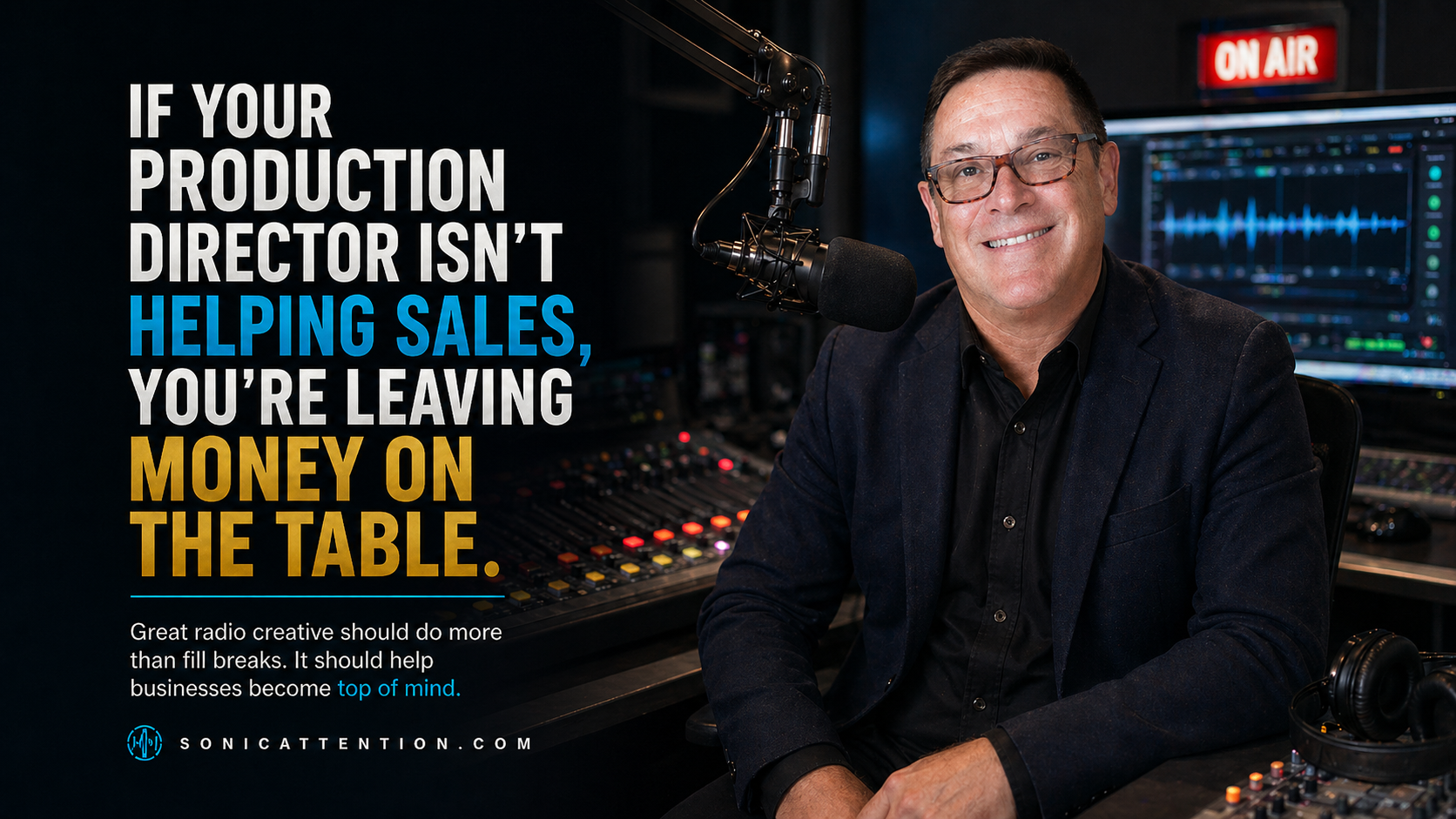
If Your Production Director Isn’t Helping Sales, You’re Leaving Money on the Table
I’ve always believed the best production people in radio are wired a little differently.
Yes, they can write a commercial.
Yes, they can voice it.
Yes, they can produce it, mix it, polish it, and get it on the air. But the really valuable ones do something bigger. They think like strategists.
A great production director should be helping the sales department walk into local businesses with ideas — not just waiting for the order to come in. That means looking at the calendar, looking at the season, looking at consumer behavior, and saying, “Here’s where this business needs to own a moment before their competitor does.”
Spring and fall heating and cooling tune-ups.
Cinco de Mayo for Mexican restaurants.
Mother’s Day for florists, restaurants, jewelers, and gift shops.
Graduation season for car dealers, furniture stores, salons, photographers, and event venues.
First cold snap for tire stores, HVAC companies, roofers, and battery shops.
Back-to-school for urgent care clinics, dentists, clothing stores, restaurants, and auto repair.
Storm season for roofers, tree services, insurance agents, generators, and home repair.
That is not just copywriting. That is revenue development. And it is exactly where radio has an advantage — if we use it.
THE RESEARCH BACKS THIS UP
Pierre Bouvard at Cumulus Media/Westwood One has been beating the drum on this for a reason. In a 2026 Westwood One analysis comparing marketer perceptions with Circana sales-effect data, creative was shown to drive 49% of incremental sales, while marketers and agencies thought it only represented 23%.
In other words, advertisers dramatically underestimate how much the actual ad matters. That should stop every radio manager, seller, and production director in their tracks. Because if creative is that big a part of the sales result, then the production department is not just a service department.
It is a sales weapon.
Radiocentre’s Turning Art Into Science study found that the most effective radio creative features revolve around consistency and recognizable audio cues — things like a consistent creative idea, a sonic brand identity, a familiar voice, and music that helps the listener identify the advertiser faster. That is exactly why jingles, sonic logos, branded music beds, signature voices, and repeated campaign hooks matter.
They are not decoration. They are memory devices. System1 and Radiocentre’s Listen Up! research also found that audio ads that create more positive emotion drive more consumer action, including purchase and brand use. Their analysis of 131 radio ads and responses from more than 50,000 people found that above-average positive-emotion campaigns produced a +8.2% uplift in listeners taking action.
That matters because most local commercials are still written like newspaper ads with music underneath. Name. Address. Phone number. List of services. “Family owned and operated.” “Call today.” That is not strategy. That is an audio business card.
WHERE SONIC ATTENTION FITS
This is where SonicAttention is different. I’m not just trying to make something “sound good.” I’m trying to help a business become easier to remember. Audacy and Veritonic found that sonic branding in radio ads can lift ad recall by 17% and purchase intent by 6%.
The same study found that radio ads with sonic branding were seen as more trustworthy, more likable, more empowering, and more relevant. Music in ads also drove purchase intent by 5% and recall by 4%.
That tells me what I’ve believed for years from sitting behind the console: The right sound can make a business feel bigger than it is. A strong jingle can make a local company sound established.
A memorable hook can make a new advertiser feel familiar.
A consistent sonic identity can help a business get credit for the message before the listener even hears the offer. That is powerful. And local businesses need that just as much as national brands do.
THE THREE LOCAL CATEGORIES I’D TARGET FIRST
The research gives radio sellers and production directors some obvious places to start.
1. Restaurants and quick-service food Restaurants are perfect for creative audio because food decisions are emotional, immediate, and often made in the car. Katz Radio Group found that exposure to audio ads led to a 6%+ increase in QSR intent, with targeted consumers 4% to 7% more likely to visit.
They also found that 89% of respondents make last-minute meal decisions while in the car, and 82% said simply hearing food ads can make them feel hungry. That screams for better creative. A Mexican restaurant should not just run a generic Cinco de Mayo spot.
It should own a sound for Cinco de Mayo. A chicken restaurant should not just say “lunch specials.”
It should have a lunch hook people can sing back. A pizza place should not just run “two large one-topping pizzas.”
It should have a Friday night family anthem.
2. Automotive Auto is another category made for radio because people are already listening in the car — and because buying a vehicle involves both emotion and research. Radio Matters reported that radio campaigns drove a 7% increase in auto dealer website activity, and AM/FM increased new site visitors 12% for every day campaign spots aired.
Another Provoke Insights survey found radio listeners were buying vehicles at twice the rate of non-radio listeners, 17% versus 9%. That means the creative should do more than announce inventory. A dealer needs a recognizable sound.
A service department needs a seasonal campaign.
A tire shop needs to own the first cold snap, the first road trip weekend, and the first day everybody realizes their tires are bald.
3. Home improvement and home services This is where local radio can print money if the creative is smart. Home improvement decisions are often planned, seasonal, and triggered by life moments. Radio Matters reported that radio listeners are more likely than non-listeners to work on home improvement projects, 40% versus 25%, and 81% of radio listeners plan their home improvement purchases
. One-third made their purchase within days. That means HVAC, roofing, flooring, landscaping, pest control, plumbing, windows, pools, tree service, and remodeling should not just be sold “spots.” They should be sold moments.
The first hot weekend.
The first freeze warning.
The week pollen turns every car yellow.
The month everybody starts thinking about patios, pools, and cookouts.
The week after a storm.
The week before company comes over for Thanksgiving.
That is where a good production director can help sales. Not by waiting for a copy sheet. By bringing an idea.
THE REAL POINT
The best radio creative does not start with, “What do you want the spot to say?” It starts with, “What moment should this business own?” That is the question too many stations stopped asking.
And that is also why I believe the production director role has to be bigger than production. A strong production director should understand the listener the way a good air talent understands the listener.
You learn how to create anticipation. You learn how to make people feel something. You learn how to make a phrase stick. You learn how to take something ordinary and turn it into something people actually notice. T
hat same instinct belongs in the sales process. Because when radio creative is done right, it does not just fill commercial breaks. It helps businesses become top of mind. And in a crowded market, top of mind wins.