
The Old Sales-vs.-Programming Fight Misses the Point
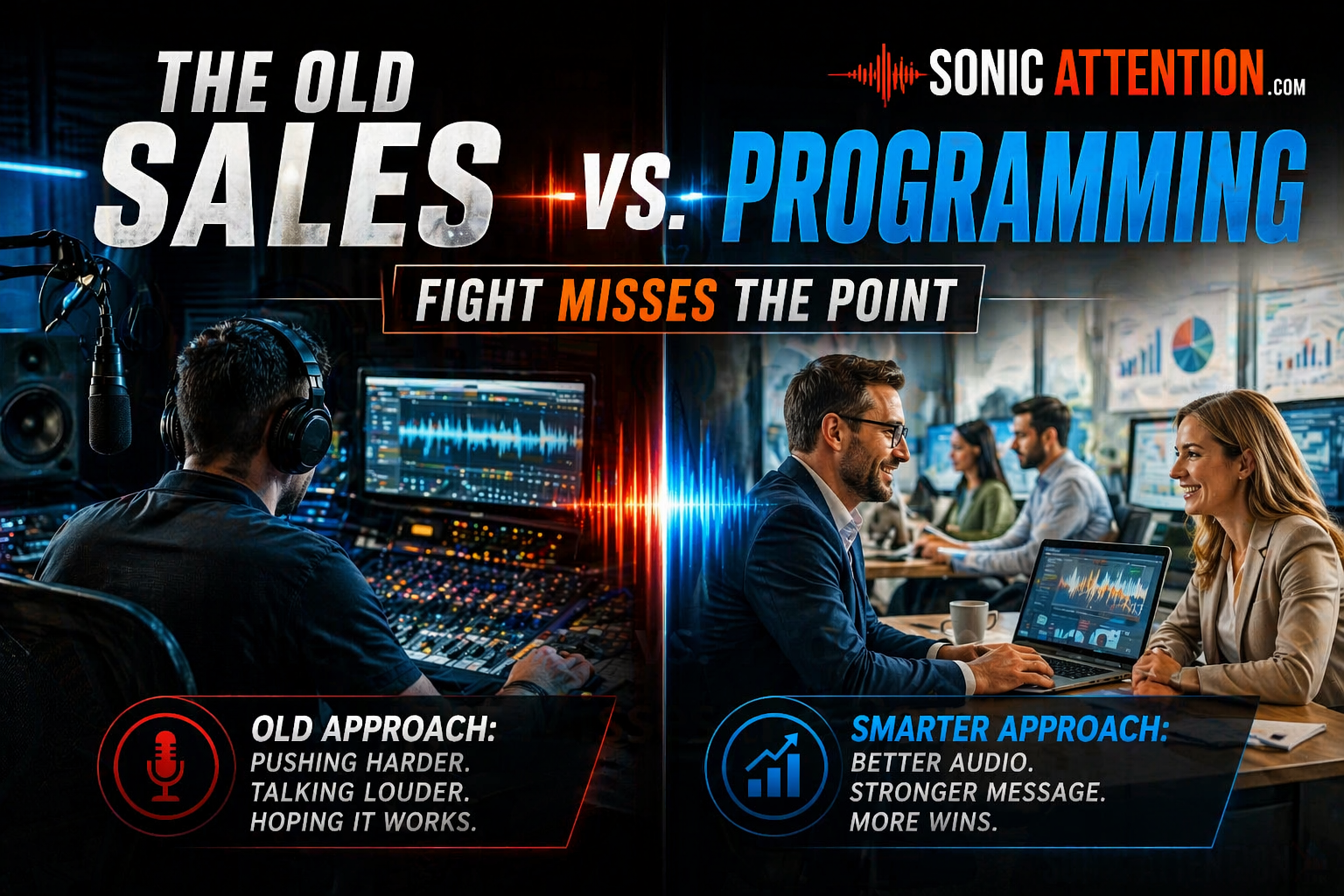
For years, I watched the old “sales versus programming” tension play out in radio. Like a lot of people in this business, I saw those worlds as separate, sometimes even conflicting. But over the last few years, my perspective has changed, and honestly, it has reinvigorated the way I feel about radio.
I’m not talking about going out and selling. The level of commitment it takes to do that well is enormous, and it is not realistic to expect today’s air talent and programmers to add full-time selling to everything else already required of them.
What I am talking about is collaboration.
Sales and programming are two sides of the same story. One side opens the door. The other helps deliver results. When those sides truly work together, radio becomes much more than a schedule and a rate card. It becomes a creative solution.
That is the part of the business that excites me more than ever.
I love working with sales teams to build campaigns that actually move the needle for clients. I love helping create ideas that do more than fill a commercial break. I’m talking about using talent to grab attention, build trust, and create something memorable. That can mean a compelling voiceover, a network-quality commercial, a promo that sounds larger than life, or the kind of human sonic branding that gives a local advertiser a real identity and a real advantage.
At its best, radio is still one of the most creative businesses anywhere. And no matter what job title you hold in this industry, creativity is still the engine that drives success.
That is what I keep coming back to.
I love creating on the air. I always will. But I also find myself increasingly drawn to using that same creativity for clients, for station imaging, and for promos. There is something deeply satisfying about helping a business tell its story in a way that connects and delivers.
Of course, not every interaction between sales and programming is perfect. There are frustrations on both sides, and usually they come down to the same issue: lack of preparation. Bad communication, weak ideas, and unclear expectations can make any collaboration harder than it needs to be.
But even with those realities, I’ve come to believe this: when programming takes ownership of the creative tools that help drive revenue, everybody wins. The client wins. The sales team wins. The station wins. And radio sounds stronger, smarter, and more valuable.
That realization has renewed my commitment to this business.
I still love the performance side of radio. But I’ve also rediscovered how much I love the creative side that helps businesses grow. For me, that’s not a distraction from programming. It’s an extension of what great programming has always been about: connecting, communicating, and creating something people remember.
And maybe that’s the bigger point.The future of radio will not be built by sales alone or programming alone. It will be built by people on both sides who understand that creativity is not extra. Creativity is the product.
Notes
[1] Radiocentre, Listen Up! The report describes Radiogauge as a tool for understanding campaign effectiveness and improving creative development and campaign outcomes.
[2] RAB, ABX Advertising Benchmark Index. The ABX summary highlights the role of creative quality in driving advertising effectiveness.
[3] Josh Brown, “Programming Matters: Drive Ad Sales With Your Radio Content,” Radio Ink, March 26, 2025.
[4] Pierre Bouvard, “System1: New Study Reveals How Audio Personalities Drive Advertising Effectiveness,” Westwood One, November 20, 2023.
[5] RAB, ABX Advertising Benchmark Index. The ABX summary notes that AM/FM radio tested at about 92% of TV’s creative effectiveness at roughly one-fourth the CPM.