
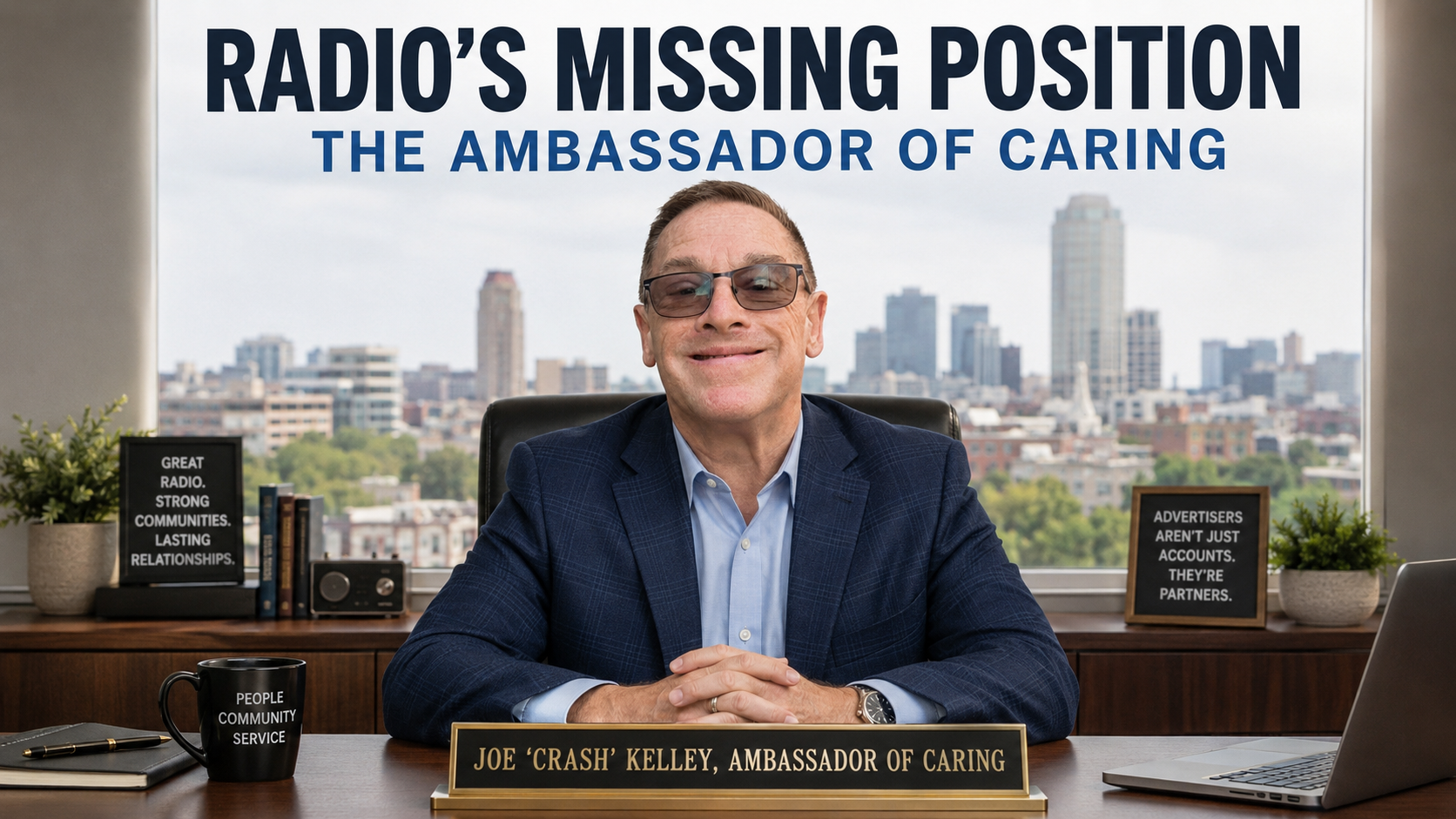
RADIO’S MISSING POSITION: THE AMBASSADOR OF CARING
l
Whatever radio automates, one thing it better now automate and that is: RESPONSIBILITY.
Radio is spending an enormous amount of energy figuring out what it can eliminate. Can we operate with fewer local personalities? Can one programmer handle several markets? Can artificial intelligence produce the commercials? Can promotions be centralized? Can the account executive handle the copy, the digital order, the remote, the contest and everything else that once required an actual team?
Those are understandable questions. Expenses matter. Efficiency matters. Technology matters. I use technology every day, and I believe it can give local broadcasters capabilities they could never afford before.
But none of those efficiencies answers the most important question every advertiser is silently asking:Will you care as much about my campaign after I sign the contract as you did while you were trying to sell it to me?
That may be one of the biggest questions facing local radio right now. Advertisers are not running out of money to spend. Local advertising expenditures continue to grow, and projections for 2026 place the total well above $180 billion. The money is there. It is simply being divided among more competitors offering targeting, convenience, creative services, immediate reporting and constant access to campaign information.
Radio cannot respond to that competition simply by lowering rates, adding a few digital products to the proposal or cutting its own operating costs again.
At some point, we have to become extraordinarily good at taking care of advertisers again.
RADIO USED TO BE THE LOCAL MARKETING DEPARTMENT
At its best, local radio was never just a collection of commercial availabilities. It was the marketing department for local businesses that could not afford to hire an agency of their own.A good account executive learned the client’s business. A creative person helped develop the message.
A local personality gave the campaign credibility. The promotions department created excitement around it. The station showed up at the grand opening, introduced the owner to the community, gave away prizes, talked about the event on the air and solved problems before the advertiser ever knew there was a problem.
The client was not simply buying 30 seconds. The client was buying ideas, energy, creativity, community connections and the confidence that someone inside the station was personally invested in helping the campaign succeed.
That complete relationship was one of radio’s greatest competitive advantages. Unfortunately, in too many operations, we have dismantled it one position and one responsibility at a time. The salesperson may still make the promises, but the execution is now scattered among departments that are centralized, understaffed, overloaded or completely unaware of what was promised.
The client gradually becomes the project manager. They have to ask whether the commercial was completed. They have to send the event information again. They have to search the station website to see whether the banner was posted. They have to remind someone that the giveaway was supposed to begin.
They have to ask whether the social-media post ever went up or whether the winners were selected.That is not value-added service. That is assigning work to the customer.
SERVICE IS PART OF THE PRODUCT
Radio often says that its audience is the product it sells to advertisers. That is only part of the transaction. The experience of doing business with the station is also part of the product.
Advertisers judge radio by more than ratings, reach and frequency. They judge whether their calls are returned, whether deadlines are met, whether the commercial is effective, whether promotions are executed, whether mistakes are acknowledged and whether somebody steps up and fixes the problem.We sometimes act as though advertisers are only looking for the lowest cost per thousand or the most immediate transactional result.
Of course, performance matters. But many local advertisers are also looking for someone who understands their business, brings them a useful idea and knows how to turn advertising into something more than a schedule of commercials.
There is still money available for good ideas. There is still money available for campaigns that solve actual business problems. What advertisers are becoming less willing to buy are generic packages, recycled promotions, weak creative and promises that nobody inside the building is truly responsible for keeping.
That is where radio has an opportunity. We can still offer something a self-service digital dashboard cannot: a real human being who understands the client, understands the market and is determined to make the campaign work.But only when we actually provide that human being.
EVERY CLUSTER NEEDS AN AMBASSADOR OF CARING
Perhaps every radio cluster needs someone whose primary responsibility is not selling another order, scheduling another commercial or processing another promotion request.Perhaps every cluster needs an Ambassador of Caring.
The title may sound soft, but the responsibility would be anything but soft. This person would be empowered to move heaven and earth to make sure advertisers receive everything they were promised and, whenever possible, something more.
The Ambassador of Caring would own the advertiser’s experience from the first serious campaign discussion through the final recap. The account executive would still lead the business relationship. Programming would still protect the station’s brand. Production would still create the audio. Promotions would still handle the contest or event. Digital personnel would still manage the online components.
But the ambassador would connect all of it.
One person would know the entire plan. One person would know what the client expects, what creative has been approved, when the campaign begins, what promotional elements were promised, where the digital material is supposed to appear, who is handling the remote and what proof should be gathered afterward.
When everyone owns a small part of a campaign, it becomes very easy for no one to own the result. The Ambassador of Caring would own the result.That person would not replace the sales representative. In fact, the position could make the salesperson far more effective.
Instead of spending half the day tracking down missing copy, correcting production orders, chasing contest details and apologizing for execution problems, the salesperson could concentrate on learning the client’s business, developing relationships and finding new opportunities.The ambassador would make sure the station delivers.
CREATIVE CANNOT BE AN AFTERTHOUGHT
The work should begin with the message, because taking care of the advertiser means doing more than simply putting every talking point into a 30-second commercial.
Too many local commercials are technically complete but creatively useless. They include the address, the phone number, the business hours, every available service and a closing line that sounds exactly like the commercial that aired before it. The spot runs as ordered, so we tell ourselves the job has been done.It has not.
Great service sometimes means telling the advertiser that the message is trying to do too much. It means helping the client identify the strongest benefit, creating an opening that earns attention and building a campaign theme that people can actually remember. It means thinking beyond a single commercial and developing a sound that can become connected to that business over time.
This is where resources such as Sonic Attention can become part of the station’s service system. A smaller radio cluster may not have a full-time jingle composer, campaign strategist, imaging specialist, copywriter and multiple voices on staff. That does not mean the station cannot provide those capabilities.
It means the station needs to know where to find them and how to put them to work for the advertiser.The Ambassador of Caring could identify the accounts that need more than a standard commercial. A client may benefit from a jingle, a sonic logo, a musical campaign, a stronger script, a custom promotion or several versions designed for different stations and audiences.
The objective is not to add creative products simply because they can be sold. The objective is to give the advertiser the strongest possible chance to be noticed, remembered and chosen.We should never forget that creative is part of customer service. Running a weak commercial exactly as ordered may fulfill the contract, but it does not necessarily serve the customer.
EXECUTION HAS TO BECOME SACRED
The best idea in the world is worthless when nobody carries it out.
A contest that never properly launches, a promotional announcement that does not run, a web banner that appears after the event, a personality who arrives unprepared or a prize that is never awarded can destroy more confidence than a great sales presentation can build.
Advertisers do not care that the promotions director was out, that the digital department is in another market, that three people were copied on the email or that the production order was entered incorrectly. Those are our problems. The advertiser paid us to solve marketing problems, not to become involved in our internal ones.
The Ambassador of Caring would maintain a clear campaign calendar showing every promised element: commercial start dates, promotional mentions, contests, website placements, social posts, appearances, endorsements, digital components and reporting deadlines.
Before the campaign begins, the ambassador would confirm that every asset had been approved and delivered. During the campaign, the ambassador would verify that the important elements were actually running. After the campaign, the client would receive a useful recap containing airchecks, screenshots, contest participation, winner information, event photos, digital results and recommendations for what should happen next.
This does not require a giant new bureaucracy or another complicated software platform. It requires one person with ownership, authority and permission to act.
The ambassador must be able to escalate missing materials, stop an incomplete launch, demand a correction and contact the advertiser before the advertiser discovers the mistake.Care without authority becomes an apology. Care with authority becomes service.
TECHNOLOGY SHOULD HELP US CARE MORE
Artificial intelligence and automation can absolutely help radio deliver this level of attention. They can accelerate script development, organize campaign information, create additional versions, identify missing assets and reduce repetitive production work.
Outside creative partners can give smaller operations capabilities that once required an entire internal department.That is exactly how efficiency should be used. It should increase what the customer receives, not give us another excuse to reduce what we provide.Technology can help produce the commercial, but it cannot personally care whether the commercial was approved before it aired.
Software can schedule a contest promo, but it cannot notice that the contest page is missing from the website. Automation can generate a report, but it cannot call a frustrated business owner, accept responsibility and make the situation right.
Radio should not reject technology. That would be foolish. We should use every tool available to make our work better, faster and more affordable.But we cannot use technology as an excuse for eliminating responsibility.
BECOME TOO VALUABLE TO CANCEL
Radio cannot guarantee that every campaign will create an immediate line of customers at the advertiser’s front door. No responsible media company can promise that.
What radio can guarantee is preparation. We can guarantee responsive communication. We can guarantee thoughtful creative. We can guarantee that promotions will be executed as described. We can guarantee that the advertiser will not have to chase us to receive the service they already paid for.
Those guarantees create trust, and trust makes a station much harder to replace.There is an important difference between being a media vendor and being a marketing partner. A vendor sells units. A partner protects the client’s investment. A real partner learns from every campaign, improves the next one, brings new ideas without being asked and notices opportunities the business owner may not have considered.
That kind of relationship is much more difficult to cancel than a schedule of spots.
Radio has spent years talking about client churn, declining shares and money moving into digital media. We should also be willing to ask how much business has been lost because clients became tired of poor communication, average creative, missed promotional elements and promises that sounded much better during the sales presentation than they looked during the campaign.
Not every revenue problem is caused by the competition. Some are caused by the customer experience we created ourselves.
CARING MUST BECOME AN OPERATING STRATEGY
Caring cannot simply be a slogan in a sales presentation. It cannot be a quality we hope certain employees happen to possess. It must become an operating strategy.
Promises must be documented. Creative must be evaluated. Responsibilities must be assigned. Deadlines must be visible. Problems must be escalated. Results must be reviewed. Clients must be contacted before they have to ask what is happening.
Most importantly, someone must be responsible for making sure all of that gets done.
Radio still has reach. It still has immediacy. It still has trusted personalities, local knowledge, emotional storytelling and the ability to make a small business feel important within its own community.
Those are powerful advantages.
But they mean far less when the advertiser receives indifferent service or inconsistent execution.
Radio does not have to out-automate every digital platform, and it does not have to become the cheapest advertising option in the market. It can become the most attentive, creative, accountable and determined local media partner available.
Perhaps the next essential position in a radio cluster is not another person charged exclusively with finding new revenue. Perhaps it is someone charged with making sure the advertisers who have already entrusted us with their money are treated as though their success truly matters.
An Ambassador of Caring.Because whatever else radio changes, centralizes, automates or eliminates, it cannot eliminate customer service. It cannot eliminate creativity. It cannot eliminate execution.
And it cannot expect advertisers to remain loyal to stations that have stopped showing them how much their business matters.