
Your Logo Looks Great. Now Close Your Eyes.
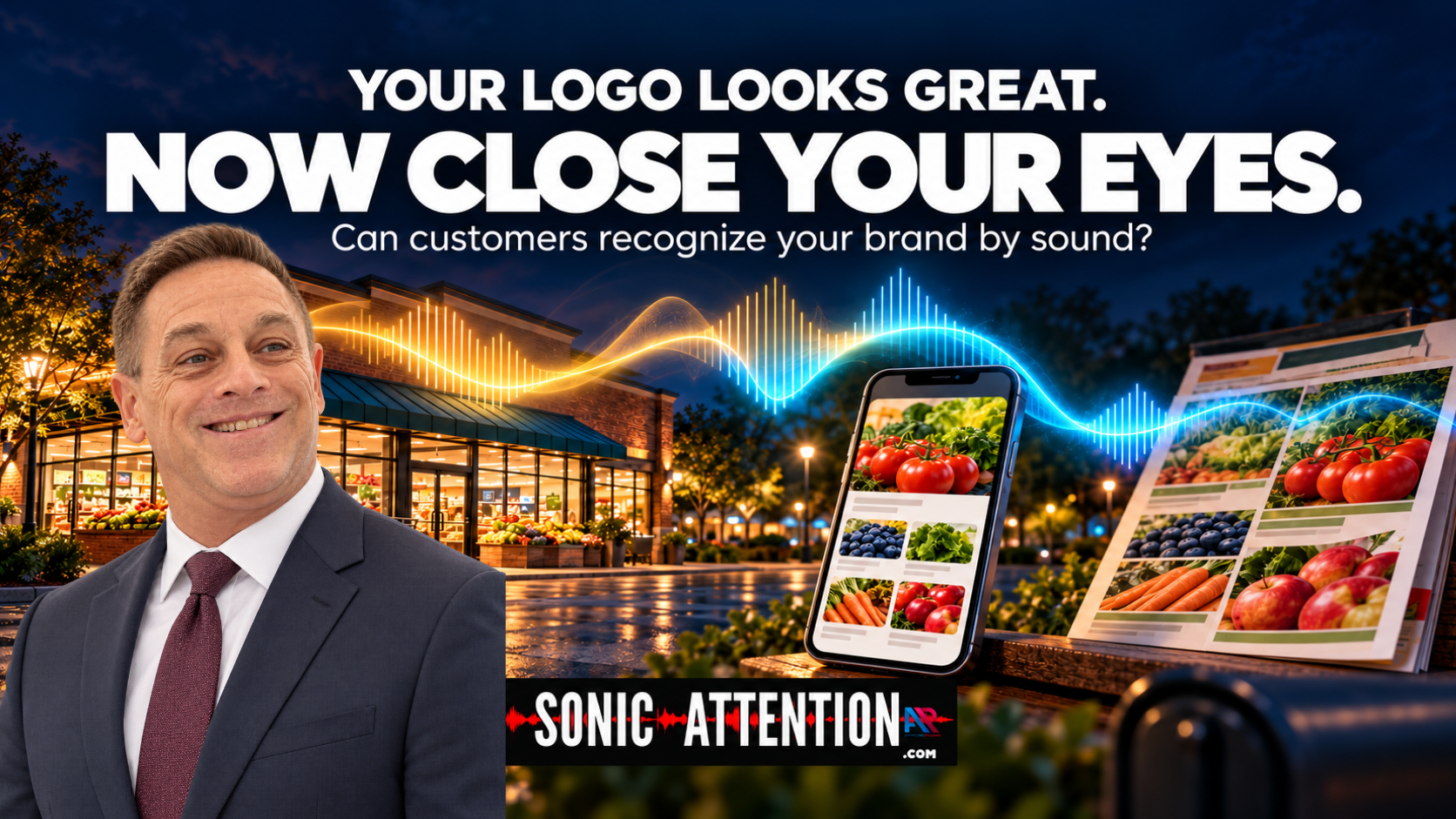
How a local IGA spec campaign connects sonic identity, digital offers, and direct mail—and what other businesses can learnBy Joe ‘Crash’ Kelley | SonicAttention.com | October 18, 2026Business owners will debate a logo until everyone in the room has developed an opinion about the exact shade of blue. They will compare fonts, inspect the spacing between letters, and ask whether the symbol looks contemporary enough. Then the radio commercial arrives, somebody puts a pleasant music bed underneath the announcer, and the conversation about brand identity apparently ends.Here is the question I wish more businesses would ask: if a customer could not see your logo, could that customer still recognize your brand? When your advertising reaches someone through a speaker, headphones, or a video playing nearby, what identifies you? Your company already has a visual identity. It deserves an equally deliberate conversation about its sound.I recently developed a spec campaign for a local IGA grocery store. The creative centered on hometown pride, expressed through a warm musical identity and a memorable sung finish. But the commercial also pointed listeners toward the IGA digital campaign and the store’s branded weekly specials in direct mail, explaining how to access the offers. The sound had a practical assignment.
Hear the Local IGA Spec Campaign
A local IGA spec campaign produced by Joe “Crash” Kelley, connecting a memorable musical identity with digital offers and weekly specials.Joe Browning Producer of Loyd Ford The Encouragers · RAHILLY'S IGA REVISED PROUD FULL MIX DONUT (1)Listen to the Local IGA Demo on SoundCloudIGA makes this an especially useful example. The Independent Grocers Alliance brings independently owned local stores together under a nationally recognized brand. Its own description emphasizes the ability to compete with shared brand support while maintaining each retailer’s connection to its community.[1] IGA is also celebrating its centennial in 2026, making the relationship between lasting identity and local relevance particularly timely.[2]The campaign I produced was for a local store. What interested me was the branding opportunity: a familiar national identity could coexist with a musical expression of that particular store’s personality. The local name, the hometown message, and the way the melody resolved could work together. A customer could hear the neighborhood connection instead of merely reading a claim about it.The spec demonstrated how audio could help the other advertising work together. The musical identity supplied a recurring introduction to the store. The spoken message supplied the next step: where to find the specials. A listener had both a reason to remember the business and a direction to follow. That is a more useful creative brief than simply making a commercial sound cheerful.IGA’s own marketing guidance supports connecting these channels. A May 2025 article describes extending the weekly ad across digital platforms and direct mail, including printed QR codes leading to digital offers.[3] Its current digital advertising resources also include digital circulars and ads intended to send shoppers to store websites and weekly specials.[4] My local spec was built around that broader opportunity.Consider how such a campaign could develop. A shopper hears the musical signature and a clear invitation to check the specials. A mailer repeats the campaign language and identifies the same store. Online, a short video can bring back the musical phrase. Each encounter has a different job, while the shared identity can help shoppers connect them. That is a proposed strategy, rather than a measured result from this spec.In print, the repeated campaign words can echo the sung line for people who know it. The design team and audio producer should agree on that wording, so the mailed piece and commercial reinforce the same store identity.The grocery category supplies a surprisingly relevant research backdrop. In findings released in September 2026, sound branding agency amp examined 100 grocery brands worldwide. It reported that 63 percent of the content analyzed used stock music, only 31 brands had a sonic logo, and just 15 used music classified as owned.[5] Those numbers describe that study’s sample, but the imbalance deserves attention.Stock music can be useful. A well chosen track can establish pace, mood, or seasonal energy. The question is what a listener learns about your particular business. If the same track could accompany a supermarket, a mattress sale, and an insurance offer, it may be doing an excellent job of sounding pleasant while doing very little to identify the advertiser.A sonic logo is a short, repeatable sound associated with a brand. It might be a few notes, a sung name, or a distinctive audio gesture. Sonic branding is the broader plan: how melody, voice, rhythm, and sound express the same identity across different encounters. A jingle can supply the memorable core of that plan without becoming a full song.You can see the distinction in established corporate examples. Intel describes its signature sound as a five-note tune.[6] Mastercard introduced a sonic identity in 2019 with a melody intended to extend across sound logos, musical scores, hold music, and payment acceptance sounds.[7] The useful lesson for a local business is the discipline: develop something recognizable, then give it a consistent role.The evidence extends beyond famous examples. Ipsos analyzed 2,015 U.S. pieces of video advertising for its 2020 report, The Power of You. Sonic brand cues were substantially more prevalent among the highest performers on branded attention than among the lowest performers.[8] The frequently quoted 8.53 figure is that study’s high-versus-low association; it is not a promise of eight times more sales.That distinction makes the argument more credible. A producer cannot promise that a five-second melody will repair pricing, distribution, or customer service. What the research supports is taking sound seriously as part of how an advertisement earns attention and connects that attention to the right brand. People remembering an enjoyable commercial is useful only if the advertiser receives the credit.More recent work from System1 and TikTok points in the same direction. Their short-form video research analyzed 887 ads and responses from more than 92,000 users across its studies. It identifies sonic assets and brand music among the useful tools for combining recognition with attention.[9] These findings concern short-form video, an especially relevant environment for businesses extending their radio creative into social advertising.The same research associates effective early branding with stronger brand memory.[10] That should challenge the habit of saving every identifying element for the final seconds. If a viewer scrolls away before your big reveal, your production may have entertained someone without introducing your business. An opening musical phrase, clearly sung name, or recognizable voice can make the identity part of the idea from the beginning.For a grocery store, this is an opportunity to connect changing information to a stable identity. Prices change. The featured department changes. A holiday promotion has a different mood from a weekly meat sale. The musical signature can give those different messages a common home. The customer has something familiar to recognize while the commercial delivers something new to act on.That was the thinking behind the local IGA work. Hometown pride suggested warmth and confidence, with a melody and vocal treatment that could make the closing name feel welcoming. Every syllable still had to be clear. If the audience remembers the mood but mishears the store’s name, the production has missed an essential part of its assignment.Writing for memory also involves choices that a generic instruction to make something catchy will not resolve. Research summarized by the University of Cambridge’s Centre for Music and Science distinguishes recognizing a melody from being able to sing it back. The researchers found a trade-off between those abilities.[11] A tune can be distinctive enough to recognize while being awkward to reproduce.For a local campaign, I want the creative team asking which job matters most. Should people recognize the store immediately? Finish the line? Recall the name when planning a shopping trip? Those are related goals, but they deserve specific decisions about words, range, rhythm, and length. A complicated vocal flourish may impress the producer while making the customer’s task harder.Consistency matters just as much as composition. The Ehrenberg-Bass Institute describes strong distinctive assets in terms of fame and uniqueness: people must learn the connection, and the cue must point to the right brand.[12] A new melody does not arrive with that association already installed. Advertising has to teach it by presenting the sound and the business together over time.This is where businesses can undermine good creative. They approve a memorable signature, use it briefly, then replace it because the owner wants something fresh. The owner hears every version, attends every production discussion, and may tire of the material long before a lightly exposed customer has learned it. Creative renewal should preserve useful recognition while giving the audience a new reason to pay attention.Ehrenberg-Bass emphasizes reach, presenting assets with the brand, and commitment when explaining how distinctive assets develop.[13] My practical translation is to build a campaign family. Keep the identifying phrase or musical shape recognizable while adapting the surrounding material. A holiday arrangement, a quick social ending, and a longer radio commercial can sound related without forcing the same complete recording into every format.Repetition deserves care, too. A 2006 experimental study found that familiarity and repeated exposure to sound logos could improve some evaluations and purchase intentions, while its melody-only experiment did not find a simple increase in liking from repetition.[14] Familiarity can help, but there is no scientific permission slip here to hammer an irritating recording into the ground.That is why a good production package should make continued use practical. For a store campaign, I would consider a full commercial version, a short sung signature, and an instrumental bed that leaves room for changing copy. A clean ending gives the editor a reliable destination. A shorter adaptation helps the identity survive when the available time shrinks.The broader system can then connect radio commercials, social videos, and other appropriate uses. Mastercard’s original announcement explicitly planned for different musical styles and regional interpretations of a consistent melody.[15] A neighborhood grocer does not need Mastercard’s resources to borrow that principle. The useful ambition is a sound that fits the business and remains recognizable through sensible variations.For businesses experimenting with AI production, the strategic question becomes even more pressing. Producing another musical option is increasingly easy. Choosing a direction worth repeating still requires judgment. Somebody must decide whether the name is intelligible, the emotion fits, the hook belongs with the message, and the result will work under real copy. Generating more options does not make those decisions disappear.I would also put the sound through ordinary listening conditions. Play it through a phone speaker. Hear it beneath the announcer. Listen without the screen. Ask someone outside the production process which business they think they heard. That is a useful first check, although a few informal reactions should never be dressed up as a representative consumer study.For a more disciplined check, measure correct brand identification before and after sustained exposure. Include customers and potential customers, and distinguish people who recognize a tune from people who connect it to your store. Ehrenberg-Bass stresses measuring what consumers have actually learned about an asset.[16] Website visits, searches, and sales can add context, but a rise in any one number cannot, by itself, establish what caused it.This changes the production conversation. Ask whether successive commercials are building something recognizable, and whether the message makes the next step easy. A sung identity cannot explain every offer, but it can support a clear invitation to find them. The production budget can strengthen a continuing brand while the copy directs attention toward the website, weekly ad, or mailer.The local IGA campaign brought that possibility into focus for me. A neighborhood grocery store can speak with warmth and musical confidence while keeping its own name and community promise at the center. The principle travels well beyond groceries. A dental practice, home services company, or furniture store can ask the same question about what connects its separate advertisements in a customer’s mind.Sound will not rescue a business that disappoints its customers. It can, however, give a business another deliberate way to be recognized when people encounter its advertising. The visual identity should keep doing its job. The opportunity is to bring the same attention to the melody, voice, and musical signature that accompany it. Close your eyes. What tells you whose business this is?
Notes and Sources
[1] Independent Grocers Alliance. About IGA. Accessed October 18, 2026. IGA describes a nationally known alliance supporting independently owned local grocery stores. This provides organizational context; the campaign discussed in the article was local.https://www.iga.com/about[2] Jessica Vician, IGA. IGA Turns 100! How We’re Celebrating.... January 22, 2026. Confirms IGA’s 1926 founding and 2026 centennial.https://www.iga.com/insights/iga-turns-100-how-were-celebrating[3] IGA News. How to Supercharge Your Weekly Ad with Omni-Channel Marketing. May 8, 2025. Discusses connecting weekly ads with digital platforms and direct mail, including QR codes leading to digital ads or offer destinations. This supports the broader strategy; it does not document the author’s local spec campaign.https://www.iga.com/insights/how-to-supercharge-your-weekly-ad-with-omni-channel-marketing[4] IGA. Digital Media Buying Desk. Accessed October 18, 2026. Describes digital circulars, custom video and display advertising, and uses including directing shoppers to websites and promoting weekly specials. The article does not imply that the local store purchased any particular IGA service.https://www.iga.com/digital-buying-desk[5] amp sound branding. US Grocery Brands Struggle to Make Themselves Heard as 63% of Grocery Content Relies on Stock Music. Findings released September 29, 2026; posted October 6, 2026. Study of 100 grocery brands worldwide. Findings refer to the analyzed brands and content. amp is a commercial sound branding agency; its index is not an independent sales experiment.https://ampsoundbranding.com/news/us-grocery-brands-struggle-to-make-themselves-heard-as-63-of-grocery-content-relies-on-stock-music[6] Intel. What Is the History of Intel’s Signature Sound?. Reviewed January 14, 2022. Intel identifies its sound mark as a five-note tune composed by Walter Werzowa.https://www.intel.com/content/www/us/en/support/articles/000015030/programs.html[7] Mastercard. Sound On: Mastercard Debuts Sonic Brand. February 8, 2019. Company announcement describes a melody extending across sound logos, music, hold music, and payment acceptance sounds. Cited as a documented strategy example, rather than independent proof of effectiveness.https://www.mastercard.com/news/eemea/en/newsroom/press-releases/en/2019/february/sound-on-mastercard-debuts-sonic-brand/[8] Adam Sheridan, Ipsos. The Power of You: Why distinctive brand assets are a driving force of creative effectiveness. February 2020, pp. 6–9. Meta-analysis of 2,015 U.S. video creative cases. Figure 7 reports an 8.53 high-versus-low branded-attention association for sonic brand cues. It does not mean 8.53 times more sales, or 8.53 times better than visual logos.https://www.ipsos.com/sites/default/files/ct/news/documents/2025-10/power-of-you-ipsos.pdf[9] System1 and TikTok. The Long and the Short (Form) of It. Methodology and findings accessed October 18, 2026. Combines research on 887 short-form video ads with a separate creative-fatigue experiment; over 92,000 users across the studies. Evidence concerns the tested short-form video context.https://system1group.com/creative-effectiveness-tiktok[10] System1 and TikTok. The Long and the Short (Form) of It — early branding findings. Accessed October 18, 2026. Reports associations between effective early brand identification and stronger memory and awareness lift. The article’s production recommendations are the author’s application of those findings.https://system1group.com/creative-effectiveness-tiktok[11] Silas, S.; Robinson, M.; Baker, D.; Harrison, P. M. C.; Jacoby, N.; and Müllensiefen, D.. The recall and recognition of sonic logos. 2026, Psychology of Aesthetics, Creativity, and the Arts; DOI 10.1037/aca0000870. University of Cambridge project summary explains the trade-off between melodic recognition and the ability to sing a melody back. Publication record: https://cms.mus.cam.ac.uk/publications/silas-sonic-logo-memory/https://cms.mus.cam.ac.uk/explore/sonic-logo-mem-explorer/[12] Jenni Romaniuk, Ehrenberg-Bass Institute. Brands of Distinction. Accessed October 18, 2026. Explains fame and uniqueness as characteristics of distinctive assets and the need to build learned brand associations.https://marketingscience.info/news-and-insights/brands-of-distinction[13] Peilin Phua and Nicole Hartnett, Ehrenberg-Bass Institute. Maximise distinctive assets. Discussion of 2020 IPA Effectiveness Award examples; accessed October 18, 2026. Discusses reach, presenting brand and asset together, and long-term commitment. Suggested local campaign versions in the article are the author’s recommendations.https://marketingscience.info/news-and-insights/maximise-distinctive-assets[14] Ken Matsuda, Takashi Kusumi, Mitsue Yamada, and Takeo Nishi. The effects of repeated exposure to sound logo and melody familiarity on product evaluations. 2006, The Japanese Journal of Cognitive Psychology, 4(1), 1–13; DOI 10.5265/jcogpsy.4.1. Experiment 1 involved 48 participants and Experiment 2 involved 55. Findings concern evaluations, recall, and stated purchase intentions, rather than observed retail sales.https://www.jstage.jst.go.jp/article/jcogpsy/4/1/4_1_1/_article[15] Mastercard. Sound On: Mastercard Debuts Sonic Brand — Global Resonance, Local Relevance. February 8, 2019. Describes adaptations across genres, instruments, tempos, and regions while maintaining a consistent melody.https://www.mastercard.com/news/eemea/en/newsroom/press-releases/en/2019/february/sound-on-mastercard-debuts-sonic-brand/[16] Jenni Romaniuk, Ehrenberg-Bass Institute. Brands of Distinction — measuring asset strength. Accessed October 18, 2026. Calls for measuring the identity elements consumers have processed into memory. The suggested before-and-after check is the author’s practical application; causal sales attribution requires a stronger design.https://marketingscience.info/news-and-insights/brands-of-distinction