
AI Won't Save Radio by Eliminating More People. It Might Save the People Who Are Left.
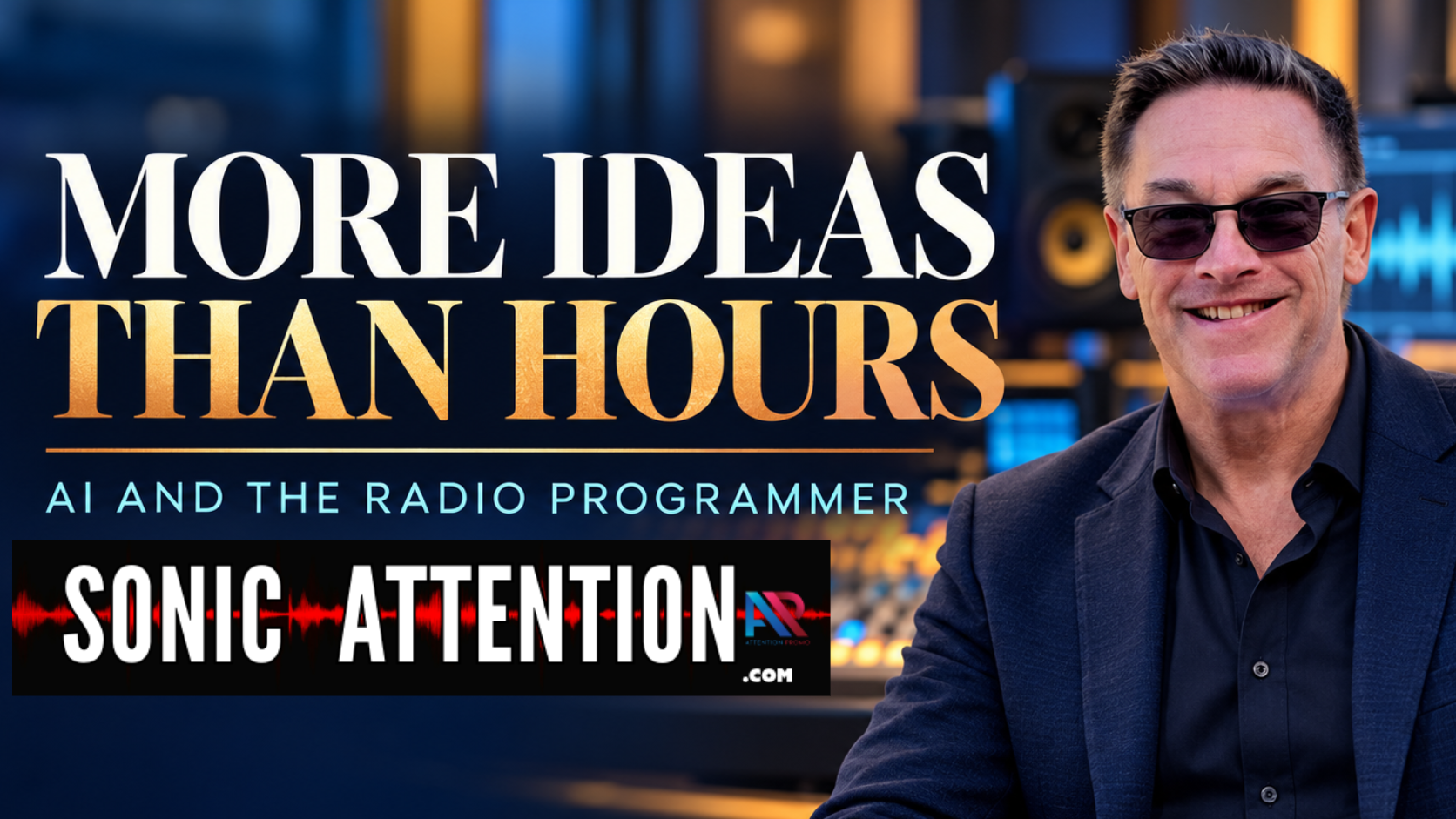
One person. Five radio stations. More ideas than hours in the day. And a technology that’s giving experienced broadcasters exciting new possibilities.
By Joseph Browning | SonicAttention | October 22, 2026
What Would You Do With an Extra 20 Hours a Week?
Let me ask my fellow radio programmers a question. If somebody walked into your office tomorrow morning and handed you an additional twenty hours every week, what would you do with them? Would you spend more time listening to your radio station? Take a fresh look at your music rotations? Develop a promotion that actually excites listeners? Work with an air personality on improving their show? Maybe you'd finally get around to that imaging project you've been thinking about for six months. Or perhaps you'd simply go home at a reasonable hour once in a while.
Now, I'm not suggesting artificial intelligence is guaranteed to give every programmer twenty additional hours. That's a hypothetical number, not a measured industry average. But after spending considerable time incorporating AI into my daily workflow, I can tell you that the possibility of recovering meaningful amounts of time is very real. And I think we're asking the wrong questions about what that means for radio.
Everywhere I look, there's another discussion about artificial intelligence replacing announcers, eliminating production positions or automating programming decisions. We hear about everything AI might take away from broadcasting, but relatively little about what it might give back to the people who love this business. Frankly, I'm tired of the gloom and doom. I'm much more interested in what AI can help us accomplish. Because the greatest value of artificial intelligence in radio might have very little to do with replacing people. It might be giving the people who are already here enough time to do their jobs extraordinarily well.
Five Stations, Five Audiences
I currently oversee programming, operations and production responsibilities for five radio stations serving Southwest Georgia. Five stations. Five formats. Five different audiences. Five distinct sets of programming and promotional needs. My responsibilities include commercial production, spec spots, music scheduling and database maintenance, station imaging, programming, website content, digital promotions, community events and an assortment of operational duties that seem to multiply every week.
If you've worked in radio for any length of time, you know the business has changed. Consolidation, advances in technology, changing advertising markets and new audience habits have transformed the way stations operate. Responsibilities that once belonged to several departments are now frequently handled by smaller teams or individuals managing multiple properties. I don't view that as an invitation to criticize the industry or the people making difficult business decisions. Broadcasting is operating in a very different economic environment from the one many of us entered decades ago. The important question is how we adapt successfully.
I'm not particularly interested in spending my time wishing radio operated exactly as it did twenty or thirty years ago. I want to make the most of the opportunities available to us today while helping build a stronger future. And that's where my enthusiasm for AI begins. I see it as a way to help experienced broadcasters become more effective, more productive and, perhaps most importantly, more creative.
The Cost of Constant Interruptions
A good radio programmer's responsibilities have never been limited to selecting songs and making sure the commercials run. We're responsible for the overall listener experience, and that requires understanding our audience, maintaining the station's personality and continually evaluating how the product sounds. Programming involves music scheduling, imaging, contesting, marketing, audience research, talent development, special events and sales support. Add personnel scheduling, employee coaching, digital content, website maintenance and general administration, and you begin to appreciate how many different kinds of thinking are required throughout a typical workday. That's where the hidden challenge begins.
You sit down to work on music scheduling. A salesperson needs a commercial revised immediately. You open your production software, but somebody calls about an upcoming remote broadcast. A website promotion needs updating, and now there's a question about an employee's schedule. By the time you return to the music database, you've practically forgotten what you were trying to accomplish. Sound familiar?
Microsoft's 2025 Work Trend Index found that the busiest 20 percent of Microsoft 365 users by incoming ping volume received a meeting invitation, email or chat approximately every two minutes during core working hours.[1] That doesn't mean radio programmers experience exactly the same interruption rate, but it illustrates a problem most of us recognize. Modern work isn't just consuming our time. It's fragmenting our attention.
Programming a radio station requires concentration. Building an effective music rotation, developing a promotional strategy, evaluating an air personality or creating a compelling advertising campaign cannot always be accomplished in fifteen-minute increments between emergencies. Some of our best work requires the opportunity to think, and thinking has become one of the hardest things to find time for.
A Creative Collaborator in the Production Room
I've spent decades in radio programming, production and management, working in different markets, formats and ownership environments. Experience helps you recognize what needs to be done, but it doesn't necessarily create enough hours to do everything you'd like to accomplish. What has changed for me is the way I approach the workload. I'm using ChatGPT and AI-assisted workflows as a combination of creative collaborator, researcher, production assistant and organizational resource. Let's start with commercial production.
A salesperson comes to me with a new client, a collection of sales notes and an expectation that we're going to create something interesting. Traditionally, developing concepts, writing scripts, revising copy and preparing production materials could consume a substantial portion of the day. Now I can explore several creative directions almost immediately. I can challenge AI to approach a campaign from different perspectives, refine the strongest ideas, anticipate timing problems and prepare scripts for specific voice performances. From there, I can develop synthetic voice performances, generate original music concepts and assemble a finished commercial in my production software.
I'm not surrendering creative control. I'm directing the process, making the decisions and determining whether the finished product meets my standards. I still decide whether the concept is strong, the performance is believable, the timing is correct and the commercial is something I'm willing to put on the air. In fact, I often find myself exploring more creative possibilities because I can experiment with approaches that previously would have required considerably more preparation. That's an important distinction. AI isn't necessarily reducing the creativity involved in producing a commercial. It can give me an opportunity to increase it.
And commercial production is only one application. I use AI to help prepare promotional copy, develop social media campaigns, organize information for remote broadcasts, research community news, maintain website content and create coordinated promotional materials for multiple stations. Instead of repeatedly developing the same basic information, I can establish the essential facts and adapt the presentation to each station's format and audience. A country station, classic rock station, Hot AC station, Urban AC station and news/talk operation shouldn't all communicate in exactly the same voice. AI helps me maintain those distinctions while reducing repetitive preparation. It doesn't remove my responsibility to understand the stations. It makes that knowledge more valuable.
What the Research Actually Shows
This isn't entirely anecdotal. In a study published in Science, researchers Shakked Noy and Whitney Zhang examined how ChatGPT affected professional writing assignments. Participants using AI spent approximately 40 percent less time completing the tasks, while independent evaluations found an 18 percent improvement in output quality.[2] Those results don't mean every radio production assignment takes 40 percent less time. The researchers studied specific professional writing tasks, not radio programming.
But consider how much writing takes place in a typical broadcast operation. Commercial scripts, promotional announcements, client presentations, website content, social media posts, event summaries, employee communications and programming proposals are all part of our work. Writing is woven throughout the broadcast workday. Another study by Erik Brynjolfsson, Danielle Li and Lindsey Raymond examined generative AI assistance in a large customer support operation. Researchers found an average productivity improvement of about 15 percent in the published study, with particularly meaningful benefits among less-experienced employees.[3]
Research involving Boston Consulting Group consultants also found that AI-assisted participants completed certain tasks faster and produced higher-quality results when those tasks were well suited to the technology.[4] Importantly, that study also demonstrated that AI assistance could produce worse outcomes when applied to tasks beyond its effective capabilities. Anybody who's spent substantial time experimenting with AI understands that distinction. Sometimes the technology produces something brilliant, and sometimes it produces something astonishingly wrong. That's why experience, verification and professional judgment remain essential.
The research doesn't establish a universal productivity figure for broadcasting. What it demonstrates is that meaningful improvements are possible when knowledgeable people apply AI to appropriate tasks. The opportunity is real. The challenge is learning how to use it effectively.
More Time for Music Programming
Here's an area I believe deserves much more attention. Music scheduling involves both science and art. There are rotations to evaluate, category balances to maintain, artist separation rules to enforce, daypart considerations, library maintenance, tempo relationships and countless programming decisions that affect how a station sounds throughout the day. Good scheduling software already performs important functions, but imagine combining that software with an AI analytical assistant capable of examining exported scheduling data.
It could help identify recurring artist conflicts, questionable category balances, excessive repetition, weak rotation patterns or periods where the musical flow deserves closer examination. A programmer could ask why certain titles consistently appear in particular dayparts or whether existing rotations are producing the intended exposure. AI could flag potential problems and organize the findings into a useful report. These applications would require reliable data exports, appropriate software access and a carefully designed workflow, but the opportunity is intriguing.
And I wouldn't want AI making every programming decision anyway. A computer might identify that two songs share similar characteristics. An experienced programmer knows whether those songs actually work together for the audience. It takes experience to understand why a record that looks perfect on a spreadsheet doesn't necessarily belong between two particular titles. That's programming.
I want AI handling more of the analytical preparation so I can spend more time making those decisions. Let the technology help identify potential problems. Let the programmer decide how the station should sound.
Better Promotions, Better Marketing
Think about the promotional side of radio. How much time do we spend assembling contest rules, preparing promotional copy, creating website announcements, coordinating social media posts, gathering event details and maintaining expiration dates? These are important responsibilities, but they also contain substantial amounts of repetitive work.
Consider a concert promotion involving multiple stations. There may be on-air promotional copy, website articles, social media graphics, text-to-win instructions, winner announcements, contest deadlines and follow-up promotions. Each component needs to be accurate, consistent and delivered on time. An AI-assisted workflow can help organize the campaign, develop station-specific materials, prepare checklists and flag approaching deadlines. Human review remains essential, particularly when dealing with contest rules, eligibility requirements, prize descriptions and legal obligations.
But consider what that improved efficiency makes possible. Instead of devoting the afternoon to reconstructing a promotional checklist, the programmer can focus on making the promotion more entertaining. Instead of concentrating entirely on whether the website has been updated, there's an opportunity to develop another creative angle that gives listeners a reason to participate. Better time management can lead directly to better marketing. And better marketing creates additional value for the station, its advertisers, sponsors and community partners.
Making Room for Coaching
Here's another responsibility that deserves attention: people. A good operations manager is also a coach. We evaluate air personalities, provide feedback, coordinate schedules, address performance concerns and help employees develop their skills. An effective aircheck session isn't simply telling an announcer to talk less or tighten the breaks. It requires preparation, thoughtful listening, constructive criticism and an understanding of what improvement should actually sound like.
AI can help organize aircheck notes, prepare coaching frameworks, summarize agreed-upon objectives and create development plans. It can help structure meeting agendas, organize follow-up assignments and identify scheduling conflicts. That doesn't mean AI should be making personnel decisions. Confidential employee information, sensitive personnel records and employment matters require appropriate privacy protections, approved systems and direct human oversight.
The opportunity is to make management more organized and coaching more effective. Imagine having enough time to conduct meaningful aircheck sessions regularly instead of squeezing them in whenever the production room happens to be quiet. That's the kind of improvement I would welcome.
Starting the Day With a Clear Plan
One of the most promising possibilities isn't particularly glamorous. It's simply beginning the day knowing exactly what requires my attention. Imagine arriving at the station and receiving an organized briefing covering all five stations.
Which promotions expire today? What commercial production orders are approaching deadline? Which community events require updated copy? Are there upcoming sports broadcasts that affect programming? Have any music scheduling issues been flagged? Are there outstanding client revisions? Which projects absolutely must be completed today, and what can reasonably wait?
Much of that information already exists somewhere. The problem is gathering it, organizing it and turning it into a practical plan. With properly connected and authorized systems, AI could assemble those priorities into a single manageable briefing. Not every broadcast software platform currently provides the necessary integration, and any system accessing confidential operational information would require appropriate safeguards. But the potential is obvious.
Just imagine beginning your morning by addressing the most important responsibilities instead of spending the first part of the day trying to figure out what you've forgotten. And imagine what happens when the assistant can also help prepare the materials needed to complete those assignments. Now we're moving beyond a chatbot that answers questions. We're talking about a genuinely useful operational assistant.
Adapting to the Radio Business We Have
Radio has changed enormously over the course of my career. Consolidation, new technologies, shifting advertising markets and changing audience habits have transformed how stations operate. Responsibilities that once belonged to several departments are now frequently shared among smaller groups of professionals. That's not unique to my situation. It's a reality throughout much of the industry.
I don't believe there's much value in spending our time wishing the business still operated exactly as it did twenty or thirty years ago. We have to work with the industry we have today while continuing to build the industry we want tomorrow. That's precisely why I'm excited about artificial intelligence.
AI gives experienced broadcasters an opportunity to manage expanding responsibilities more effectively without sacrificing the creativity, attention to detail and local connection that distinguish great radio. It doesn't eliminate the value of additional talented people. Far from it. It gives the people currently doing the work a remarkable collection of tools to help them succeed. For me, that's an encouraging development.
I'm interested in what we can accomplish with the experience, creativity and technology available to us right now. And for the first time in years, I see technology offering a meaningful opportunity to improve both our productivity and the quality of our work.
The Survival Dividend and the Creative Dividend
Here's where I think the conversation becomes especially interesting. Every hour recovered through AI creates two possible benefits. I call the first the survival dividend. That's the time AI helps us recover so we can manage the enormous number of responsibilities already on our desks.
It's being able to finish the commercial revisions, prepare tomorrow's promotions, update the website and organize an upcoming event without feeling that something important is always being neglected. For someone managing multiple stations, that's no small accomplishment.
But there's a second benefit, and I believe it may ultimately be more valuable. The creative dividend. That's the time we can reinvest in improving the product. Developing memorable station imaging, experimenting with a new music feature, creating an original promotion, coaching an air personality or developing a spec commercial that generates genuine excitement inside the sales department. It's having time to think about the listener experience and actually listen to the station long enough to recognize what needs improvement.
These are the activities that distinguish great radio from radio that merely functions. A station can technically operate twenty-four hours a day without sounding particularly interesting. Automation has made that possible for decades. What keeps a station relevant is the imagination and judgment behind what comes out of the speakers. And those qualities require time.
I don't want every hour AI saves me to be immediately replaced with another administrative assignment. I want some of those hours reinvested in making our stations better. That isn't avoiding work. It's making better use of the experience we've accumulated throughout our careers.
People Are Still Listening
Here's another reason I refuse to accept the constant predictions of radio's demise. People are still listening. Nielsen's analysis of U.S. audio consumption during the first quarter of 2026 continued to identify AM/FM radio as the dominant source of ad-supported audio listening.[6]
Radio certainly faces serious competition. Podcasts, streaming services, social media and on-demand entertainment have permanently changed the marketplace. But the idea that traditional radio has become irrelevant simply isn't supported by the available audience data. We still have meaningful reach, powerful local advertising relationships and opportunities to create programming that connects with listeners in ways national platforms often cannot.
I believe technology can help us make better use of those advantages. We now have tools that can help programmers handle routine responsibilities more efficiently, develop stronger creative material and devote more attention to the listener experience. What an extraordinary opportunity. We should be exploring how these technologies can make local radio more compelling, more responsive and more valuable to the communities we serve.
Experience Still Decides What Good Sounds Like
There's an irony here. Some broadcasters hear the words artificial intelligence and immediately imagine radio stations filled with synthetic voices, generic music and mechanically generated content. That's one possible application of the technology, but it's certainly not the only one. I use AI-generated voices and music in commercial production when they're appropriate for the project. I also recognize how important it is to direct those tools carefully.
A poorly conceived commercial doesn't suddenly become effective because the announcer is synthetic. A generic jingle isn't memorable simply because a computer generated it. And a bad programming decision remains a bad programming decision regardless of how sophisticated the software may be. The person responsible for the finished product still has to know what good sounds like. That's where experience becomes so valuable.
AI can generate twenty ideas in the time it might previously have taken to develop two, but somebody still has to recognize which one is worth producing. It can assist with numerous vocal approaches, but somebody still has to identify the delivery that sounds convincing. It can help create music beds and branding concepts, but somebody still has to decide whether they reinforce the station's identity.
I'm not interested in making radio sound more artificial. I'm interested in using artificial intelligence to make radio sound more creative, polished, timely and relevant. That's a very different objective.
AI Literacy Is a Practical Radio Skill
We talk a great deal about technical proficiency in radio. We expect programmers to understand music scheduling software, automation systems, audio production, audience research and increasingly complicated digital platforms. I believe AI literacy now belongs on that list. Not because everybody needs to become a software developer, but because knowing how to direct artificial intelligence effectively is becoming a practical management skill.
You have to learn how to explain what you want, establish creative parameters, challenge weak results and recognize when the technology is making something up. You have to understand which information can be trusted, what must be verified and what should never be placed into an unapproved system. You also need to recognize when a task is better handled by a human being.
The National Institute of Standards and Technology's AI Risk Management Framework emphasizes oversight, reliability and risk management in the responsible use of artificial intelligence.[7] Those principles belong in broadcasting, too. When we're dealing with local news, contests, advertising claims, personnel matters or emergency information, speed can never replace accuracy. AI should help us accomplish the work. It shouldn't eliminate professional responsibility.
But learning to use these tools thoughtfully is becoming one of the smartest investments an experienced broadcaster can make. And frankly, I think it's fun. After decades in this business, I'm discovering new creative possibilities almost every week. That's not something I expected to say about another technological change.
Have I Only Scratched the Surface?
I suspect I have. Despite the number of AI applications I've already incorporated into my workflow, I believe there are many more possibilities worth exploring.
Imagine a system that examines music scheduling reports and alerts a programmer to unusual patterns. Another that prepares a daily promotional briefing across an entire station group. Another that helps organize commercial production orders, identify missing information and anticipate deadlines. Another that reviews upcoming community events and prepares promotional opportunities appropriate for each format. And another that helps coordinate station branding across websites, social platforms, on-air promotions and advertising campaigns.
These systems would require reliable data, authorized access, careful testing and human supervision, but the building blocks suggest how much farther the technology can take us. And once repetitive responsibilities become more manageable, something interesting happens. The programmer begins to have choices again.
Do I spend the next hour fixing an administrative problem, or developing something that might make my station more successful? For a long time, that wasn't much of a choice. The administrative problem usually won. AI may finally help change that.
What Should We Do With the Time We Recover?
Suppose an experienced programmer becomes substantially more efficient by incorporating AI into daily operations. What should we do with that improved efficiency? We could fill every recovered hour with another assignment, but I believe there's a more interesting possibility. What if we used some of that time to improve the product?
What if the programmer could develop stronger station imaging, better promotions, more effective advertising campaigns and more thoughtful music programming? What if there were additional opportunities for meaningful talent development? What if we measured success through listener engagement, client satisfaction, campaign performance and the quality of the station's on-air presentation? Wouldn't that be a worthwhile investment of the time we're recovering?
We should also recognize that greater efficiency can make demanding jobs more sustainable. There's nothing wrong with using technology to reduce unnecessary stress, organize priorities and make a busy workday more manageable. Productivity doesn't have to be measured exclusively by the number of additional assignments completed. Sometimes it should be measured by the quality of the work and the satisfaction of doing it well.
I Still Love Radio
I got into this business because I love radio. I love the excitement of a well-executed promotion, the sound of carefully produced imaging and the satisfaction of finding the right music, voice and creative approach. I love developing commercial campaigns that make local advertisers sound like major national brands, even when their budgets are modest. And I love the relationships local radio can build with the communities it serves. Those are the things that made this career worth pursuing.
I don't believe artificial intelligence threatens that enthusiasm. I believe it can help restore more time for the work that inspired it. When AI takes some of the repetitive preparation off my desk, I have more room to concentrate on the parts of the business that require experience and imagination. Even when the workload remains demanding, having a capable assistant available to help organize the next project makes an enormous difference.
I don't have to know every answer before I begin. I can explore an idea, challenge it, improve it and move forward. That's a powerful resource for somebody responsible for five different radio stations. And I suspect it's an even more valuable resource for somebody who still genuinely enjoys the creative process.
I'm not using AI because I've lost my enthusiasm for radio. I'm using it because, after all these years, I still have more ideas than I have hours in the day.
That really is what this is all about.
What Will We Do With These Possibilities?
That's the question I want fellow radio programmers to consider. Not whether AI will eventually change our business. It already is. Not whether every new technology deserves unquestioning enthusiasm. It doesn't. The real question is what we intend to accomplish with the capabilities now becoming available to us.
Will we simply use AI to keep up with the next round of assignments, or will we deliberately reclaim some time to make our radio stations more creative, compelling and connected to the audiences we serve? I know which possibility interests me. I've spent enough years in this business to recognize the difference between a station that's merely operating and a station that's genuinely being programmed.
One fills the hours. The other gives people a reason to listen. I want to spend more time doing the second. And if artificial intelligence can help me accomplish that while managing the demands of a five-station operation, I'm all for it.
I don't believe the future of radio has to be a story about diminished expectations. It can be a story about experienced professionals discovering new tools, new possibilities and new ways to bring their creativity to the airwaves. We've spent years talking about everything radio has lost. Maybe it's time to start talking about what we can gain.
The greatest promise of AI isn't that one person can do the work of five. It's that one person might finally have the time, tools and creative freedom to do their own job extraordinarily well. And after all these years in radio, I find that possibility genuinely exciting.
Research Notes and Sources
- Microsoft — 2025 Work Trend Index Annual Report (April 23, 2025). The interruption measure is based on the top 20% of Microsoft 365 users by incoming ping volume; it is not a direct measurement of broadcast programmers.
- Shakked Noy and Whitney Zhang — “Experimental Evidence on the Productivity Effects of Generative Artificial Intelligence,” Science (July 13, 2023). The randomized experiment involved 453 college-educated professionals completing assigned writing tasks. Average completion time fell by 40%; evaluated quality rose by 18%.
- Erik Brynjolfsson, Danielle Li and Lindsey Raymond — “Generative AI at Work”. The study examined more than 5,000 customer-support agents. The published Quarterly Journal of Economics article (2025) reports an average 15% gain in issues resolved per hour, with greater benefits for less-experienced workers. Published journal article.
- Fabrizio Dell’Acqua and colleagues — “Navigating the Jagged Technological Frontier,” Harvard Business School. The experiment with Boston Consulting Group consultants found benefits on tasks within AI’s capabilities and worse accuracy on a task outside that frontier. Published research, Organization Science (March 11, 2026).
- U.S. Bureau of Labor Statistics — “Broadcasting BLS Statistics on Radio Day” (August 20, 2025). Additional industry background: U.S. radio broadcasting stations employed about 52,680 workers in May 2024. This background reference is not used to estimate AI savings or staffing needs.
- Nielsen — “The Record: Q1 U.S. Audio Listening Trends” (June 2026). The quarterly analysis describes AM/FM radio’s leading share of U.S. ad-supported audio listening. AM/FM includes over-the-air listening and digital streams.
- National Institute of Standards and Technology — AI Risk Management Framework and Generative AI Profile. AI RMF 1.0 was released January 26, 2023; the Generative AI Profile was released July 26, 2024. Both address trustworthy and responsible use of AI. Generative AI Profile (NIST AI 600-1).