
By All Means, Keep Hating AI.
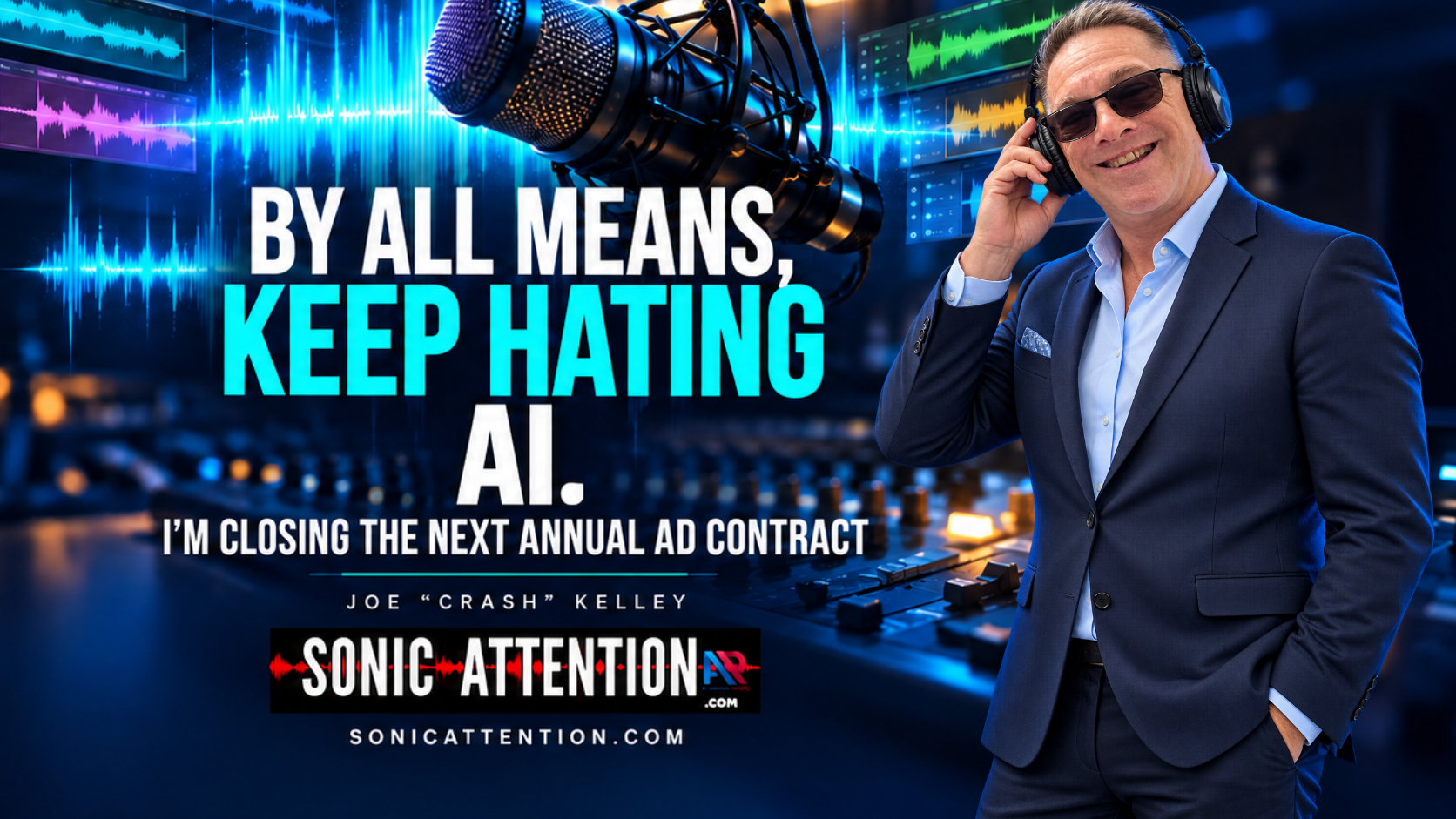
Radio producers should judge the work before dismissing the tools.
By Joe “Crash” Kelley
I still hear station clusters in some pretty substantial markets where the same two or three people seem to read nearly every local commercial. Different businesses, familiar voices, another weak music bed that sounds like it was selected because it happened to be available.
I listen as a producer. I hear the commercial that made it to air, but I also start imagining the commercial it could have been. A different vocal personality. Music that belongs to the idea. A little tension before the payoff. Some reason for that business to sound different from the one in the preceding spot.
That is what excites me about the production tools available now. I can pursue more of what I hear in my head. I can develop voices and direct performances around a concept, create music for a particular client, and keep exploring until the pieces start to sound like they belong together. I can aim for the polish and personality of a national campaign without limiting the idea to whoever is available to read it that afternoon.
But by all means, if you’re a competitor, fight the good fight. Jump aboard the anti-AI bandwagon. Carry the banner that mediocre is better because it’s real.
Yes. Sometimes it’s real bad.
I am being deliberately provocative, but there is a serious question underneath it: why would a producer dismiss a much larger range of creative possibilities before hearing what an experienced person can do with them?
I know the department behind the commercial
I work as an operations manager and production lead in a five-station radio cluster. Programming, production, and on-air responsibilities compete for my attention. I understand what happens when the available hours and the work that needs to be done stop matching up.
When a small staff voices most of the commercials, that is often a staffing reality. It says nothing about whether those people have talent. The same producer who turns in a straightforward read over a serviceable bed might have a far more ambitious idea and no practical way to execute it before the deadline.
I want that producer to have more choices. I want the person who can write a funny exchange to have access to characters who can carry it. I want the person imagining an emotional commercial to have more musical options than the handful of tracks that almost fit.
Our limitations are familiar. Familiarity does not make them a creative philosophy. An advertiser has paid for an opportunity to be heard, and I want to do something worthwhile with it.
That starts with the business. What should people feel about this advertiser? What is the promise? Does the commercial need warmth, authority, mischief, or some combination that changes as the story unfolds? Those decisions should shape the production. They should come before I ask which voice or music bed happens to be easiest to use.
The sound has to belong to the idea
An insurance commercial asking a family to think about protection needs a different emotional approach from a vacation promotion inviting them to get on the road. Calling both reads “friendly” tells me very little. Friendly can be reassuring, playful, intimate, or full of anticipation. I need to direct the difference.
The same goes for music. A bed can be pleasant and still be wrong. It might rush a thoughtful message, flatten a joke, or put an emotional commercial into generic corporate territory. I want to shape the musical direction around the spot, including where it needs to leave space for the voice and where it should help the ending land.
I have been working through those choices with jingles, too. A grocery-store name sung by a choir creates a different impression from the same name delivered by a tender solo voice. Moving toward a polished pop vocal or a piano-driven dance arrangement changes the personality again. Then comes the deceptively difficult part: making sure the listener can actually understand the business name.
An impressive arrangement that swallows the name is a production problem I still have to solve. So is a gorgeous vocal that puts the stress on the wrong syllable. The tools give me options; my ear has to decide whether those options serve the advertiser.
There is a business reason to care about those details. Radiocentre and System1’s Listen Up! research examined 131 radio ads using effectiveness and emotional-response data from more than 50,000 listeners and non-listeners. Character, an unfolding story, a sense of place, and dramatic intimacy were associated with stronger emotional and memory responses. More positively received campaigns also generated more reported consumer action.[1]
That research did not compare AI with human production. It supports the reason I want a broader creative palette in the first place. The listener’s experience of the commercial matters. I want tools that help me make that experience more engaging and more recognizably the client’s own.
Come sit through the revisions
Anyone who thinks this workflow consists of typing “make a great commercial” and downloading the result should come sit through the revisions.
I can ask for warmth and get something that sounds theatrical. I can ask for conversational and get a read that has no momentum. A voice can sound wonderful in isolation and be completely wrong for the copy. A model can misunderstand a local name that any listener in the market would recognize immediately.
Timing is another reality check. A script needs to fit thirty seconds, and telling a voice generator “thirty seconds” does not make it so. I still have to listen, measure, adjust the copy or performance, and leave room for the production. When a read is several seconds short, an attractive voice has not magically finished the assignment.
Music brings its own revisions. I have had instrumental versions with traces of a vocal still hanging around. Asking for a correction can change the feel of the track. Now I have another decision to make about whether to regenerate, edit, separate elements, or take a different direction.
Working through those problems makes the producer’s role obvious. I am listening critically, choosing, and solving problems throughout. I write copy and lyrics, develop melodic directions and vocal personalities, and make production decisions that carry through to the finished work.
When the first result misses, I have to explain what is missing. “Better” is rarely a useful direction. More weight in the voice, less announcer rhythm, a clearer opening word, a melody that leaves the business name room to breathe: those are choices I can work with.
The opportunity is to attempt ideas that would otherwise stay in my head. Some attempts fail. Some need more work than I expected. Some open up a direction I want to pursue. That is a creative process I recognize.
What happens when people hear the work
I keep coming back to the listener because an argument among producers can become strangely detached from the person hearing the commercial while driving, working, or making dinner.
A study published online in September 2024 and appearing in Quality & Quantity’s 2025 volume examined audio advertising with 1,292 multitasking participants. The researchers reported similar effects for AI and human voices in that context. More than half of listeners did not recognize that they were hearing AI voices.[2] It is evidence against the assumption that listeners automatically identify and reject synthetic speech during ordinary distracted listening.
System1’s Andrew Tindall reported a different test in November 2025: 18 AI-generated long-form ads shown to 2,700 viewers averaged 3.4 Stars for emotional response against the company’s global average of 2.3. Before AI was explicitly raised, most viewers described the work as typical professional advertising. Once asked directly, 62 percent said AI had been used.[3]
That small sample cannot establish that AI caused the higher scores. The emotional measurements also came before the explicit AI question, so the study does not prove disclosure leaves reactions unchanged. What interests me is that the work connected with people before the production debate became the subject. I think our industry should take that response seriously.
Newer research offers another reason to judge execution carefully. An October 13, 2026 Columbia Business School working-paper summary describes display-ad research covering more than 16 billion impressions. AI images outperformed human-created images on click-through rates when they did not visibly look AI-generated.[4]
In August 2026, INFORMS reported Marketing Science research in which an AI system guided by performance learning and brand standards produced Instagram creative with a mean click-through rate of 0.98 percent, compared with 0.65 percent for a professional designer’s portfolio.[5] Both examples concern visual advertising, and clicks are not sales. They nevertheless make it difficult to defend a blanket claim that AI-assisted creative must perform worse.
For me, the useful lesson is to put more effort into selecting and refining the work. The second study’s system was deliberately built around performance and brand standards. That is a much more interesting conversation than whether a generator was involved at all.
Disclosure deserves an honest conversation
I would like to say that great work makes the AI question disappear for everybody. The research does not let me make that promise.
IAB and Sonata Insights reported in January 2026 that 73 percent of surveyed Gen Z and Millennial consumers said knowing an ad was AI-created would increase or make no difference to their purchase likelihood.[6] That is self-reported intention, not measured sales, but it shows disclosure is not automatically a deal breaker for those respondents.
Other evidence is less favorable. A 2026 Journal of Business Research paper reports eight studies in which AI-use disclosure reduced engagement by making the advertiser’s effort and the product’s quality seem lower.[7] Audience, context, and expectations matter. I cannot turn mixed findings into a universal claim simply because it would make my argument more convenient.
I can make a narrower argument with confidence: the label alone is an inadequate review of the commercial. It tells you a tool was involved. It does not tell you whether the producer had an original concept, directed the performance effectively, or made something worth remembering.
I also understand why people care about jobs, permission, and honest representation. Those concerns deserve specific answers. A fictional voice should not be presented as an actual customer giving a testimonial. Clients should understand the work they are buying. None of that requires us to dismiss every creative application before listening.
Give the producer more room
My enthusiasm for this workflow comes from doing the work. I know how much judgment remains necessary, and I know how much more I can attempt when the available voices and music stop setting such a narrow boundary around the idea.
That is also why I do not see these tools as an excuse to keep reducing the staff. One person carrying responsibility across multiple stations still needs time to think, listen, revise, and understand the client. Increasing the number of commercials that can be generated does not automatically increase the number that are worth airing.
Give capable producers the tools and enough room to use them well. Let their experience guide the performances. Let them reject something technically impressive because it fails the message. Let them build a sound the advertiser can keep using and listeners can learn to recognize.
At SonicAttention, I want the demos to make that case. Listen to the copy, the voices, the lyrics, the melodic ideas, and the way the production fits together. Decide whether the commercial gives the business a personality and whether the message survives all that sound.
Tell me the performance is unconvincing. Tell me the melody is forgettable, the brand gets lost, or the offer is unclear. Those are useful criticisms, and I should have to answer them. A badly made AI commercial deserves the same scrutiny as any other badly made commercial.
But if your entire critique is “you used AI,” you have stopped before the part of the conversation that helps either the producer or the advertiser.
I want to make better commercials. These tools give me more ways to try, and I intend to use them.
If you would rather carry the anti-AI banner, carry on. I’m working on the next spot.
Hear the work for yourself. Explore my latest production demos at SonicAttention.com. For custom commercials, jingles, or a free spec, email joecrashkelley@sonicattention.com.
Sources and research
- Radiocentre and System1, Listen Up! Emotion’s Defining Role in Audio Advertising Effectiveness (2023). Analysis of 131 ads and data from more than 50,000 people; industry research, not an AI comparison. https://www.radiocentre.org/our-research/listen-up/
- Shih-Hao Lu, Huyen Thi Thanh Tran, and Thanh-Sang Ngo, “Are we ready for artificial intelligence voice advertising? Comparing human and artificial intelligence voices in audio advertising in a multitasking context,” Quality & Quantity 59 (2025), 1–22; online September 9, 2024. N = 1,292. https://doi.org/10.1007/s11135-024-01967-x
- Andrew Tindall of System1, “Consumers don’t know AI made the ad... and when we tell them, they don’t really care,” The Drum, November 13, 2025. Author-reported industry study: 18 ads, 2,700 viewers; not a randomized disclosure experiment or a sales study. https://www.thedrum.com/opinion/consumers-don-t-know-ai-made-this-ad-and-when-we-tell-them-they-don-t-care
- Yannick Exner, Jochen Hartmann, Oded Netzer, and Shunyuan Zhang, “AI in disguise—How AI-generated ads’ visual cues shape consumer perception and performance,” Columbia Business School working-paper summary, October 13, 2026. Quasi-experimental visual-ad research; click-through is not sales. https://business.columbia.edu/faculty/research/ai-disguise-how-ai-generated-ads-visual-cues-shape-consumer-perception-and
- INFORMS, August 4, 2026, research release on Remi Daviet and Yohei Nishimura, “Leveraging Generative AI to Create Visual Content in Digital Advertising,” Marketing Science. Brand-vetted, active-learning system; campaign-specific results. https://www.informs.org/News-Room/INFORMS-Releases/News-Releases/AI-Generated-Ads-Outperform-Human-Designers-in-Live-Campaign-Advantage-Holds-18-Months-Later
- IAB and Sonata Insights, The AI Ad Gap Widens, January 15, 2026. Survey of 505 US Gen Z and Millennial consumers and 104 advertising executives, conducted October 2025–January 2026. The 73 percent combines increased and unchanged self-reported purchase likelihood. https://www.iab.com/insights/the-ai-gap-widens/
- “Is that your best effort? How AI-use disclosure in digital advertising affects perceived effort and engagement,” Journal of Business Research 215 (2026), article S0148296326003899. Publisher abstract reports eight studies across online, laboratory, and field environments; disclosure can reduce engagement. https://www.sciencedirect.com/science/article/pii/S0148296326003899