
We Care About Radio. So Now What?
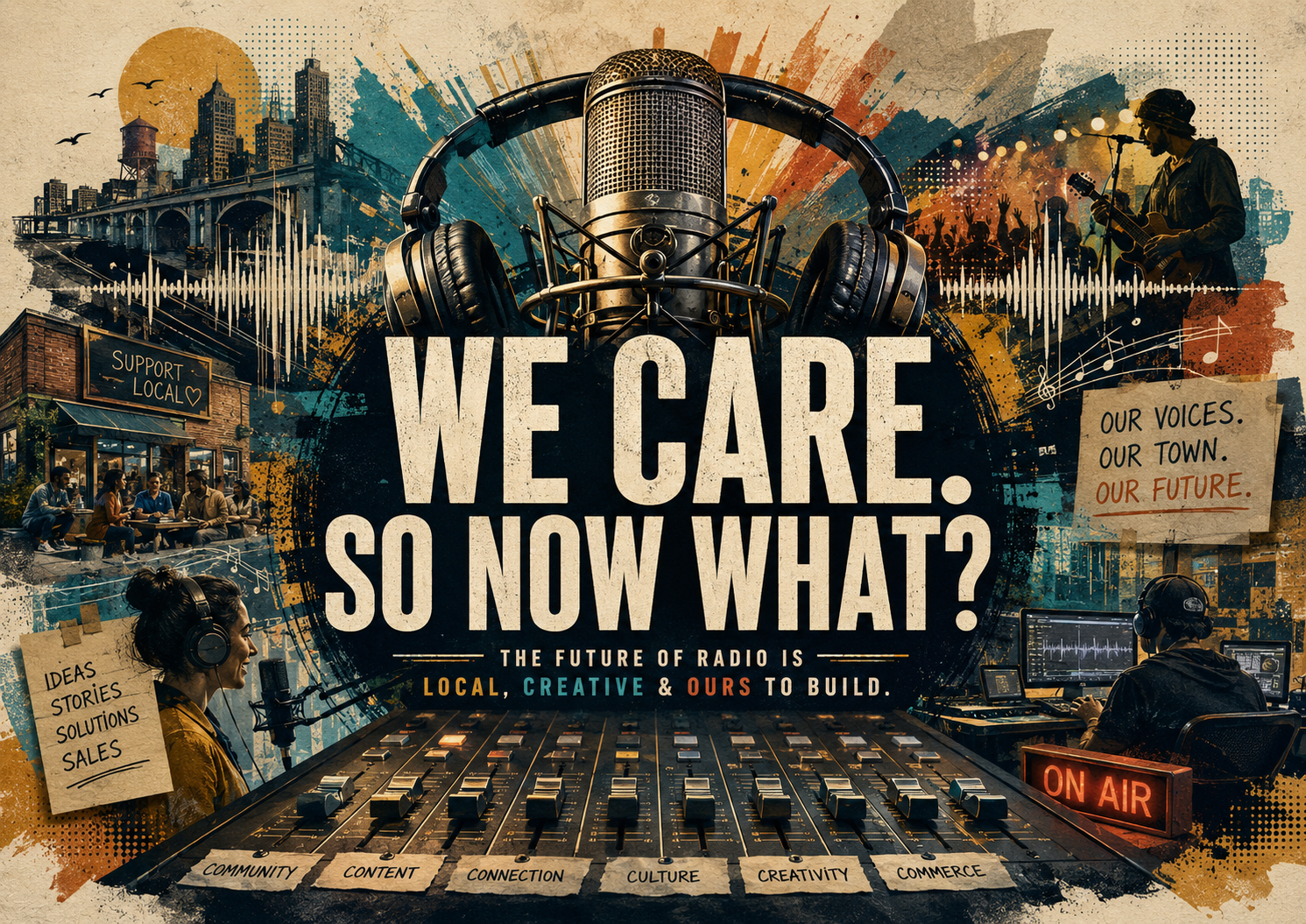
Caring is where radio starts. It is not where radio wins.
My last article was called “Radio Needs People Who Still Care. Do You?” A lot of people responded to that. Thousands of interactions. A lot of comments. A lot of people in this industry saying, in one way or another, “I still care.” And I believe them. I really do.
There are still a lot of people in radio who care deeply about this business, about their stations, about their listeners, about their clients, and about what radio has meant in their lives.
But here is the uncomfortable next question: now what?
Because caring about radio is important, but caring alone will not bring radio back. Caring alone will not rebuild revenue. Caring alone will not make a local business renew. Caring alone will not make a listener choose your station over Spotify, SiriusXM, YouTube, TikTok, podcasts, or whatever comes next.
If we believe radio is not dead, then we have to do more than defend it emotionally. We have to prove it financially, creatively, locally, and consistently. And the answer is not hiding from us. It has been sitting in front of us the whole time.
Creativity.
Not creativity as a cute word in a company mission statement. Real creativity. Creativity as a business strategy.
Creativity in local content. Creativity in sales. Creativity in commercial production. Creativity in promotions. Creativity in sonic branding. Creativity in how we make a local advertiser sound memorable instead of disposable.
That is what built radio in the first place.Fred Jacobs’ research keeps pointing the industry back to this reality. According to Radio World’s coverage of Jacobs Media’s Techsurvey 2026, the survey included almost 31,000 core radio listeners across about 500 stations, and 60% of respondents said DJs, hosts, or shows were a reason they listen to radio, compared with 53% who cited music or favorite artists.
Fred Jacobs also wrote after Techsurvey 2025 that, for the 7th consecutive year, core radio fans were more likely to cite personalities over music as a driver of radio listening, and that crossover first happened in 2019.
That should hit every radio operator right between the eyes. The music is not enough. The tower is not enough. The playlist is not enough. The liner card is not enough. The app is not enough. The “we’re local” positioning statement is not enough.
The value is in the human connection. The value is in the creative connection. The value is in the station sounding like it actually lives in the market it serves.
So why are we still acting like local talent is optional? Why are we asking personalities to be relevant while accepting airshows filled with generic national show prep instead of insisting on local content? Why are we replacing local observation with recycled celebrity birthdays? Why are we pretending that an air talent who knows the roads, the weather, the restaurants, the schools, the Friday night games, the fundraisers, the weird local stories, and the emotional temperature of a market is just “overhead”?
That person is not overhead. That person is product. That person is revenue. That person is part of why a listener feels like the station belongs to them.
And if you are an air talent who says you care, then caring also means going the extra mile with your sales department. It means understanding that your job is not just to crack the mic and go home. It means helping sellers understand what you can bring to a client. It means being willing to brainstorm endorsement ideas, local campaign angles, live broadcast hooks, station promotions, social extensions, and creative ways to make advertisers feel like they are part of the station instead of just another unit in the log.
A great local talent should not be hidden from sales. A great local talent should be one of the strongest creative weapons sales has.
This is where too many radio stations have missed the point. We keep talking about the power of personalities, but then we do not connect those personalities deeply enough to revenue.
RAB’s own Creative Best Practices deck says radio personalities are “the original social influencers” and that using trusted personalities in creative provides immediate credibility, endorsement, and relevance to listeners.
That is not just a programming point. That is a sales point. That is a revenue point. If listeners trust the people on the air, then those people should be part of how we help trusted local businesses tell better stories.
But we have to be honest about the sales side too. A lot of radio sales departments are filled with good people who are trying hard, but too many were thrown into the job with not enough training, not enough belief, not enough creative support, and not enough understanding of what they are really selling. Some did not dream of being in radio. They settled for a radio sales job until something better came along.
That is not an insult. That is reality. And when you combine that reality with weak training, high pressure, and generic packages, you do not get inspired selling. You get survival.
Sales turnover is a real problem. A Harvard Business Review piece distributed through the Phoenix Business Journal reported that estimates of annual turnover among U.S. salespeople run as high as 27%, twice the rate in the overall labor force.
Now put that reality inside a radio station. A new seller comes in. They get a list. They get a budget. They get some packages. They get pressure. They get told to sell radio, digital, remotes, sponsorships, streaming, websites, newsletters, contests, and whatever else the company needs this quarter.
But do they get belief? Do they get training? Do they get creative ideas they are excited to present? Do they know how to explain branding, frequency, recall, sonic identity, and emotional connection to a local business owner? Or are they just trying to survive until Friday?
The 2026 RAB/Borrell benchmarking report makes the training point clearly. According to RAB, radio managers “overwhelmingly cite sales training” as the most important driver of digital revenue growth, and the report says stations that significantly outperform peers tend to train more frequently and execute integrated campaigns more consistently.
That is the business argument. Training matters. Belief matters. Execution matters. But I would add one more thing: creative firepower matters.
Because a seller who walks into a client meeting with a package is just asking for money. A seller who walks into a client meeting with an idea is bringing value. That is a completely different conversation. That is where radio has lost too much of its magic.
We have treated production like the last stop before the log prints. We have treated copy like a chore. We have treated jingles like something old-fashioned. We have treated local creative like something we will get to if there is time. And then we wonder why clients say, “I tried radio and it didn’t work.”
Maybe radio was not the problem. Maybe the commercial was. Maybe the schedule was too light. Maybe the message was forgettable. Maybe the ad sounded like it came off an assembly line. Maybe nobody gave the client a hook. Maybe nobody made them memorable.
Westwood One’s Creative Best Practices Handbook points to a Nielsen study of roughly 450 campaigns across all media showing creative represents 49% of sales, and Nielsen itself has written that great creative remains the single most important factor in successful ad campaigns.
That is not a small thing. That is the ballgame.
RAB’s Creative Best Practices deck says branded music, tones, voices, and audio signatures are invaluable, and that melodic logos drive 32% higher recall than non-melodic counterparts. The same deck says jingles stick in a listener’s mind and can stay with them like favorite songs.
So no, the jingle did not die. Bad jingles died. Lazy jingles died. Assembly-line production died. Or at least it should have.
Modern sonic branding is not about making everything sound like 1978. It is about giving a business an ownable sound. A memory device. A musical logo. A phrase. A hook. A campaign identity.
Something that makes a local bank, body shop, car dealer, HVAC company, restaurant, church event, animal clinic, or furniture store sound bigger than its budget. RAB also says localizing and personalizing radio copy is effective, and its cited data shows localized ads outperforming national versions on measures like buying consideration, website visits, information-seeking, and brand interest.
That is exactly why I built SonicAttention. Not because I wanted to relive some old radio fantasy where every commercial sounds like 1978. I built it because I still believe a great audio idea can help a local advertiser stand out. I believe a spec jingle or sonic branding concept can change the entire conversation with a client.
Suddenly, the seller is not just asking for money. The seller is bringing an idea. When a client hears their business sound polished, memorable, emotional, and real, something changes. They are not just buying spots anymore. They are buying belief in their own brand.
Radio needs more of that. Not more generic beds. Not more copy that sounds like every other copy. Not more “conveniently located at.” Not more spots where the business name finally shows up at the end. Not more production that sounds like the same 6 voices and the same 12 music beds being shoveled through the same system every day.
We need campaigns. We need sonic identity. We need humor when it fits. We need emotion when it matters. We need local references. We need format-sensitive production. We need air talent involved in endorsements that actually make sense. We need sellers trained to recognize a great idea when they hear one.
This is not nostalgia. This is the case for local radio.
A local station that sounds local has value. A local talent who knows the market has value. A local campaign that makes a business memorable has value. A local seller who brings ideas has value.
The problem is not that radio has no value. The problem is that too many companies polluted the value. After the Telecommunications Act of 1996, consolidation changed the industry dramatically. Broadcast Law Blog notes that the Act eliminated national caps on the number of radio stations one party could own and increased how many stations one owner could control in the largest radio markets.
In their review of radio station valuation models, Alan B. Albarran and W. Lawrence Patrick wrote that station trading soared during the 1980s and 1990s as multiple ownership policies were relaxed, and their paper reviews how brokers and appraisers assessed radio acquisition value.
Wall Street saw value. Corporate consolidators saw value. Private equity saw value. They saw cash flow, influence, and local power.
What too many of them never fully understood was where that value actually came from. It was not just the licenses. It was not just the towers. It was not just the automation system. It was not just the music library.
The value came from people who cared enough to make radio matter: creative people, local people, salespeople with ideas, air talent with connection, production people who could make a local advertiser sound famous, and promotions people who could put the station in the middle of the community.
That value never disappeared. It got polluted. Polluted by debt. Polluted by sameness. Polluted by cuts. Polluted by hubbing. Polluted by treating talent like a line item. Polluted by treating salespeople like disposable bodies. Polluted by treating production like an assembly line. Polluted by pretending radio could keep harvesting revenue from a product it was no longer willing to properly feed.
And now the industry has a choice.
We can keep saying radio is not dead, or we can prove it. Prove it with training. Prove it with better creative. Prove it with local air talent who actually matter. Prove it with sales teams who understand the value of what they are selling. Prove it with campaigns that make clients memorable. Prove it with sonic branding that makes local businesses sound famous. Prove it with production that does not sound like it was built on an assembly line. Prove it with passion that turns into revenue.
Radio does need people who care. I will never back away from that. But caring cannot be where the story ends. Caring has to show up in the sales meeting. Caring has to show up in the production room. Caring has to show up in the client presentation. Caring has to show up in the local show prep.
Caring has to show up in the spec campaign. Caring has to show up when an air talent helps a seller win, when a production director makes a client sound bigger, when a manager invests in training, and when a station decides it is going to matter locally instead of just exist locally.
Because caring is beautiful, but caring without action is just sentiment.
Caring is where radio starts. Putting that care into an actionable strategy is how radio wins.