
The Signal is NOT the Problem
Radio still has the audience. What it lacks is an operating model designed for 2030.
Editorial origin and independence: The big questions facing the radio broadcast industry prompted the questions behind this article. The analysis, conclusions and recommendations below were developed independently from publicly available data and research. This is not a transcript adaptation, and it does not reproduce the interview’s language, sequence or distinctive arguments.
◆The central finding
Radio still commands mass audio attention, but the industry has reduced human capacity faster than it has rebuilt the revenue system. Its best path is to turn local reach into measurable relationships—through distinctive talent, consultative selling, first-party audiences, useful community service and disciplined multiplatform products.
◆Executive findings
The medium is not disappearing at the same rate as its employment base. In 2025, AM/FM still accounted for 62% of U.S. ad-supported audio time, while a federal employment series shows radio-broadcasting jobs down roughly 46% from 2000 to 2025.
The financial stress is real, but reach alone cannot cure it. Public filings show pressure on legacy broadcast revenue and balance sheets even as digital audio and podcast revenue grow.
Consolidation is not a complete explanation. Academic evidence finds that ownership concentration can increase some forms of programming variety. The decisive question is what owners do with scale: reinvest in local capability and differentiated products, or use efficiencies mainly to meet debt and quarterly constraints.
Localism is not nostalgia. It is a defensible economic position built on trust, local knowledge, live utility, personalities and relationships with small and midsize advertisers—assets that national platforms cannot reproduce cheaply market by market.
AI should remove production friction and raise the output of less-experienced staff. Used as a substitute for identity, judgment or accountable local presence, it can make stations more efficient at producing content listeners can obtain anywhere.
Career security will come less from a title than from a visible stack of value: audience trust, revenue contribution, multimedia production, data literacy, community access, client problem-solving and responsible use of automation.
◆1. Radio’s paradox: a durable medium inside a stressed business
The most important distinction in any honest assessment of radio is the difference between the medium and the business model. Those two conditions are often collapsed into a single mood—either radio is declared dead because companies are cutting, or declared healthy because millions still listen. The evidence supports neither shortcut. Radio remains a major part of the American audio day, while the institutions that turn that attention into revenue and careers have been shrinking.
Nielsen’s third-quarter 2025 analysis estimated that Americans spent 3 hours and 53 minutes per day with audio. Sixty-four percent of that time was ad-supported. Within the ad-supported share, radio captured 62%, compared with 20% for podcasts, 15% for streaming music and 3% for satellite radio. That is not the footprint of an extinct medium. It is also not a guarantee of a healthy radio company. Audience time is an input; the business survives only if it can convert that time into advertiser outcomes, recurring relationships and products with acceptable margins.[1]
The car remains radio’s strongest environment, but even there the shape of listening is changing. Edison Research reported that AM/FM captured 55% of in-car audio time in the first quarter of 2026. Among listeners ages 13 to 34, the AM/FM share was 46%, while streaming audio reached 30%. At the same time, 14% of daily AM/FM listening was already occurring through streams rather than over the air, and 30% of weekly radio listeners used a stream at least some of the time. The strategic conclusion is not that the transmitter no longer matters. It is that “radio” must be managed as a brand and relationship available in several listening contexts, not as a tower plus a website.[2][3]
Spoken-word listening makes the challenge even clearer. By the fourth quarter of 2025, podcasts accounted for 40% of spoken-word audio time and AM/FM for 39%, a first in Edison’s tracking. Radio still owns habit, live companionship and local presence. Podcasts have trained audiences to expect on-demand access, depth, searchable archives and narrowly relevant hosts. A station that treats podcasting as an afterthought is not merely missing a digital format; it is declining to meet a changed expectation about control and relevance.[4]
The other half of the paradox
Employment moved in the opposite direction from audience scale. A Bureau of Labor Statistics industry-productivity series counts 122,800 jobs in radio broadcasting in 2000 and 66,000 in 2025—a decline of about 46%. The series includes wage-and-salary workers, unincorporated self-employed workers and unpaid family workers, so it is broader than a payroll headcount; the direction is nevertheless unmistakable. A separate BLS occupational estimate found about 52,680 employees at radio broadcasting establishments in May 2024, including 13,710 announcers and radio DJs, 7,510 advertising sales agents, 5,500 producers and directors, and 3,850 broadcast technicians.[5][6]
That reduction matters beyond the obvious human cost. A local media business has two kinds of capacity: production capacity and relationship capacity. Automation can reduce the labor required to schedule music, version a spot, transcribe an interview or distribute a clip. It is much less effective at attending a school-board meeting, earning a caller’s confidence during a tornado warning, discovering why a retailer’s promotion failed, mentoring a new seller or becoming a recognizable part of civic life. When cuts do not distinguish between commodity tasks and relationship assets, they can preserve the signal while weakening the reason to choose it.
◆Evidence at a glance
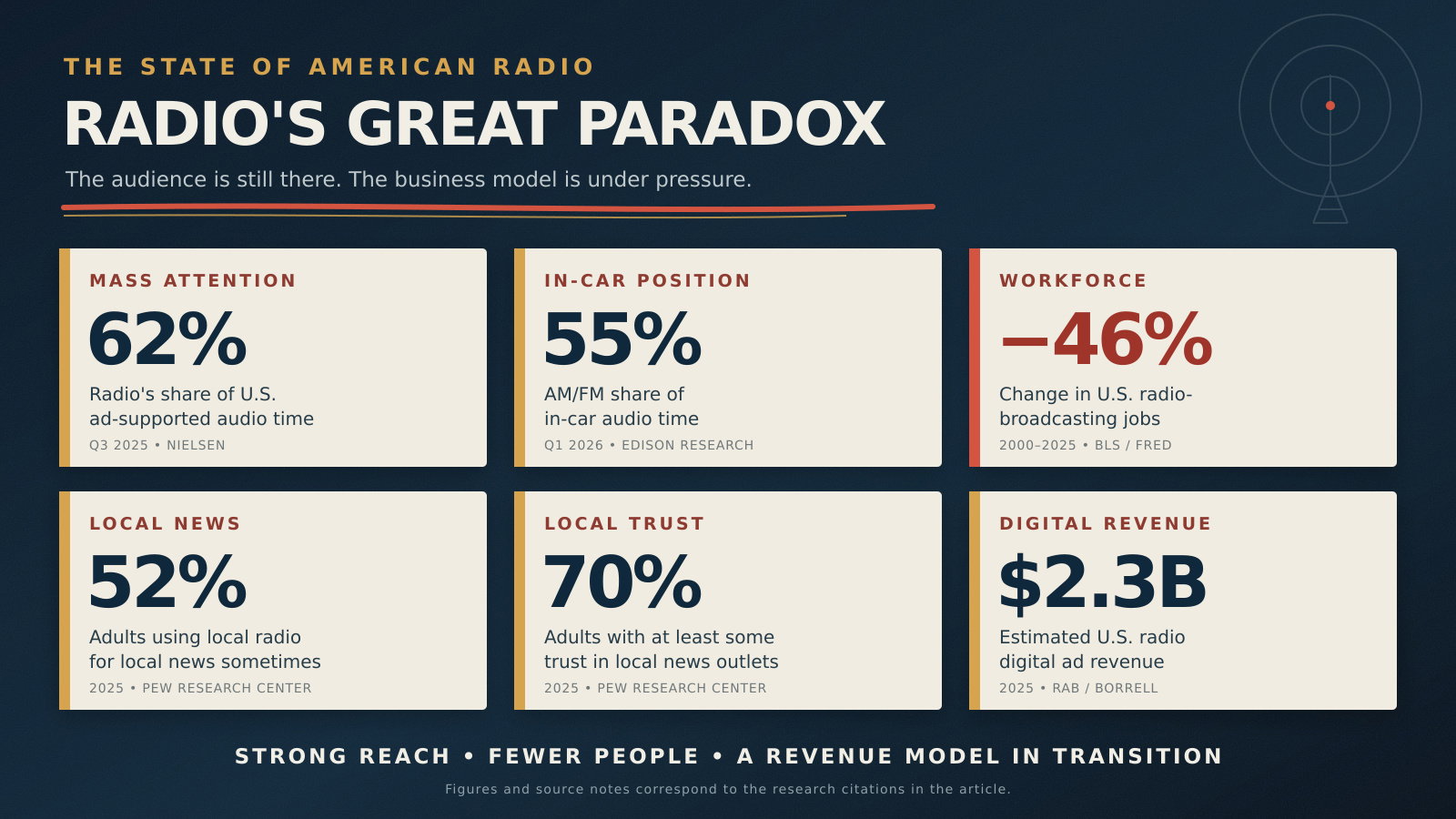
Six research figures showing radio’s audience strength, workforce contraction, local-news use, trust and digital revenue.
These measures come from different methodologies and should not be combined into a single market-share claim. Read together, they define the operating problem: radio retains large-scale attention and meaningful local utility, but its institutional capacity and legacy economics have weakened.
2. What broke: the conversion system, not the transmitter
For most of the twentieth century, a station could monetize scarcity. It controlled a limited local channel, sold units of time, and benefited from advertisers having fewer mass-reach alternatives. Digital platforms dissolved that scarcity. A local business can now buy search intent, social targeting, connected television, retail media, email automation and measurable lead generation. Radio’s problem is not simply that “the ad pie fragmented.” The market changed the definition of a satisfactory sale. Reach still matters, but buyers increasingly expect targeting, creative variation, measurement, lead capture and an explanation of what happened after the campaign aired.
The largest operators’ filings show the transition under load. In 2025, iHeartMedia reported $1.63 billion in Multiplatform Group broadcast revenue, down 5.4% from 2024. Its Digital Audio Group revenue rose 14.2% to $1.33 billion, including 25.6% growth in podcast revenue. Consolidated revenue was nearly flat at $3.87 billion. The same filing reported $5.05 billion of total debt, $402.5 million of net interest expense and $77.7 million of restructuring expenses, following $101.4 million the year before. Year-end employment fell from about 10,100 in 2024 to 9,550 in 2025. Those facts do not establish a single cause, but they do show why a company can possess enormous audience assets while operating under intense pressure to remove cost.[7][8]
Cumulus Media offers a more acute example. The company reported 2025 net revenue of $741.7 million, down 10.3%, adjusted EBITDA of $52.0 million and a net loss of $200.7 million. In March 2026 it entered Chapter 11 with a plan to eliminate roughly $592 million of debt. Audacy had completed its own restructuring in 2024, reducing funded debt from about $1.9 billion to $350 million. These restructurings are not evidence that broadcast reach is valueless. They are evidence that leverage, declining spot economics and slow product transition can overwhelm even very large portfolios.[9][10][11]
The cost-cutting trap
A cost reduction can be necessary, and centralized systems can remove genuine duplication. But a sequence of cuts is not a strategy unless management can name the customer value preserved, the capability being rebuilt and the point at which savings will be reinvested. Without those tests, the company can enter a loop: fewer local people produce a less distinctive product; a less distinctive product earns less attention and fewer direct relationships; weaker relationships increase price pressure; lower revenue triggers another cut. Each step may look rational in isolation while the system deteriorates.
Workplace research adds another warning. A meta-analysis of longitudinal studies found job insecurity associated with adverse employee attitudes, health and behavior over time; the authors emphasize that sustained uncertainty is not a cost-free management condition. Radio cannot ask reduced teams to invent new products, take creative risks and build community trust while simultaneously teaching them that every innovation may merely accelerate the next reduction. Psychological safety is not softness here. It is production infrastructure for a business that needs experimentation.[12]
A practical capital-allocation rule
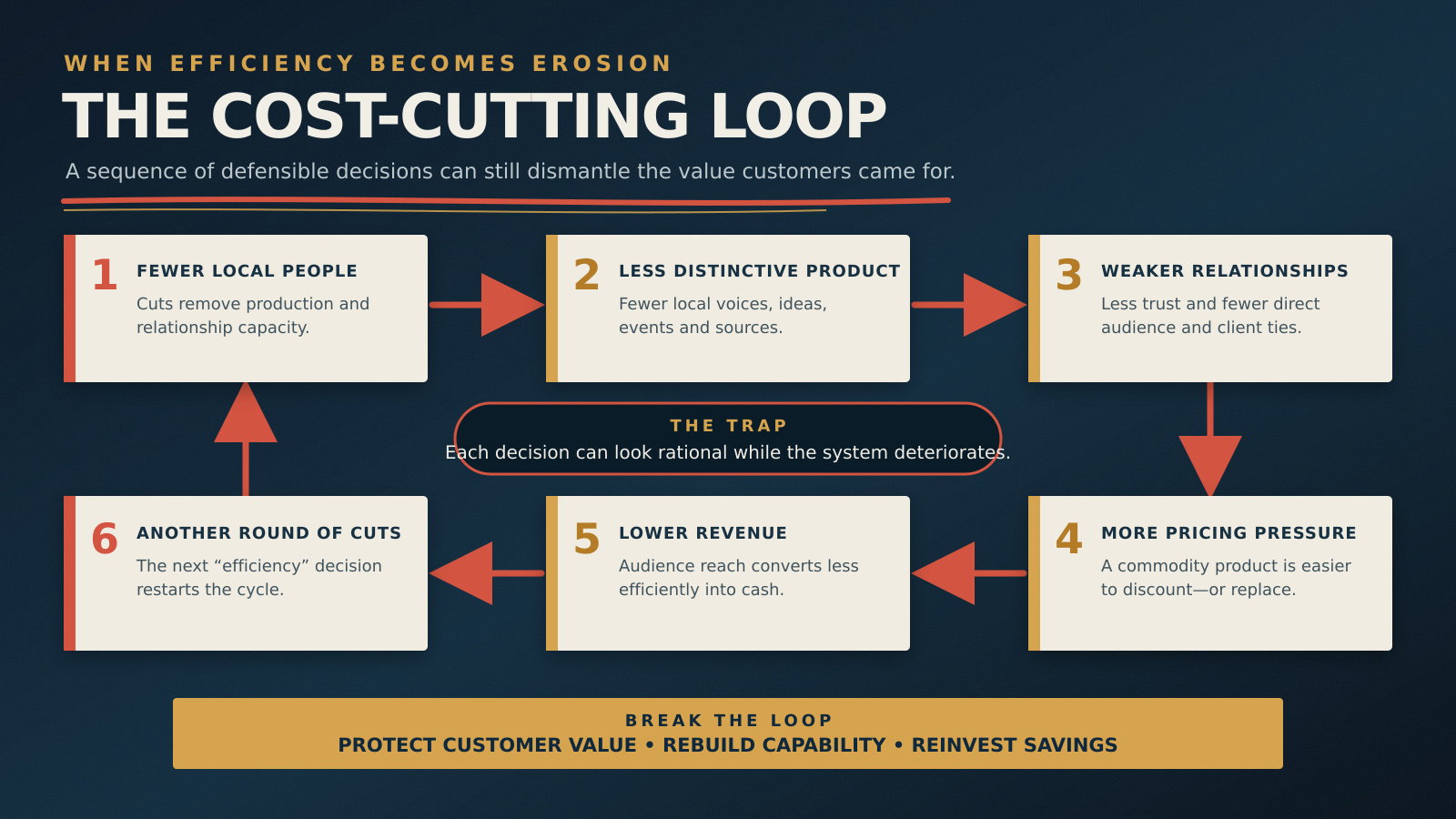
A loop showing fewer local people, less distinctive product, weaker relationships, pricing pressure, lower revenue and another round of cuts.
Every efficiency program should disclose three things internally: the work being eliminated, the customer value that will remain protected, and the share of savings committed to new revenue capability. If the third number is zero, the plan is contraction—not transformation.
3. Localism is an economic system, not a slogan
The strongest case for local radio is not sentimental. It begins with evidence that Americans still value local information and trust local sources. Pew Research Center found that 85% of U.S. adults considered local news at least somewhat important to their community’s well-being. Majorities rated local news organizations as accurate, transparent and attentive to important stories; 69% said local journalists were mostly in touch with their communities. In 2025, 52% of adults said they got local news from radio at least sometimes. Yet only 21% followed local news very closely, down from 37% in 2016, and only 8% named radio as their preferred platform for local news.[13][14]
That combination is easy to misread. Radio remains a meaningful source, but it is no longer the default interface for many consumers. The opportunity is therefore not to recreate an all-news era or fill every clock with civic content. It is to make selected local information unusually useful: severe-weather action, school changes, elections, sports, traffic disruptions, public-safety updates, local culture and explanations of how decisions affect daily life. A station should be able to state which recurring community problems it solves better than a feed, a national streamer or an undifferentiated music service.
Trust provides a second advantage. In September 2025, 70% of Americans said they had at least some trust in local news organizations, compared with 56% for national news organizations and 37% for information from social media sites. Local trust had declined from 2016, so it cannot be taken for granted, but it remained the strongest of the three. The Federal Communications Commission’s local-radio record similarly emphasizes local hosts, sports, bands, festivals, emergency information and other market-specific content as features that distinguish broadcast radio in a broader audio market. In 2025, the Eighth Circuit upheld the FCC’s local radio ownership rule while remanding separate television provisions.[15][16]
The human advantage
Localism becomes economically useful when it produces repeated relationships. Scholarship on radio and audio has long examined parasocial interaction—the sense of knowing a media personality despite the relationship being largely one-sided. A U.S. study of radio listeners found that relationships with radio personalities were associated with listening and consumer-related perceptions. Research on host-read podcast advertising likewise finds that favorable attitudes toward hosts and host-read formats can influence how audiences respond to advertised products. These studies do not prove that every personality sells every campaign. They do support a more defensible proposition: a trusted human voice can be an asset in attention, persuasion and continuity, not merely a line item between songs.[17][18]
That asset must be developed. “Local” is not satisfied by inserting a city name into a liner, and personality is not the same as unstructured airtime. The most valuable hosts build recognizable franchises, maintain standards, prepare interviews, show up in the community and create material that can travel across broadcast, clips, newsletters, podcasts and events. The job is closer to a portfolio of audience products than a four-hour shift.
Radio also remains part of public warning infrastructure. The Emergency Alert System allows national, state and local authorities to distribute emergency information through broadcast, cable and satellite systems, and FEMA identifies broadcasters as participants in the Integrated Public Alert and Warning System. Emergency utility should not be used as a shield against every criticism of the business. It should be treated as a design obligation: resilient staffing, clear escalation protocols, trusted live voices and rehearsed local partnerships.[19]
4. What consolidation research actually says
The history of post-1996 radio invites a simple story: more ownership concentration produced fewer voices, less variety and a weaker local product. Part of that story may describe individual markets, but the strongest research cautions against treating it as a universal law. Economists Steven Berry and Joel Waldfogel found that consolidation reduced station entry while increasing the number of formats per station, with some evidence that concentration increased absolute format variety. Their result is important precisely because it complicates the argument. Scale can support differentiated formats when a group avoids cannibalizing itself.[20]
But format labels are not the same as local capacity, original reporting, live companionship or sales depth. A portfolio can contain more distinct music positions while employing fewer people and originating less market-specific work. The policy and management question is therefore not “large or small?” It is “what capabilities does ownership preserve, and what does scale make possible?”
A large consolidator can spread technology costs, national sales, data systems, benefits, legal support and experimentation across hundreds of stations. It can also centralize judgment too far, standardize distinctive brands into interchangeable products and let debt service crowd out reinvestment. An independent operator can decide quickly, develop deep local ties and take a long view. It can also become dangerously dependent on one owner, one major advertiser, a small group of sellers or an undercapitalized transmission plant. Neither structure is virtuous by default. Reinvestment behavior is more predictive than the logo on the door.
5. The revenue model radio needs
The next radio company is not a collection of spot avails with digital products bolted on. It is a local audience-and-commerce company with broadcast at its center. Broadcast supplies efficient reach, habit and cultural presence. Digital adds addressability, continuity and measurement. Events add physical proof and sponsor inventory. Personalities add trust. Sellers translate a client problem into a coordinated solution. The model works only when these pieces are managed as one system.
Industry benchmarking suggests that digital has moved beyond an experiment. The Radio Advertising Bureau and Borrell Associates estimated U.S. radio digital advertising revenue at $2.3 billion in 2025—24.4% of industry advertising revenue—and projected 9.5% growth in 2026. Because this is an industry-sponsored benchmark, it should be read as a directional commercial measure rather than an independent census. The operational question is also more demanding than the top line: how much digital revenue is recurring, differentiated and profitable after platform, fulfillment and sales costs?[21]
A station can report impressive digital billings by reselling products available from dozens of agencies. That may serve clients and produce margin, but it does not necessarily strengthen the station. The more durable model connects digital products to assets the station uniquely controls: trusted hosts, local content, permission-based audience data, events, category knowledge, client relationships and the ability to combine rapid reach with follow-up.
Consultative selling is the bridge
Radio’s sales transition is often described as a technology problem. It is more fundamentally a discovery and strategy problem. A meta-analysis covering 155 samples and more than 31,000 salespeople found that adaptive selling and customer orientation have related but distinct antecedents and consequences; adaptive selling showed the stronger direct link to objective performance. Another meta-analysis found a smaller but significant positive relationship between customer orientation and salesperson job performance. Research on firm-level sales strategy likewise links systematic customer segmentation, prioritization and selling models with market and salesperson performance.[22][23][24]
The implications are concrete. A seller should enter a meeting able to diagnose the client’s economics, not merely describe station demographics. The proposal should name the business objective, the customer to be reached, the message, the conversion path, the measurement plan and the decision date. The account review should ask whether the campaign changed store traffic, qualified leads, applications, appointments, ticket sales or another agreed outcome. Reach remains part of the solution; it is no longer the entire explanation.
6. Artificial intelligence: remove friction, preserve authorship
AI will change radio work, but the available evidence argues against treating automation as a simple headcount formula. In a large field study of customer-support workers, access to a generative-AI assistant raised productivity by about 14% on average, with the largest gains among less-experienced and lower-skilled workers. In an experiment with 453 college-educated professionals performing writing tasks, generative AI reduced completion time by 40% and increased output quality by 18%. These studies concern other kinds of knowledge work, not broadcasting, so their percentages should not be imported directly into radio budgets. Their pattern is useful: AI can diffuse know-how, speed routine production and narrow skill gaps.[25][26]
The International Labour Organization’s 2025 assessment concludes that job transformation is more likely than wholesale replacement in many occupations exposed to generative AI, while emphasizing the need for training and worker participation. For radio, the high-return uses are transcription, research assistance, versioning, rough cuts, metadata, scheduling, proposal preparation, performance summaries and repurposing. Human review must remain accountable for facts, taste, legal risk, editorial judgment and any voice that trades on community trust.[27]
The failure mode is generic abundance. If every station can generate a competent weather intro, music break, social caption and client script in seconds, competence stops differentiating the product. The advantage moves to original access, judgment, recognizable voice and a disciplined editorial point of view. AI should give local humans more time to do the work only they can do; it should not make a local station sound like the same machine everywhere.
7. A blueprint for major consolidators
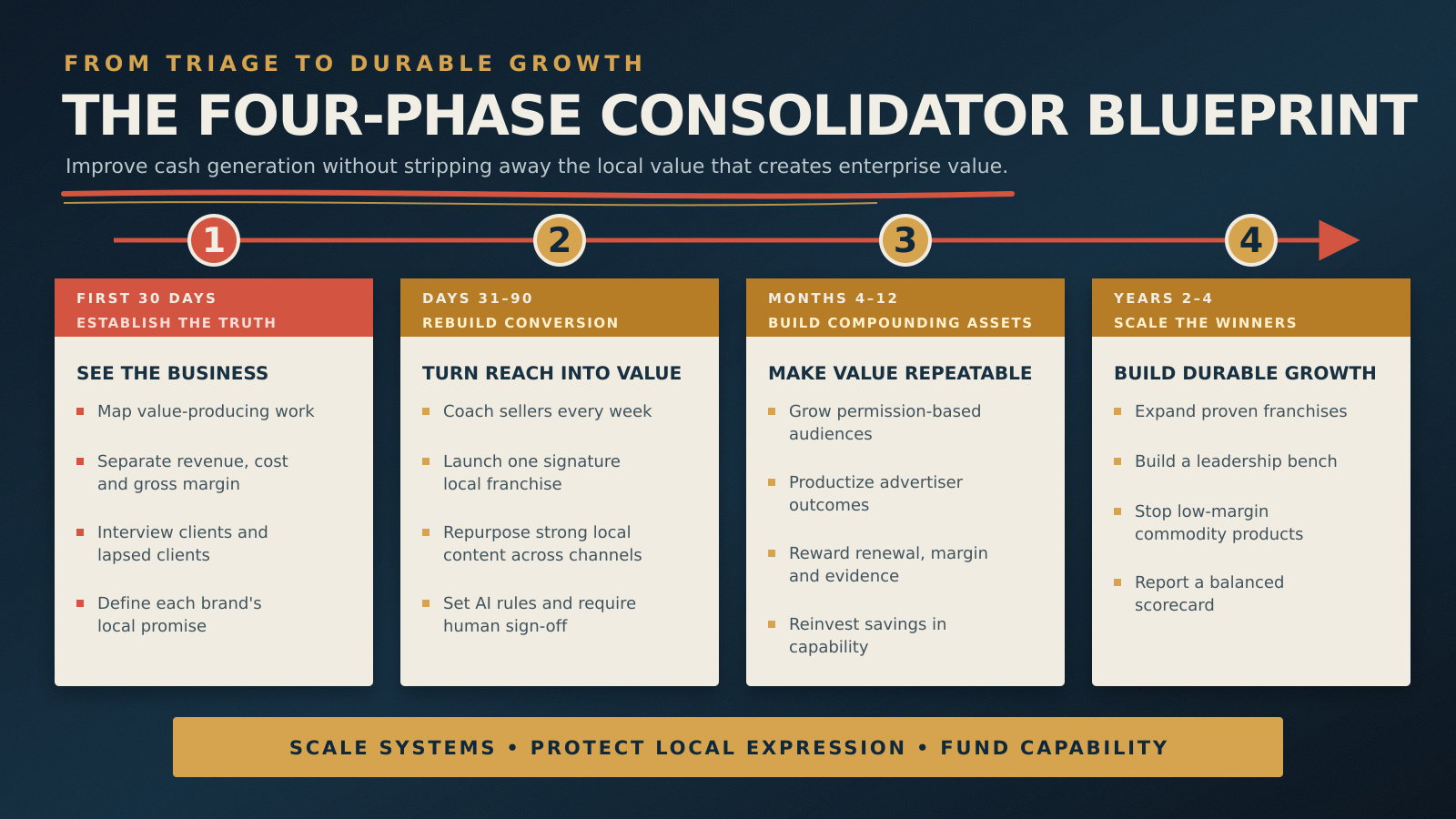
The following plan assumes a large group must improve cash generation while protecting enterprise value. It does not depend on reversing every past reduction. It requires distinguishing scale economics from local value and funding both deliberately.
◆Phase I: first 30 days — establish the truth
Map value-producing work market by market. Classify activities as commodity production, technical necessity, audience relationship, advertiser relationship, community access or management/coaching. Do not begin with titles; begin with outcomes.
Create a market economics sheet that separates broadcast spot revenue, network/national revenue, digital revenue by product, events, production costs, fulfillment costs, churn and gross margin. A digital dollar is not automatically a better dollar.
Interview twenty clients and twenty lapsed clients in each priority market. Ask what business problem they hired the station to solve, what evidence they trusted, why they renewed or left, and what they now buy elsewhere.
Define a local promise for every brand. The promise should identify an audience, a recurring need and the station’s distinctive behavior—not a format adjective.
◆Phase II: days 31–90 — rebuild conversion capacity
Install weekly seller coaching around discovery, segmentation, creative strategy, measurement and renewal. Managers should inspect calls and proposals, not merely the revenue board.
Launch one signature local franchise per brand or cluster. It might be severe-weather readiness, high-school sports, local music, small-business growth, civic explanation or a recurring live event. Protect enough staff time to make it excellent.
Create a shared content workflow. One strong local segment should be producible as broadcast audio, an on-demand episode, two or three vertical clips, a newsletter item and a sponsor-ready recap—without requiring five independent teams.
Adopt an AI use standard. Approved uses, human sign-off, disclosure rules, data restrictions, synthetic-voice limits and fact-checking ownership should be clear before experimentation becomes reputational risk.
Phase III: months 4–12 — build compounding assets
Grow permission-based audiences. Email, text, app, membership and event registrations should be tied to clear value and consent. First-party relationships reduce dependence on any one distribution platform.
Productize advertiser outcomes. Build a small number of repeatable packages for categories the market understands deeply—recruitment, healthcare, home services, automotive, entertainment or local retail—while preserving room for custom strategy.
Tie incentives to durable value. Reward renewal, account growth, gross margin, data capture and case-study quality in addition to new gross billing. Avoid compensation that encourages low-margin digital volume or destructive spot discounting.
Create a reinvestment covenant. Reserve a stated share of recurring efficiency savings for sales capability, local franchises, measurement, research and talent development. Track the return publicly inside the company.
Phase IV: years 2–4 — scale the winners
Expand proven franchises across similar markets while leaving room for local expression. Standardize the operating kit—research, templates, measurement, legal and training—not the host’s voice or the community’s agenda.
Develop a leadership bench. The missing middle manager is often the hidden constraint on sales quality, talent development and execution. Promotion should require evidence of coaching, not only personal production.
Use portfolio reviews to stop low-margin commodity products and reinvest in defensible ones. Transformation requires subtraction as well as addition.
Report a balanced scorecard to boards and lenders. Revenue per employee belongs on it, but so do advertiser retention, digital gross margin, first-party audience growth, local original output, event contribution, talent retention and brand health.
◆Pitfalls large groups should avoid
Calling any nonbroadcast billing “digital transformation” without reporting gross margin, churn and client outcomes. Centralizing decisions that require local knowledge while leaving local teams accountable for the results.
Eliminating coaching roles and then blaming sellers or talent for inconsistent execution. Using AI to increase the volume of interchangeable content.
Treating headcount as the primary productivity measure in a relationship business. Discounting spot inventory to defend short-term share, thereby teaching buyers that the product lacks pricing power.
8. A blueprint for independent owners
Independent operators can move faster and may be freer to reinvest patiently, but independence is not a protective moat. The owner should build systems before success becomes dependent on personal heroics.
Choose two or three local categories in which the company will become unusually knowledgeable. Build research, creative examples, benchmarks and case studies around them.
Cap concentration risk. Track the share of revenue represented by the largest advertiser, the largest seller and the owner’s personal relationships. Create succession plans before a departure becomes a crisis.
Cross-train without collapsing roles. Every essential process needs a documented backup, but the same person cannot indefinitely be host, seller, videographer, engineer and event producer at full quality.
Buy scale selectively. Use networks, shared services and outside specialists for commodity technology, cybersecurity, payroll, fulfillment and research so local staff can concentrate on differentiated work.
Maintain a reinvestment floor. Protect a minimum annual budget for talent development, audience research, sales training, equipment reliability and one signature local franchise.
Build a cash and continuity plan. Severe weather, advertiser loss, owner illness and equipment failure are predictable categories of risk even when their timing is not.
◆9. A career blueprint for radio professionals
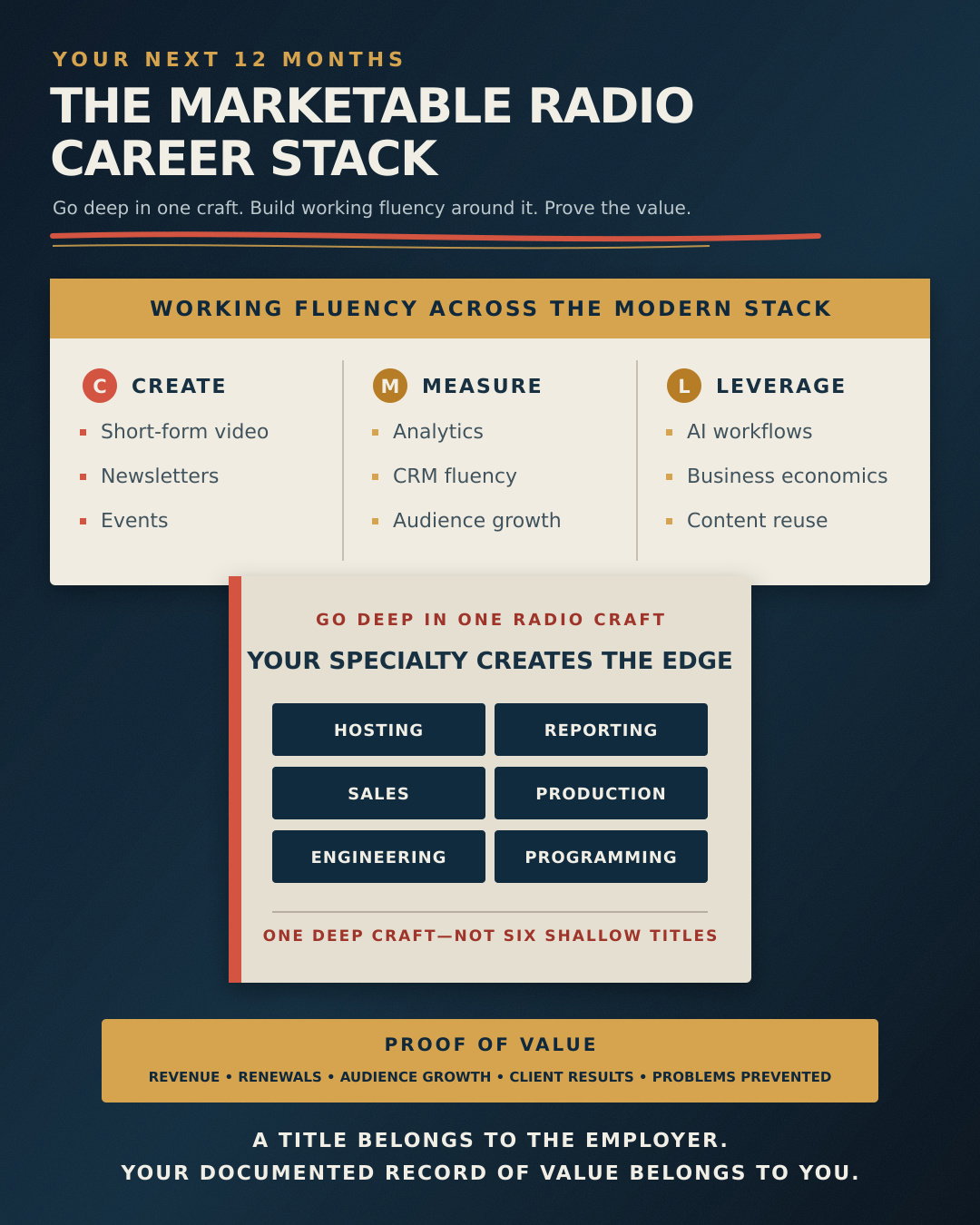
No employer can make a traditional radio title permanently secure. The more useful goal is marketability: the ability to demonstrate value in the current station, elsewhere in audio, or in adjacent media and marketing work. BLS projects employment of announcers and DJs to decline 2% from 2024 to 2034, with openings arising mainly from replacement needs; the agency explicitly notes consolidation, stations operating without live DJs and AI use as constraints. Reporters face a projected 4% decline, while BLS stresses multimedia and technology skills. The correct response is neither panic nor denial. It is a planned expansion of capability.[28][29]
Your next 12 months
Write a one-sentence value thesis. Replace “I am an air personality” or “I am a seller” with a statement about the result you create: attention, trust, qualified leads, renewals, local access, efficient production or audience growth.
Build a T-shaped skill stack. Keep one deep craft—hosting, reporting, sales, production, engineering or programming—and add working fluency in short-form video, analytics, CRM, newsletters, events and AI-assisted workflows.
Complete a 90-day skills sprint. Choose one business skill and one production skill, complete a real project, and publish or document the result. Certificates matter less than evidence.
Maintain a monthly value dossier. Record revenue influenced, renewal wins, audience growth, event turnout, response time, content reuse, client results and problems prevented. Protect confidential information and employer ownership, but do not rely on memory at review time.
Learn the economics. Understand a basic profit-and-loss statement, contribution margin, CPM, customer acquisition cost, lead quality, attribution limits, churn and renewal. People who can connect craft to economics are harder to commoditize.
Build a portable professional presence ethically. Maintain a current portfolio, biography, references and examples you are permitted to share. An owned newsletter, professional site or independent creative project can demonstrate consistency without taking employer intellectual property.
Use AI as a supervised junior assistant. Create repeatable workflows for research, transcription, logging, draft variations and reporting. Verify facts, protect source and client data, and keep a record of the time or quality gained.
Strengthen relationships outside the building. Know community leaders, advertisers, creators, engineers, agencies and peers in adjacent media. Careers move through trusted networks long before a vacancy is posted.
Evaluate employers like an investor. Ask about debt and ownership, local decision rights, sales coaching, digital fulfillment, training budgets, advertiser concentration, recent turnover and what the company reinvests after a cost reduction.
Build personal resilience. Where feasible, create an emergency fund, review contract restrictions and maintain lawful, nonconflicting freelance options. Financial breathing room improves career judgment.
The portable career asset
A title belongs to the employer. A documented record of creating revenue, audience trust, useful content, operational reliability and community relationships belongs to the professional—subject, always, to confidentiality and intellectual-property obligations.
10. The scorecard: measure what the new model is supposed to create
A transformation fails when the company continues to reward the old system exclusively. Ratings and spot revenue remain essential, but they are lagging measures of only part of the business. The operating dashboard should connect attention, relationships, client value, economics and capability.
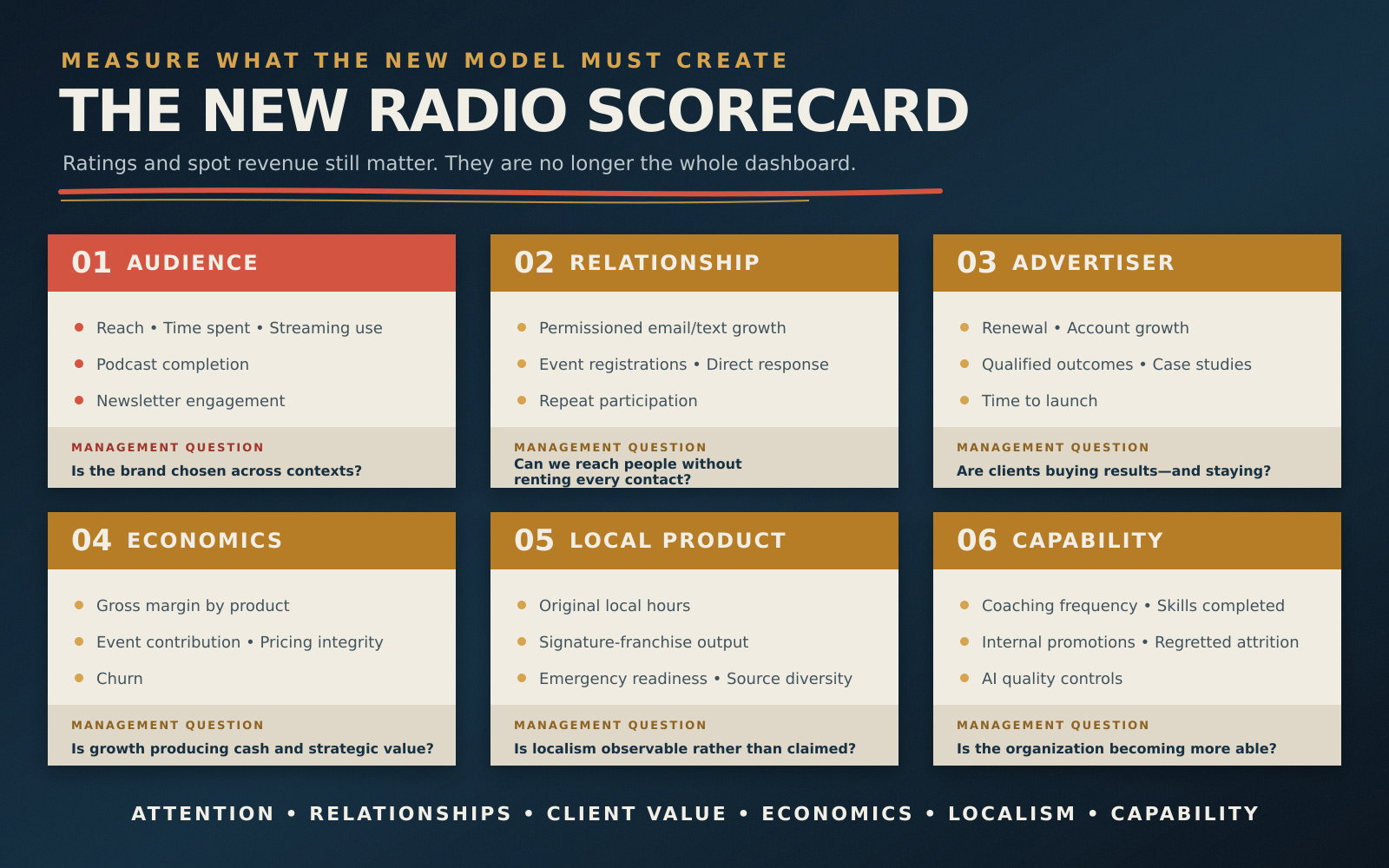
A final choice
Radio does not need to preserve every old workflow or promise that every historical job will return. It does need to protect the human capabilities that create differentiated attention, local knowledge, advertiser confidence and public usefulness. That distinction is the line between modernization and managed decline.
The data does not support a funeral. They support urgency. Radio still has meaningful share of ad-supported listening, a powerful position in the car, local trust, emergency utility and personalities capable of forming durable audience relationships. It also has a smaller workforce, pressured legacy revenue, formidable digital competitors and, at several large companies, financial structures that have narrowed the room for error.
The winning strategy is therefore neither nostalgia nor indiscriminate disruption. It is disciplined recombination: broadcast reach with first-party relationships; local personalities with on-demand distribution; consultative sellers with measurable products; centralized tools with local judgment; automation with accountable human authorship; efficiency with explicit reinvestment.
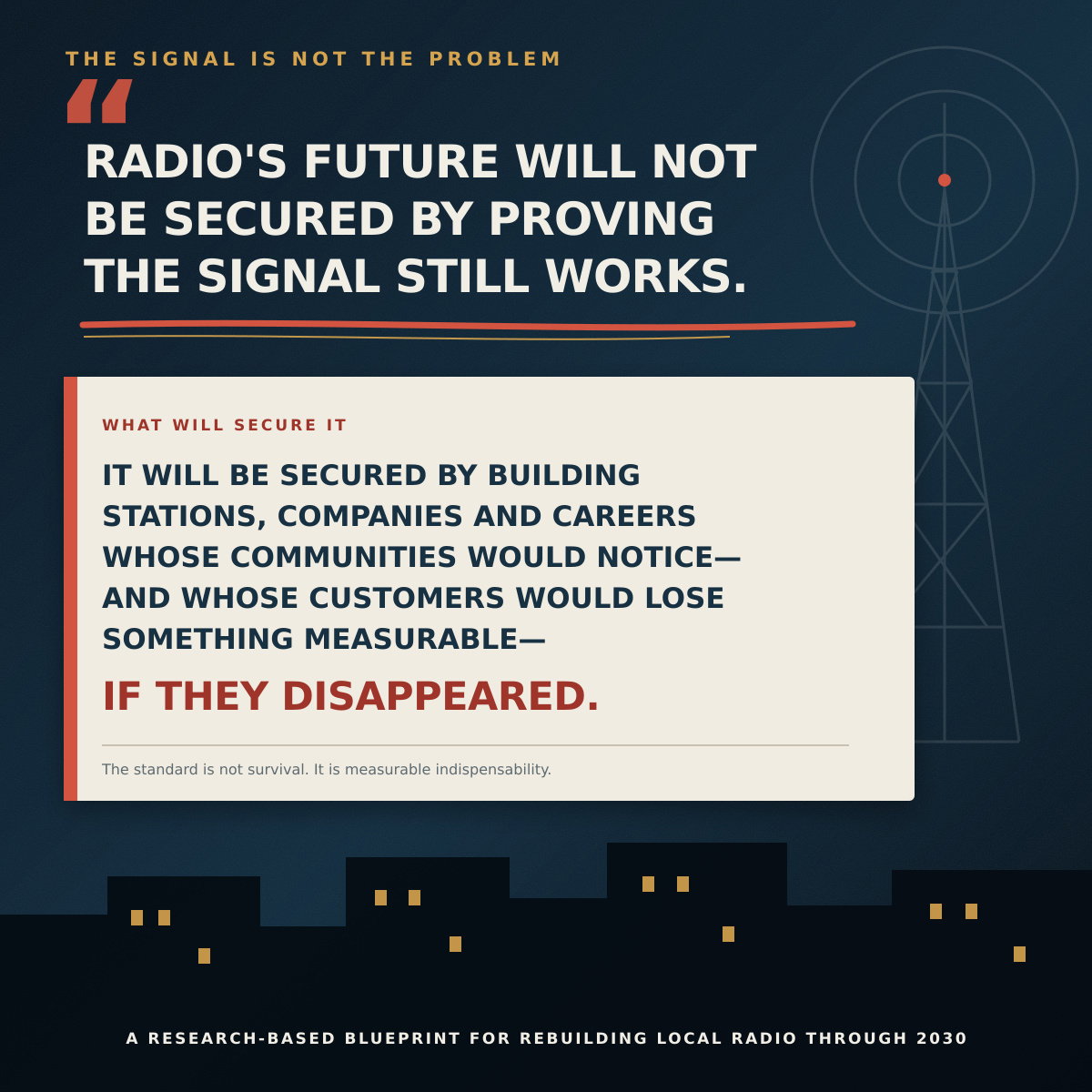
The transmitter is still an extraordinary distribution asset. But radio’s future will not be secured by proving the signal still works. It will be secured by building stations, companies and careers whose communities would notice—and whose customers would lose something measurable—if they disappeared.
Research notes and limitations
Research cutoff: 16 August 2026. Financial and audience figures use the latest relevant public releases identified by that date.
Audience studies use different universes and measures. Share of time, weekly use, reach and platform preference are not interchangeable.
The BLS employment series and occupational estimates differ in scope. They are presented separately, not summed.
Company filings demonstrate financial conditions and management actions; they do not, by themselves, prove that any one action caused a revenue trend.
The strategic recommendations are reasoned inferences from the cited evidence and operating logic. They have not been tested as a single intervention across the U.S. radio industry.
Industry-sponsored studies are identified as such. Where possible, the article relies on federal data, regulatory records, company filings and peer-reviewed or institutional research.
◆Sources and research notes
The bracketed numbers in the article correspond to the complete sources below.
◆Nielsen, “The Record: Q3 U.S. Audio Listening Trends,” 2025. Nielsen estimated 3 hours 53 minutes of daily audio use; 64% was ad-supported, and radio represented 62% of ad-supported audio time. https://www.nielsen.com/insights/2025/the-record-q3-audio-listening-trends-2/
◆Edison Research, “Radio Continues to Dominate In-Car Listening,” Share of Ear, Q1 2026. AM/FM represented 55% of in-car audio time overall and 46% among ages 13–34; streaming audio represented 16% overall and 30% among ages 13–34. https://www.edisonresearch.com/radio-continues-to-dominate-in-car-listening/
◆Edison Research, “Growth of Streamed AM/FM Radio Sources,” 2026. Edison reported that streamed AM/FM represented 14% of daily AM/FM time in Q1 2026; 30% of weekly radio listeners used a stream at least some of the time. https://www.edisonresearch.com/growth-of-streamed-am-fm-radio-sources/
◆Edison Research, “Podcasts Lead AM/FM in Spoken Word Listening, Marking a First,” 2026. In Q4 2025, podcasts represented 40% of spoken-word audio time and AM/FM 39%. https://www.edisonresearch.com/podcasts-lead-am-fm-in-spoken-word-listening-marking-a-first/
◆U.S. Bureau of Labor Statistics, Industry Productivity Data, “Employment for Radio Broadcasting,” series IPUJN51511W200000000, retrieved via FRED. Values: 122.8 thousand jobs in 2000 and 66.0 thousand in 2025, a decline of approximately 46.3%. https://fred.stlouisfed.org/series/IPUJN51511W200000000
◆U.S. Bureau of Labor Statistics, “Broadcasting BLS Statistics on Radio Day,” The Economics Daily, 2025, using May 2024 Occupational Employment and Wage Statistics. https://www.bls.gov/opub/ted/2025/broadcasting-bls-statistics-on-radio-day.htm
◆iHeartMedia, Inc., Form 10-K for the year ended December 31, 2025, segment tables. Broadcast revenue was $1.633 billion; Digital Audio Group revenue was $1.329 billion; consolidated revenue was $3.865 billion. https://www.sec.gov/Archives/edgar/data/1400891/000162828026013221/ihrt-20251231.htm
◆iHeartMedia, Inc., 2025 Form 10-K. The filing reported total debt of $5.053 billion, net interest expense of $402.5 million, restructuring expenses of $77.7 million in 2025 and approximately 9,550 employees at year end. The 2024 Form 10-K reported approximately 10,100 employees. 2025 filing: https://www.sec.gov/Archives/edgar/data/1400891/000162828026013221/ihrt-20251231.htm ; 2024 filing: https://www.sec.gov/Archives/edgar/data/1400891/000140089125000009/ihrt-20241231.htm
◆Cumulus Media Inc., “Operating Results for 2025,” filed with the U.S. Securities and Exchange Commission. The release reported 2025 net revenue of $741.7 million, adjusted EBITDA of $52.0 million and net loss of $200.7 million. https://www.sec.gov/Archives/edgar/data/1058623/000105862326000017/cmls12312025earningsrelease.htm
◆Reuters, “Radio station owner Cumulus Media files bankruptcy to cut $600 million debt,” March 5, 2026. Reuters reported a plan to eliminate about $592 million of debt. https://www.reuters.com/legal/litigation/radio-station-owner-cumulus-media-files-bankruptcy-cut-600-mln-debt-2026-03-05/
◆Audacy, Inc., “Audacy Successfully Completes Financial Restructuring,” September 30, 2024. The company said funded debt fell from approximately $1.9 billion to $350 million. Company-issued source. https://audacyinc.com/press/audacy-successfully-completes-financial-restructuring-emerges-as-a-growing-scaled-multi-platform-audio-leader-with-the-industrys-strongest-balance-sheet/
◆Magnus Sverke, Lena Låstad, Johnny Hellgren, Anne Richter and Katharina Näswall, “A Meta-Analysis of Job Insecurity and Employee Performance: Testing Temporal Aspects, Rating Source, Welfare Regime, and Union Density as Moderators,” International Journal of Environmental Research and Public Health 16, no. 14 (2019): 2536. https://doi.org/10.3390/ijerph16142536
◆Pew Research Center, “Americans’ Changing Relationship With Local News,” May 7, 2024. The survey found 85% considered local news at least somewhat important to community well-being and 69% said local journalists were mostly in touch with their communities. https://www.pewresearch.org/journalism/2024/05/07/americans-changing-relationship-with-local-news/
◆Pew Research Center, “Local News Fact Sheet,” updated 2025. The fact sheet reports trends in attention to local news, source use and preferred platforms. https://www.pewresearch.org/journalism/fact-sheet/local-news-fact-sheet/
◆Pew Research Center, “How Americans’ Trust in Information From News Organizations and Social Media Sites Has Changed Over Time,” October 29, 2025. https://www.pewresearch.org/short-reads/2025/10/29/how-americans-trust-in-information-from-news-organizations-and-social-media-sites-has-changed-over-time/
◆Federal Communications Commission, 2022 Quadrennial Review order, FCC 23-117, December 26, 2023; Zimmer Radio of Mid-Missouri, Inc. v. FCC, U.S. Court of Appeals for the Eighth Circuit, July 2025. The court denied the radio-related petitions while vacating and remanding separate television provisions. FCC order: https://docs.fcc.gov/public/attachments/FCC-23-117A1.pdf ; court opinion: https://docs.fcc.gov/public/attachments/DOC-413198A1.pdf
◆Jessie M. Quintero Johnson and Paula D. Patnoe-Woodley, “Exploring the Influence of Parasocial Relationships and Experiences on Radio Listeners’ Consumer Behaviors,” Communication Research Reports 33, no. 1 (2016): 40–46. National U.S. listener sample, N=2,700. https://doi.org/10.1080/08824096.2015.1117440
◆Margaret Moe, “Podvertising: Podcast Listeners’ Advertising Attitudes, Consumer Actions and Preference for Host-Read Ads,” Journal of Economics and Behavioral Studies 14, no. 4 (2023): 50–66. Survey sample, N=1,714. https://doi.org/10.22610/jebs.v14i4(J).3278
◆Federal Communications Commission, “Emergency Alert System,” and Federal Emergency Management Agency, “Broadcasters and Wireless Providers.” https://www.fcc.gov/Alerting/EAS ; https://www.fema.gov/emergency-managers/practitioners/integrated-public-alert-warning-system/broadcasters-wireless
◆Steven T. Berry and Joel Waldfogel, “Do Mergers Increase Product Variety? Evidence from Radio Broadcasting,” Quarterly Journal of Economics 116, no. 3 (2001): 1009–1025. https://doi.org/10.1162/00335530152466296
◆Radio Advertising Bureau, citing Borrell Associates, “Radio Digital Revenue Grew by 7.8% in 2025; Forecast to Grow 9.5% in 2026,” 2026. This is an industry-sponsored benchmark. https://www.rab.com/public/pr/pr_detail.cfm?id=1015
◆George R. Franke and Jeong-Eun Park, “Salesperson Adaptive Selling Behavior and Customer Orientation: A Meta-Analysis,” Journal of Marketing Research 43, no. 4 (2006): 693–702. The study combined 155 samples representing more than 31,000 salespeople. https://doi.org/10.1509/jmkr.43.4.693
◆Fernando Jaramillo, Daniel M. Ladik, Greg W. Marshall and Jay Prakash Mulki, “A Meta-Analysis of the Relationship Between Sales Orientation–Customer Orientation and Salesperson Job Performance,” Journal of Business & Industrial Marketing 22, no. 5 (2007): 302–310. The analysis covered 16 studies, 17 effect sizes and 3,477 respondents; the weighted relationship was positive but modest. https://doi.org/10.1108/08858620710773431
◆Harri Terho, Andreas Eggert, Alexander Haas and Wolfgang Ulaga, “How Sales Strategy Translates into Performance: The Role of Salesperson Customer Orientation and Value-Based Selling,” Industrial Marketing Management 45 (2015): 12–21. Sample: 816 salespeople and directors in 30 sales organizations. Author postprint: https://www.utupub.fi/bitstream/handle/10024/172879/IMM_2015_Terho%20Eggert%20Haas%20Ulaga_Sales_Strategy_author_post_print.pdf?sequence=1
◆Erik Brynjolfsson, Danielle Li and Lindsey R. Raymond, “Generative AI at Work,” NBER Working Paper 31161, revised 2023. In a field study of 5,179 customer-support agents, access to AI assistance increased productivity by 14% on average, with larger gains among less-experienced and lower-skilled workers. https://www.nber.org/papers/w31161
◆Shakked Noy and Whitney Zhang, “Experimental Evidence on the Productivity Effects of Generative Artificial Intelligence,” Science 381, no. 6654 (2023): 187–192. In preregistered writing tasks with 453 professionals, completion time fell 40% and quality increased 18%. https://doi.org/10.1126/science.adh2586
◆International Labour Organization, “Generative AI and Jobs: A 2025 Update,” 2025. The report emphasizes occupational transformation and task-level exposure rather than assuming job-level automation. https://www.ilo.org/publications/generative-ai-and-jobs-2025-update
◆U.S. Bureau of Labor Statistics, Occupational Outlook Handbook, “Announcers and DJs,” 2024–34 projections. BLS projected a 2% decline and about 3,800 openings per year, mostly from replacement needs. https://www.bls.gov/ooh/media-and-communication/announcers.htm
◆U.S. Bureau of Labor Statistics, Occupational Outlook Handbook, “News Analysts, Reporters, and Journalists,” 2024–34 projections. BLS projected a 4% decline and highlighted multimedia and technology skills. https://www.bls.gov/ooh/media-and-communication/reporters-correspondents-and-broadcast-news-analysts.htm ◆