
A Few OTHER Things Radio Could Try Cutting First
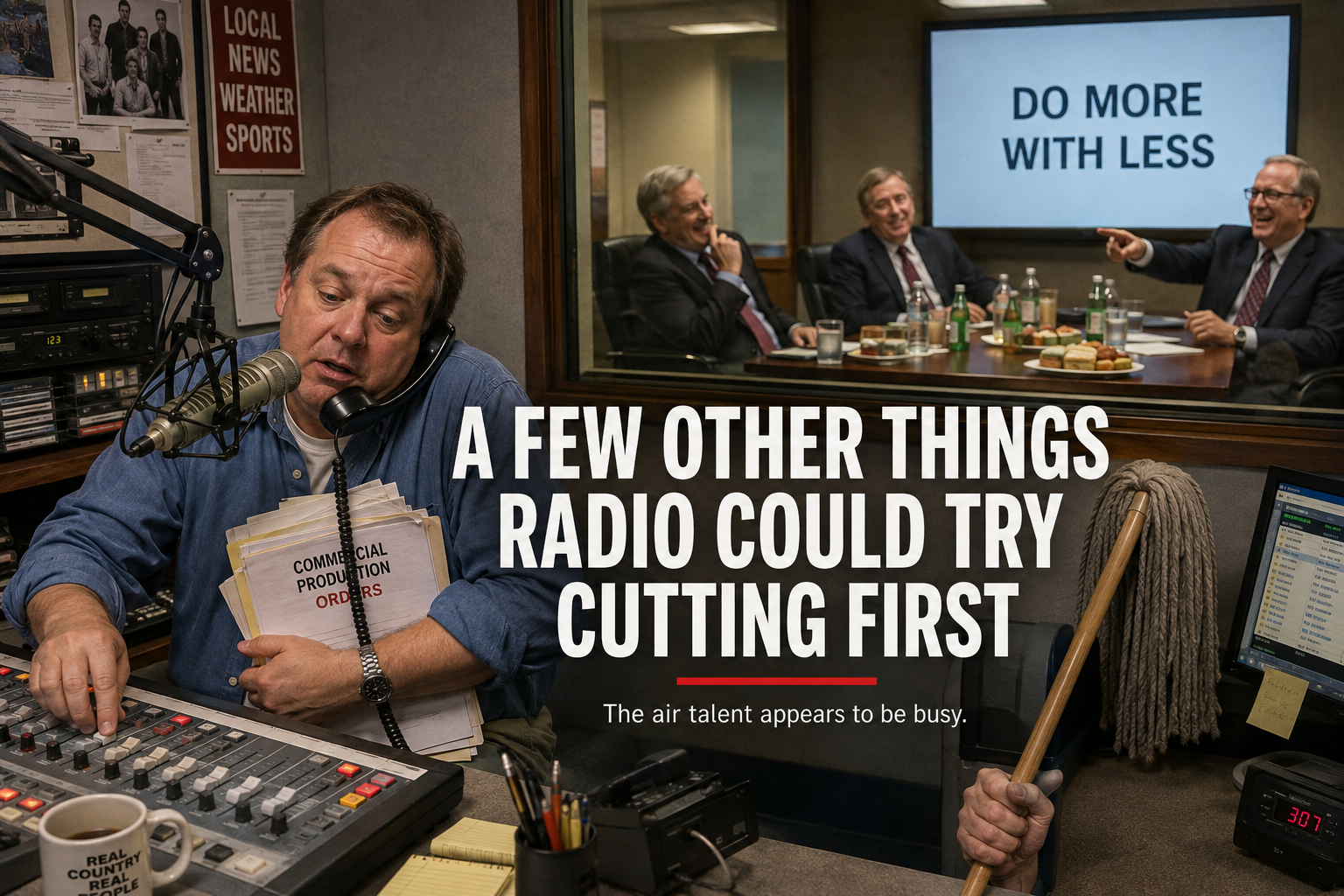
A helpful cost-saving guide for executives who have somehow exhausted every option except reducing their own seven-figure compensation
Corporate radio continues to search for efficiencies, and apparently it has once again discovered the same wildly innovative solution: remove another person listeners actually know. Another air personality disappears. Another programmer is handed a cardboard box. Another production director is told that compelling, locally created audio can now be generated automatically by a platform whose most deeply held emotion is “processing.”
◆These decisions are usually announced with familiar language about restructuring, streamlining operations, responding to challenging economic conditions and positioning the company for long-term growth. The executives explaining the necessity of sacrifice seldom appear to be participating in it personally.
◆I understand that radio companies must control expenses. Payroll matters. Debt matters. Shareholders matter. Electricity stubbornly refuses to become free just because a station had a bad quarter. But before we eliminate the final air personality, programmer or production director, perhaps we should examine a few remaining expenses that have somehow survived every restructuring.
◆In the spirit of cooperation, I have compiled some alternative cost-saving suggestions. ◆
START WITH ONE OF THE SEVENTEEN VICE PRESIDENTS INVOLVED IN APPROVING A STATION T-SHIRT
At some point, radio discovered that no local decision should be made until it has traveled through enough corporate layers to qualify for frequent-flyer status. The morning show would like to print 100 shirts for a community event. Unfortunately, the proposed design must first be examined by the market manager, regional manager, regional programming vice president, corporate branding department, legal department and someone named Blake whose actual responsibility has never been fully explained.
◆By the time approval arrives, the event happened three weeks ago and the morning show has been eliminated.
◆I am not suggesting that companies abandon standards, legal review or financial accountability. I am suggesting that if it requires seven people and 23 emails to approve a station T-shirt, there may still be a little fat left somewhere other than afternoon drive.
◆Estimated effect on the listener: Unlike firing the morning show, probably none. ◆
PERHAPS WE COULD CONSULT THE PEOPLE WHO ALREADY WORK HERE
Local employees occasionally possess useful information about the market in which they live. They know the community. They meet listeners. They understand which events matter, which advertisers have credibility and which local place names should never be pronounced the way the voice tracker in another time zone just pronounced them.
◆Naturally, this information cannot be trusted until an outside consultant places it on a PowerPoint slide and invoices the company.
◆The consultant will recommend that the station become more visible, create compelling content, engage the community and develop stronger relationships with listeners. Management will call this a bold new strategy. The local staff will call it the email they sent in February.
◆Good consultants can be valuable. They offer perspective that people inside an operation may not have. But when the consultant’s primary function is to make management hear an idea it ignored when an employee said it for free, we may have identified another possible efficiency. At minimum, we could ask the local staff before booking airfare. ◆
THREE-HOUR MEETINGS ABOUT CREATING SHORTER, MORE COMPELLING CONTENT
Radio has developed an extraordinary ability to spend an entire afternoon discussing brevity.
◆These meetings usually include 14 people, although only three will speak. One presents a chart. Another says the station needs to “meet listeners where they are.” A third reminds everyone that younger audiences consume content differently. At some point, someone uses the word “ecosystem,” and everybody nods as if a frog has just appeared in the conference room.
◆The meeting concludes with a new assignment for the remaining air personality, who was unable to attend because that person was simultaneously doing a show, writing commercials, updating the website, recording a podcast, posting video and helping a listener retrieve concert tickets from the station app.
◆Perhaps we could shorten the meeting to 20 minutes and give the other two hours and 40 minutes back to the person responsible for creating the compelling content.
◆It would be a radical experiment, but so was FM once. ◆
THE POWERPOINT PRESENTATION EXPLAINING WHY ELIMINATING COMPELLING CONTENT IS STRATEGICALLY NECESSARY
Somewhere inside every large radio company is a presentation containing an upward-pointing arrow labeled “Transformation.”
◆The presentation explains that audiences crave authenticity, personality, companionship and local connection. The next slide announces the elimination of 200 people who provide authenticity, personality, companionship and local connection. This is called aligning resources with strategic priorities.
◆Apparently, the resources and priorities have never met.
◆There will also be a photograph of diverse, attractive employees pointing happily at a graph. None of them appear to work in radio. They are standing in a spotless office where every computer is new, nobody is crying and the production studio does not contain a chair held together with electrical tape.
◆The final slide will thank employees for their continued dedication during this period of transition. It will not explain how many additional jobs that dedication will now include. ◆
ANOTHER COMPANY-WIDE REORGANIZATION SHOULD DO IT
Radio companies reorganize so frequently that employees sometimes receive a new supervisor before learning the name of the previous one. Each reorganization promises greater efficiency, faster decision-making and improved collaboration.
◆It generally produces unfamiliar titles, revised email signatures and an organizational chart resembling the electrical diagram for an international airport. Six months later, another reorganization is required to address complications created by the last reorganization.
◆Eventually, nobody knows who approves anything. This might accidentally improve the company because a few good ideas could slip through while everyone is trying to locate the correct regional senior executive vice president of integrated multiplatform audio synergy.
◆The listener, of course, notices none of this. The listener does notice when the local personality who has accompanied them to work for 15 years suddenly disappears without explanation
. ◆Funny how that works. ◆
WE MAY NOT NEED THE FIFTH DASHBOARD MEASURING THE SAME DECLINING NUMBERS
Modern radio management enjoys data. We have dashboards for ratings, revenue, streaming, website traffic, social engagement, app usage, podcast downloads, commercial inventory, contest entries and the approximate number of remaining employees who have not updated their LinkedIn profiles.
◆Data can be extremely valuable. It can reveal behavior, test assumptions and show where a company is succeeding or failing. But measuring a declining product more precisely is not the same as improving it.
◆If the dashboard says fewer people are listening, the answer may not be another dashboard explaining which hour they stopped. At some point, we may need to give them a reason to stay.
◆That usually requires a person, an idea or both. Unfortunately, those are two of the first things removed during a strategic realignment. ◆
THE SOFTWARE THAT REQUIRES SIX PASSWORDS TO ACCOMPLISH SOMETHING ONE EMPLOYEE ONCE DID IN 30 SECONDS
Efficiency tools have made radio remarkably efficient at requiring additional steps.
◆A simple production order can now involve a customer-management platform, traffic system, creative portal, cloud-storage service, internal messaging application and an authentication code sent to a telephone belonging to someone who was laid off last Thursday.
◆When employees question the process, they are reminded that the new platform will improve workflow. It certainly creates more of it.
◆The commercial that once traveled from salesperson to writer to producer now enters a technological maze where it may remain until the advertised sale has ended, the client has changed agencies or the employee finally clicks the correct shade of blue button.
◆I am not against technology. I use it every day. I am against spending $400,000 on a system designed to save the company the salary of a $45,000 employee and then assigning another $45,000 employee to spend half the day maintaining the system.
◆That is not automation. That is a hostage situation with a login screen. ◆
THE AI COMMITTEE DISCUSSING HOW TO MAKE RADIO SOUND MORE HUMAN
I use modern creative tools, and I believe they can help talented people work faster, experiment more freely and create things smaller stations and advertisers could not previously afford. Properly directed technology can extend human creativity. It does not have to replace it.
◆Corporate radio occasionally approaches this in reverse. First, remove the human beings. Then create a committee to determine why the product no longer feels human.
◆The committee eventually recommends using artificial intelligence to simulate personality, spontaneity and local awareness. These are qualities the dismissed personality had already developed naturally.
◆There will be demonstrations. There will be a pilot program. There will be an executive explaining that the system is not intended to replace anyone approximately 15 minutes before it replaces someone.
◆Then, when listeners say the result feels artificial, the company will commission research to determine why people have developed such an irrational attachment to human beings. ◆
THE MANDATORY WEBINAR TEACHING REMAINING EMPLOYEES HOW TO MANAGE BURNOUT
Few things demonstrate corporate compassion more effectively than requiring an exhausted employee to attend a webinar during lunch.
◆The presentation encourages participants to establish boundaries, prioritize mental health and maintain a healthy work-life balance. Immediately afterward, management assigns each participant three additional stations because someone in another market has been eliminated.
◆The webinar recording will be available for anyone who missed it because they were covering four jobs. There may also be a downloadable worksheet titled “Five Minutes for Me,” which takes 45 minutes to complete and must be returned to Human Resources by Friday.
◆Here is another possible wellness initiative: allow enough people to work at the station that somebody can occasionally go to the dentist.
◆No registration link required. ◆
THE EXECUTIVE RETREAT DEVOTED TO REIMAGINING RADIO’S FUTURE
The future of radio is frequently discussed at resorts located considerable distances from radio stations. Executives gather to explore transformation, innovation, monetization, artificial intelligence and changing patterns of media consumption.
◆Meanwhile, back at the station, someone is using tape to keep a microphone cable connected while explaining to an advertiser why the commercial has not been produced.
◆Perhaps the next retreat could be held inside an actual radio station. Participants might be surprised to learn that the building contains listeners, clients, employees and several excellent ideas. They might also discover why the control-room door has not closed properly since 2019.
Lunch could still be catered. We are not animals. ◆
ANOTHER “HYPERLOCAL” FORMAT ORIGINATING FOUR STATES AWAY
Nothing says hyperlocal like a personality discussing sunshine while listeners are driving through a tornado warning. ◆Centralized programming and voice tracking can be useful. Good talent can serve multiple markets effectively when the work is prepared, customized and treated with respect. But simply inserting a town’s name into a generic break is not local radio. It is geographic Mad Libs.
◆Listeners can tell the difference between someone who knows their community and someone who learned its name from the automation screen. They notice when the “local” personality repeatedly mispronounces the county, promotes an event that happened yesterday or claims to be enjoying a beautiful afternoon from a studio 600 miles away.
◆Then management wonders why the station’s local connection is weakening. A consultant may be required. ◆
FIVE LAYERS OF APPROVAL BETWEEN A LOCAL IDEA AND THE LISTENER
Radio’s advantage has always included immediacy. Something happens, the station responds and the community hears it. ◆Today, a local idea may require a written proposal, projected revenue, regional approval, legal review, brand compliance and a follow-up meeting scheduled for the second Thursday of next month. By then, the moment is gone.
◆We have constructed systems designed to prevent bad ideas and accidentally prevented timely good ones. Nobody gets in trouble for saying no. Saying yes creates responsibility, so the safest corporate answer is to request more information until everyone loses interest.
◆The result is a medium capable of responding immediately that increasingly waits for permission. ◆Time might be the resource radio wastes most enthusiastically while insisting it has none. ◆
COMMERCIAL BREAKS LONG ENOUGH FOR LISTENERS TO COMPLETE MINOR HOME RENOVATIONS
Radio depends on advertising. That is not a flaw. It is the business model. But there is a point at which adding another commercial to a break does not increase the value of the inventory. It reduces the chance that anyone will still be listening when the commercial plays.
◆We cannot promise advertisers attention while simultaneously training audiences to leave during every stopset. We also cannot surround a paying client with nine interchangeable commercials and act surprised when nobody remembers which dealership was offering the discount.
◆Perhaps fewer, better-produced commercials in more thoughtfully constructed breaks would protect both the listener experience and the advertiser’s investment. That would require radio to treat creative as part of the product instead of the material placed between invoices.
◆Estimated effect on the listener: They may return from the restroom before the music does. ◆
CAN WE FINALLY RETIRE “DOING MORE WITH LESS”?
Radio has tested this strategy thoroughly. We did more with less. Then we did even more with even less. Then the person doing more with less left, and their responsibilities were assigned to someone already doing the work of three people.
◆Eventually, “doing more with less” becomes “doing everything with nobody.”
◆This is not efficiency. It is an endurance contest with transmitters. The remarkable thing is not that mistakes occur; it is that exhausted people continue preventing hundreds of additional mistakes every day while being reminded that payroll remains too high.
◆At some point, there is no more efficiency to discover. There are simply fewer people doing worse versions of jobs they once did well. ◆
DEBT ACCUMULATED BY PEOPLE WHO NO LONGER WORK FOR THE COMPANY
Many radio employees are being asked to pay—through eliminated jobs, reduced resources and declining investment—for financial decisions they did not make.
◆The air personality did not negotiate the acquisition. The production director did not determine the purchase multiple. The programmer did not load the balance sheet with debt. Yet when the bill arrives, the people who create the product are frequently treated as the most disposable expense.
◆It is a fascinating system. The decision-makers are rewarded when the deal is made, while the employees are sacrificed when the mathematics become inconvenient. Then everyone is encouraged to embrace change with a positive attitude.
◆Perhaps the next round of cuts could begin with the debt. If that is not possible, maybe begin with the people who created it instead of the people trying to make payments by selling advertising and attracting listeners.
◆I realize this suggestion may prevent me from being invited to the executive retreat. I will attempt to recover. ◆
AND THEN THERE ARE THE SEVEN-FIGURE COMPENSATION PACKAGES
Executive leadership requires skill, experience and responsibility. Strong leaders deserve to be compensated well.
◆But if conditions are severe enough to eliminate the people heard by listeners, perhaps the sacrifice should occasionally travel upward. A temporary reduction in executive compensation would not solve every financial problem. Neither does eliminating one afternoon personality in a medium-sized market.
◆One action, however, would demonstrate that everyone is participating in the recovery. The other demonstrates that sacrifice remains most inspirational when performed by someone else.
◆I am sure there is a highly technical explanation for why the company must eliminate a $50,000 employee while preserving a seven-figure compensation package for the person explaining why the company must eliminate $50,000 employees.
◆Perhaps Blake can explain it after he approves the T-shirts. ◆
THE PART THAT ISN’T A JOKE
Radio companies face genuine financial pressure. Audience habits are changing. Advertising has become more complicated. Debt is real. New technology is disrupting old workflows, and nobody can reasonably demand that the industry operate exactly as it did 30 years ago.
◆But a company cannot cost-cut its way to relevance. When you repeatedly remove the people who create the product, you are no longer reducing expenses. You are liquidating the reason the business exists.
◆Air talent, programmers and production professionals are not decorative accessories attached to a tower and a music library. They create identity, build habits, make advertisers sound credible and respond when the community needs information. They turn a licensed frequency into something a listener might actually care about.
◆You can automate a playlist, centralize a log, generate a voice and build another dashboard. None of those things automatically creates a reason to listen.
◆Eventually, there will be nobody left to cut except the people making the decisions. Fortunately, they appear to have excellent job security. ◆
NOW IT’S YOUR TURN
I am certain I missed a few opportunities. What else could corporate radio reduce, eliminate, consolidate, cancel or politely restructure before cutting another person who actually makes the radio?
◆Add your own suggestion in the comments. Keep it funny. Keep it pointed. If you can, include your estimated savings and the likely effect on the listener.
◆Maybe together we can produce the first corporate cost-cutting plan that does not begin by removing the product. ◆
Since you're here… I also make jingles.
Original lyrics. Original melodies. National-quality production for local-advertiser budgets. Free specs — then just $100 if your client buys.