
Damn the Memories: When Social Media Timelines Remind Radio People What We Lost
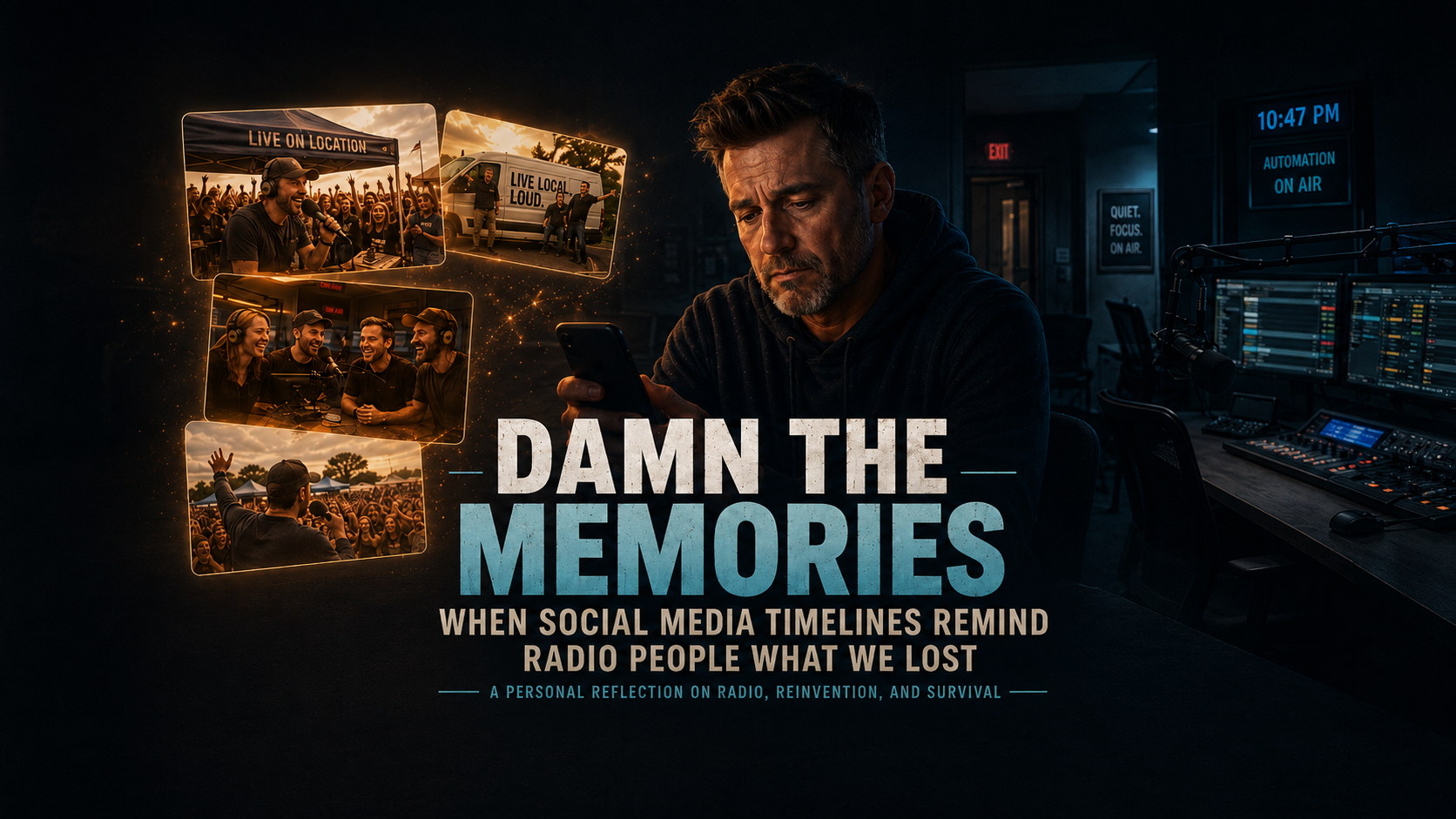
There is a particular cruelty in the timeline feature on social media. It means well. It thinks it is giving you a happy memory from your own life: a photo from a remote broadcast, a station event, a client appearance, an award night, a packed calendar, a staff shot, a studio moment, or a time when the business still felt big enough to hold everybody who loved it.
For most people, those memories are sweet. For a lot of us in radio, they can land in a completely different place. The app thinks it is handing us nostalgia. What it really hands us, sometimes, is grief.
I know that feeling too well. In 2018, I bought a house in Corpus Christi with a huge pool and a built-in hot tub. It felt like the kind of thing radio was supposed to make possible if you worked hard enough, got good enough, and built enough value in the market.
I had three years in a row where I made six figures. We had clients. We had remotes every week. There was energy around the stations and energy around the job. I was ranked Top Local Personality in three major categories, including one category usually won by a popular TV weatherman.
I was asked to emcee the Lighted Boat Parade on the Corpus Christi waterfront by the organizers.
Those things mattered to me.
It felt like proof that local radio still had muscle, and that the work we did every day could still make you visible, valuable, and part of the community.
That chapter was followed by three years of being willing to do almost anything to get back to radio. I took jobs in really small markets. I chased openings. I kept posting. I kept trying to stay visible. Many of you saw the posts every day from the beach. Some of them probably looked peaceful.
.Some of them probably looked like a guy trying to enjoy life. But underneath a lot of those pictures, I hurt.
It is emotional to look inside yourself, know you still have so much to give, and feel like there is no one willing to invest in it.My determination not to be defeated was unstoppable, but that did not mean it was painless. I had reinvented myself and restarted my career a few times over the years.
Radio people do that. We move. We rebuild. We take the next shift, the next market, the next format, the next challenge.
But what started happening in the 2020s felt different. Suddenly, there were no radio job openings in any of the "old faithful trades" Every day, we saw more layoffs, more competition for the jobs that were out there.
This did not feel like the usual career turbulence. It felt like the structure of the business itself was changing under our feet.That is why those pictures come back up in my timeline and do not always make me smile.
Not because I regret that time, and not because the memories are bad. They hurt because they remind me of a version of radio that felt bigger, healthier, more alive, and more willing to reward the people who poured themselves into it.The strange trap of social media memories is that the app thinks it is showing you a happy picture.
What you see is a different life.
You see the house, the pool, the hot tub, the remote tent, the station van, the client, the co-workers, the recognition, the momentum. You see a business where there seemed to be room to grow, room to earn, room to become somebody. Then you look at the business now, and it is hard not to feel like you are staring at evidence from another civilization.
This is not just nostalgia talking. According to BLS data carried by FRED, U.S. radio broadcasting employment was 92.1 thousand jobs in 2014. By 2025, it was 66.0 thousand. That is a drop of roughly 28% in just over a decade. Go back to 2008, when radio broadcasting employment was 111.4 thousand, and the decline to 2025 is about 41%.
Those are not abstract numbers to people who have lived through consolidation, layoffs, empty offices, and “we’re not replacing that position.” Those numbers are somebody’s midday shift, somebody’s production room, somebody’s promotions job, somebody’s first chance, somebody’s career path disappearing before they ever got to climb it.The newsroom side has felt it too.
Pew Research Center reported that radio broadcasting newsroom employment dropped from about 4,600 workers in 2008 to about 3,400 by 2020, a 26% decline. Again, that is not just data. That is the local reporter who used to know which sheriff would call back. That is the person who could turn a city council meeting into something listeners actually understood. That is one more local voice gone from a medium that built its reputation on being close to the community.
The pay picture explains another part of the ache. The Bureau of Labor Statistics reported that the median hourly wage for broadcast announcers and radio disc jockeys was $21.96 in May 2024. For those working specifically in radio broadcasting stations, the median was $18.95. RTDNA’s 2024 radio salary research was even more sobering on the news side, reporting that overall radio salaries fell 2.5%, and that after inflation, real wages dropped 5.6%
.That is why the old pictures hit so hard. Many of us remember a time when the work was difficult, but the building felt alive. There were more people in the hallway. There were more offices with lights on. There were more live shifts, more local shows, more remotes, more weekend board ops, more interns, more promotions people, more production help, more sales assistants, more characters. The station had noise. Somebody was cutting a spot. Somebody was dragging a banner stand to the van. Somebody was arguing about a segue. Somebody was trying to find the prize box. Somebody was eating lunch in the studio because they could not leave the board.
It was messy, inefficient, loud, and sometimes ridiculous. It was also human.Now, in too many places, the logs still run, the songs still play, the spots still clear, the stream still streams, and the tower still throws a signal across town.
But the building feels different.
The job feels different. The dream feels different. The person on the air is often not just the person on the air anymore. They are writing the web story, making the social post, cutting the client spec, voicing the promo, checking the automation, helping sales, producing the podcast, updating the contest page, making the meme, and still trying to sound loose, local, funny, relaxed, and happy.
Even the BLS job description reflects how much the role has widened. It notes that announcers and DJs may need computer skills, research skills, writing skills, social media interaction, and in some cases may produce and record shows from home. BLS also projects employment for broadcast announcers and radio disc jockeys to decline 6% from 2024 to 2034, citing continued consolidation and the possibility that more stations may operate without live DJs or with AI DJs
.That is the paragraph every radio person reads and thinks: yes, exactly. That is what happened. The job did not just get smaller. It got lonelier. It got heavier. It got spread thinner.
The joy did not vanish all at once. It leaked out slowly, one unfilled position at a time, one “can you just handle this too?” at a time, one dark studio at a time.And still, here is the curse: we love it. We still love it. We still know what a great break feels like. We still know when a jingle lands. We still know the difference between a commercial that fills 30 seconds and a commercial that sells something.
We still believe a local radio station can matter during a storm, a ballgame, a fundraiser, a morning commute, a Friday afternoon, or a community tragedy. We know what radio can do. We also know what radio has done to a lot of the people who kept doing it.
That is why the timeline can feel cruel. It is not just showing you younger skin or a better shirt or a fatter remote calendar. It is showing you a version of yourself who believed there would always be another job, another client, another full staff, another packed building, another way up. It is showing you a business that made room for more people, and maybe a version of your own life where the reward seemed more connected to the effort
.But I do not think this story has to end with grief
It cannot just be another radio person saying, “You should have seen it back then.” That may be true, but it is not enough.
The harder truth is that the old version of the business may not come back in the form we remember. We can mourn that without pretending otherwise. We can admit what was lost without spending the rest of our lives waiting for someone else to rebuild the hallway.
At some point, many of us have to ask a different question. If the old job titles are disappearing, where does the talent go? If the old ladder is broken, what do you build instead? If radio taught you timing, writing, production, emotion, theater, persuasion, melody, urgency, local connection, and the ability to make people feel something fast, those skills still have value. They may just need a different container.
That is the transition I have been trying to make. Not because I stopped loving radio, but because I had to find a place where the part of me that loves radio could still breathe. I had to take the skills the business gave me and aim them somewhere they could still make a difference.
For me, that has meant staking out my own niche, building around production, creative strategy, jingles, imaging, writing, local advertising, and the kind of audio work that still rewards instinct and craft. That transition is not always glamorous. It can feel lonely. It can feel like starting over after you already proved yourself. It can feel like you are betraying the version of yourself who wanted the big shift, the big title, the big office, the big market, the big validation.
But maybe the real betrayal would be refusing to grow while the business changes around you.Maybe the next great radio career does not look like the last one. Maybe it is still inside a station. Maybe it is beside a station. Maybe it is in production, podcasting, digital content, voice work, consulting, creative services, branded audio, local events, or something you build yourself because the business no longer has a neat box for what you do best.That does not make the old pictures hurt less.
When my timeline shows me Corpus Christi, the house, the pool, the hot tub, the awards, the remotes, the clients, the beach posts, and that version of my life, I still feel it. I miss the certainty. I miss the momentum. I miss the feeling that radio had a big enough future to hold everybody who cared enough to work for it.
But maybe the timeline is not finished with us.Ten years from now, it may bring up a different kind of memory. Maybe not a staff photo. Maybe not a remote shot. Maybe not the old hallway. Maybe it will be the first client who believed in your new idea, the first project you built on your own, the first article that made people see you differently, the first time your radio skills made sense outside the old radio structure.
Maybe it will show you the moment you stopped waiting for the business to validate you and started building a place where your talent could be useful again. Maybe it will remind you of the year you made the transition that redefined your career, the year you found your lane, the year you proved your talent still mattered.
Maybe one day, the timeline will not remind us only of the radio life we lost, but of the moment we found a new way to make the talent that got us there matter again.