
Attention Radio Stars: You Can Be Popular, Talented, and Still Be Gone by Lunch
The latest iHeart layoffs are not just an iHeart story.
They are a warning flare for everyone still drawing a paycheck in radio.
And I know what that warning flare feels like.
Not as a theory.
Not as a headline.
Not as somebody sitting on the sidelines taking cheap shots at a company.
I know what it feels like to have the job end. I know what it feels like to be marched out. I know what it feels like to have a box in your hand, your stomach in your throat, and your dignity somewhere on the floor while people who probably could not have done half of what you did suddenly act like they hold the keys to your future.
I have lived that walk.
And let me tell you something. It is humiliating.
It does not matter how many ratings battles you fought. It does not matter how many hours you gave. It does not matter how many clients you helped. It does not matter how many holidays you worked, how many shifts you covered, how many fires you put out, how many times you showed up when the company needed you.
When that moment comes, you are not the history. You are not the memories. You are not the wins. You are not the guy who saved the day.
You are the person holding the box.
And that is a brutal thing to learn the hard way. I also know something else.
Some of the people who seemed so powerful in that moment did not exactly go on to build empires. Some of the people who helped make those decisions have since had their own failures, their own professional reckoning, their own proof that being in charge on one bad day does not make you right, brilliant, or permanent.
That matters.
Because when you get cut, you can start believing the worst thing about yourself. You start asking, “Was I not good enough?”
Maybe you were. Maybe you were very good. Maybe you were better than some of the people making the decision. Maybe the decision was never really about your talent at all. That is why this matters so much right now.
The latest iHeart layoffs are painful because they remind us of something radio people do not want to admit.
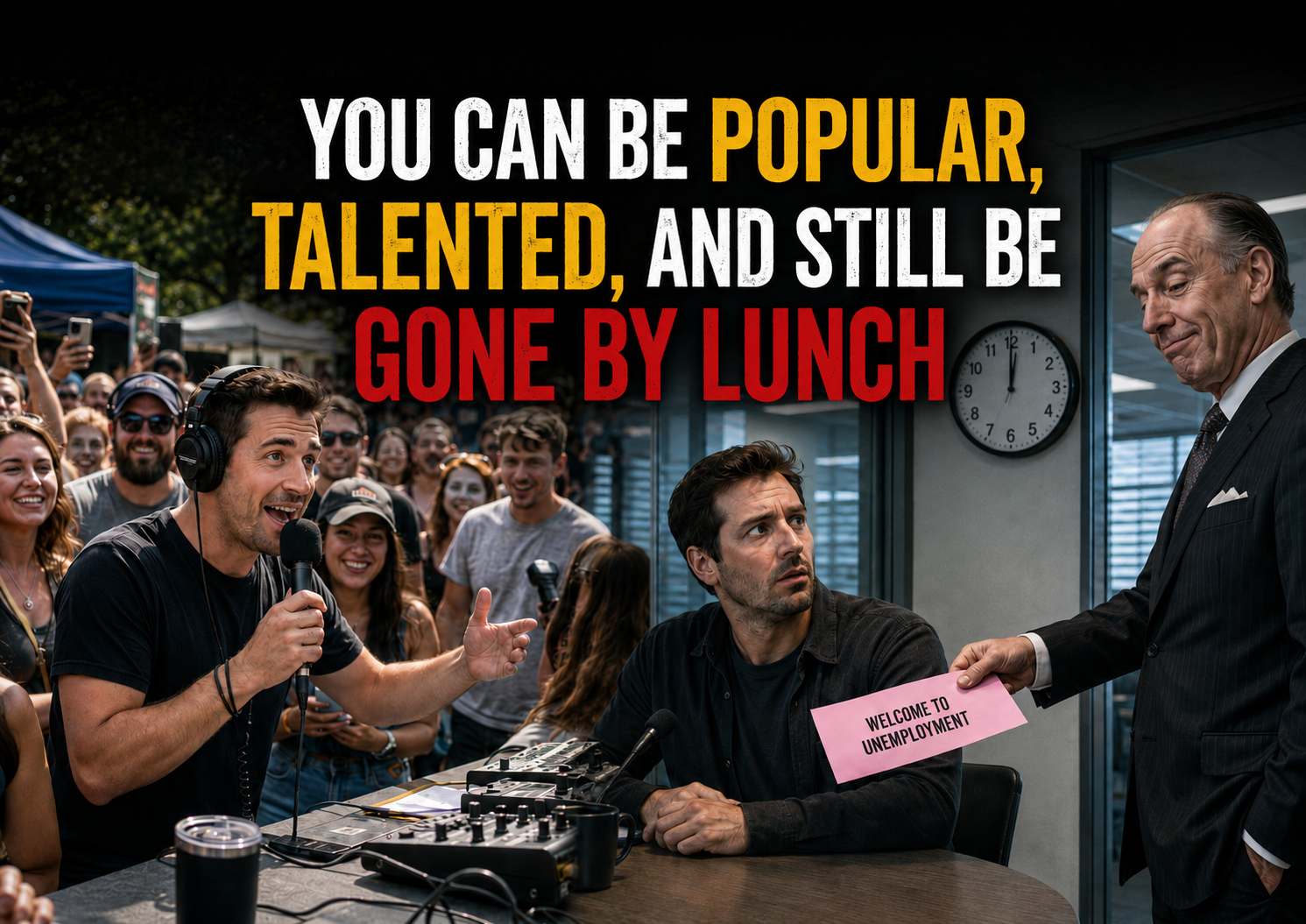
You can be popular. You can be talented. You can be loyal. You can be useful. You can be loved by listeners. You can be trusted by clients. You can be known all over town. And still, one corporate restructuring can erase your position before lunch.
That does not mean you are worthless.
It means you must stop letting a company be the sole owner of your future.
According to Radio Ink’s report, the latest iHeartMedia layoffs hit programming across dozens of markets and came as part of a larger cost-cutting campaign tied to roughly one hundred fifty million dollars in targeted annualized savings.
That is the part we have to face. This was not just a bad week for some radio people. This was business. Cold business. Spreadsheet business. Strategy deck business.
People who gave years, sometimes decades, to stations and communities found out what many of us have already learned the hard way.
The company may appreciate you.
The company may even like you.
But the company is still going to protect the company first.
And honestly, that should not shock us anymore.
iHeartMedia’s own first-quarter report said the company was launching a new fifty million dollar annualized cost-savings program in the second half of 2026, on top of one hundred million dollars in in-year savings already announced.
At the same time, the company reported first-quarter revenue was up. Digital audio was up. Podcasting was up.
That is the sentence every radio person should tape to the wall.
Revenue can be up, and people can still be cut.
Digital can be growing, and people can still be cut.
Podcasting can be growing, and people can still be cut.
The ship does not have to be sinking for people to be thrown overboard.
Sometimes the company just wants a different ship. A cheaper ship. A more centralized ship. A more automated ship. A ship with fewer people on it. And before anybody turns this into some simple anti-iHeart rant, that is not what I am doing.
This is bigger than iHeart.
This is every company.
This is every cluster.
This is every broadcaster still walking into a building thinking loyalty is the same as security. It is not. I wish it were.
It used to feel like there was some kind of deal.
You gave the company everything, and maybe the company would protect you.
You showed up. You worked hard. You moved markets. You learned the automation system. You covered the remote. You did the charity event. You voiced the last-minute spot. You helped the seller. You took the call from the angry client. You filled the weekend shift. You answered the phone on your day off. You sacrificed family time because “that’s radio.”And in your heart, you hoped somebody was keeping score.
Here is the truth.
You need to keep score yourself.
You need your own receipts.
Do not assume the company will remember what you built.
Save the airchecks.
Save the spots.
Save the imaging.
Save the client testimonials.
Save the ratings stories.
Save the campaigns that worked.
Save the pictures from the events.
Save the proof that you did more than occupy a chair.
Because the day your email is shut off is not the day to start collecting evidence that you mattered. I learned that the hard way too. I also learned its important to change all your personal social media account passwords the minute you set your box of shame in the backseat before you get home. In some cases, your old company will still acces them, even though it is of dubious legality.
When you are marched out, you are not thinking clearly. You are embarrassed. You are angry. You are scared. You are replaying every moment. You are wondering who knew. You are wondering who did not say anything. You are wondering how you are going to explain it to people.
And the worst part is, you are trying not to look broken while you feel completely broken.
That is why I am saying this now to anyone still working in radio.
Do not wait for the box.
Build before the box.
Build your LinkedIn.
Build your demo.
Build your contacts.
Build your side income.
Build your proof.
Build your reputation outside the walls of your current employer.
That is not disloyal.
That is survival.
And survival matters.
The Bureau of Labor Statistics projects employment for broadcast announcers and radio disc jockeys to decline from 2024 to 2034. BLS specifically points to consolidation and even the possibility that some stations may operate without live DJs or with AI DJs.
That does not mean talent no longer matters. It means the old chair may not be there forever. The skill still matters. The communication still matters. The ability to connect still matters. The ability to sell a moment, tell a story, make a client sound better, make a promotion work, make a fundraiser matter, make a community feel seen — all of that still matters.
But you may have to carry those skills somewhere else. And if you are smart, you will not wait until the building no longer wants you to figure out where else those skills can go. Radio people have more transferable skills than they think.
We know how to write fast.
We know how to speak under pressure.
We know how to make boring things sound interesting.
We know how to sell urgency.
We know how to calm clients.
We know how to show up in public and represent something bigger than ourselves.
We know how to turn attention into action.
That is marketing.
That is public relations.
That is content.
That is branding.
That is sales support.
That is podcasting.
That is event hosting.
That is production.
That is business development.
That is storytelling.
That is valuable.
But you have to stop seeing yourself only as your current job title.
You are not just the midday person.
You are not just the morning show producer.
You are not just the account executive.
You are not just the promotions person.
You are not just the imaging person.
You are not just the program director.
You are not just the person they might decide they can live without.
You are a skill set.
You are a voice.
You are a brand.
You are a problem solver.
You are a relationship builder.
You are a creative engine.
And if your current company cannot or will not fully value that, somebody else may.
Maybe not right away.
Maybe not easily.
Maybe not without fear.
But the day after a layoff is not the end of your value.
It is only the end of that particular arrangement.
That is hard to believe when you are standing there with the box.
But it is true.
Now, I do not want this to become one of those “radio is dead” articles.
I hate that lazy line.
Radio is not dead.
According to Nielsen’s Q1 2026 audio report, radio still commands the dominant share of ad-supported audio listening time in America.
According to BIA’s 2026 local advertising forecast reported by Radio Ink, over-the-air and digital radio together are projected to clear more than twelve billion dollars in 2026.
So no, radio is not dead.
But the staffing model has changed.
The protection has changed.
The loyalty equation has changed.
The assumption that being good, local, dependable, and loved will save your job has changed.
That is the point.
Radio still has value.
The question is whether radio people are protecting their own value.
For years, many of us gave the industry everything.
Our voices.
Our energy.
Our creativity.
Our nights.
Our weekends.
Our holidays.
Our relationships.
Our identity.
Our belief.
Some of us gave so much that when the job ended, we did not know where the company stopped and we began.
That is dangerous.
Love the work.
Do not lose yourself in it.
Care about the station.
Do not let the station become your only plan.
Serve the listeners.
Do not forget to serve your own future.
If you are still in the building, do great work. Be proud of it. Help the clients. Support the team. Make the station better. Be the kind of radio person this business still desperately needs.
But build.
Build while you are still employed.
Build while your confidence is still intact.
Build while you still have access to your work.
Build while your name still opens doors.
Build before fear makes every decision for you.
Because you can be popular, talented, and still be gone by lunch.
I know.
I have taken that walk.
I have carried that box.
I have felt that humiliation.
I have also learned that the people who take your job do not get to take your talent.
They do not get to take your voice.
They do not get to take your creativity.
They do not get to take your relationships.
They do not get to take your ability to make people listen, laugh, care, buy, show up, remember, and feel something.
They can end the job.
They do not get to end you.
So give radio your best.
Just do not give it your only plan.