
The Fatal Flaw in “AI vs. Human” Research: It May Be Testing Fear, Not the Future
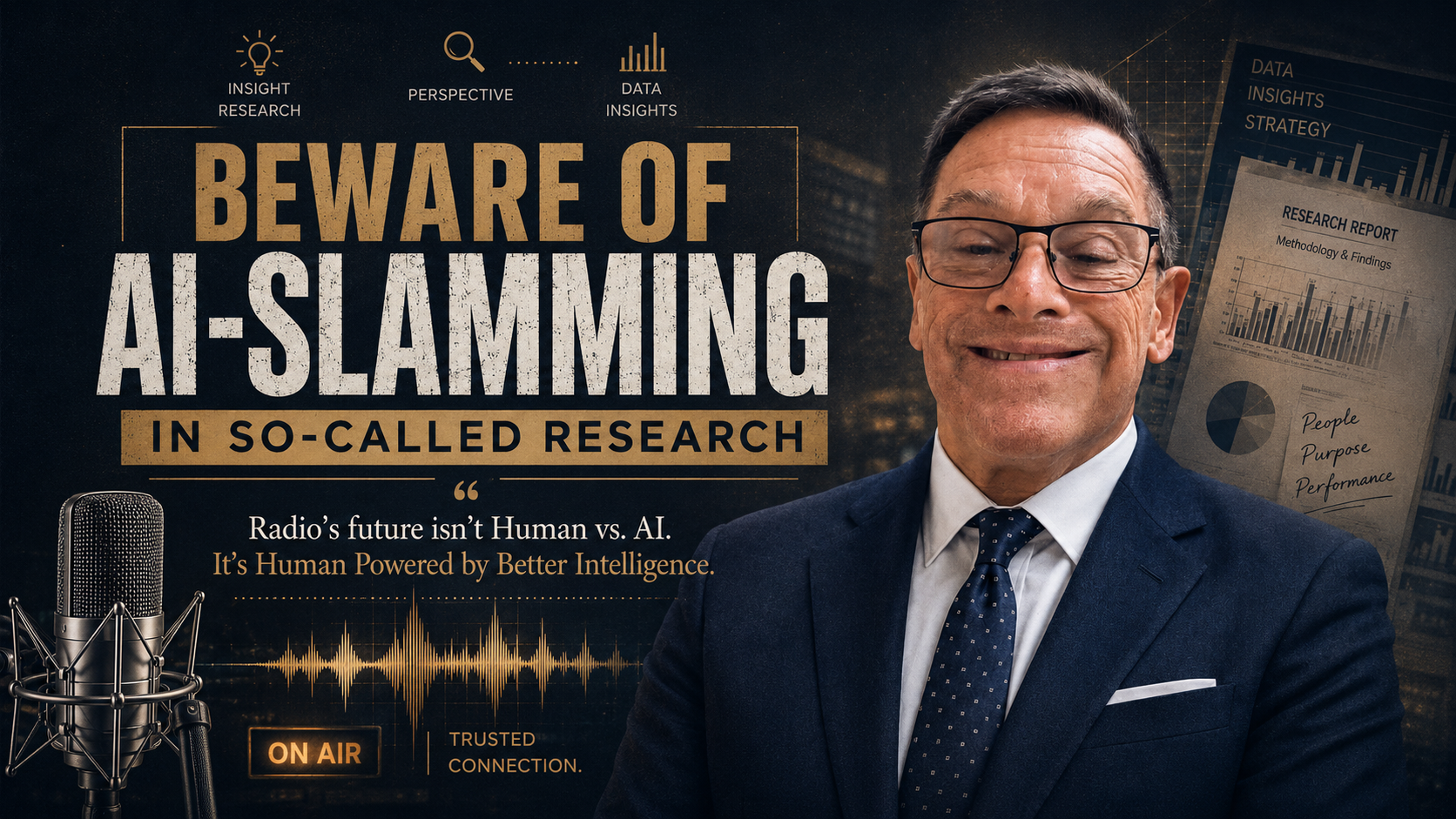
Beware of AI-Slamming in So-Called Research
By Joe "Crash" Kelley sonicattention.com
The radio industry should be very careful right now. Not because research is bad. Research is essential.
Not because human connection is overrated. It is not. Human connection is still one of radio’s greatest advantages. And not because AI is some magic solution that should replace talented programmers, personalities, promotion people, producers, or local broadcasters. That is not the point either.
The caution is this: we need to start reading AI-related research with a much sharper eye, especially when the study is framed as “AI versus human” and the methodology is not clearly shown. Because once you frame something as “AI,” you may have already changed the answer.
If a listener is asked, “Would you rather have a human radio personality or an AI radio personality?” that is not a neutral question. It loads the emotional deck before the respondent ever answers. Most people hear “AI” and immediately think of replacement, cold automation, job loss, fake voices, fake emotion, or technology taking over something personal.
That does not necessarily tell us what they would think of a better radio product. It tells us what they think of the label. That distinction matters.
There is a big difference between asking people whether they want “AI radio” and testing whether AI-assisted programming can create a better listener experience when guided by real human strategy, local knowledge, audience research, music testing, behavioral data, and experienced programmers.
Those are two completely different questions.
One question triggers emotion. The other tests performance. And if a study does not clearly explain how the question was asked, who was asked, what they were shown or played, whether the test was blind, how the choices were framed, and whether “AI” was presented as a tool or as a human replacement, then the industry should take the conclusion with a very large grain of salt.
Especially if the headline basically becomes: “Listeners prefer humans over AI.”
Of course they do, when the question is framed that way. The issue is not whether country radio, rock radio, urban radio, news/talk, or any other format needs human connection.
It absolutely does.
The issue is whether AI is being fairly evaluated as a behind-the-scenes tool that can help humans do better work, or whether it is being framed as the villain before the research even begins. That is where some of these studies can become fatally flawed.
If you tell listeners they are choosing between a real human being and a machine, many will choose the human. That result may feel satisfying, but it may not prove what people think it proves.
It may not prove that AI-assisted programming is bad.
It may not prove that AI cannot help build better music logs.
It may not prove that AI cannot help identify audience patterns.
It may not prove that AI cannot improve contesting, imaging, promotions, scheduling, copywriting, prep, targeting, or music flow.
It may only prove that people do not like the idea of being emotionally served by something described to them as artificial. That is a very different conclusion.In fact, when used correctly, AI may be one of the most powerful tools radio has ever had for making human programming smarter.
AI can analyze massive amounts of real human interaction. It can help correlate music research, streaming behavior, market trends, social reaction, listener feedback, contest response, sales categories, demographic behavior, daypart performance, and years of format knowledge.
It can help extrapolate from the data and reveal patterns that even strong programmers may miss when they are buried under daily workload.
That does not make the final product less human.It can make the final product more responsive to humans.
A great programmer still has to know the market. A great air talent still has to connect. A great production director still has to create emotion. A great promotions person still has to understand what gets people moving. A great seller still has to know the client’s pain. AI does not replace that. But it can sharpen it.
It can give skilled people more time, better insight, faster creative options, and stronger data support. It can help generate playlist possibilities based on the exact kind of human research and interaction radio has relied on for decades. The difference is that AI can process, compare, and model that information at a speed and scale that humans cannot.
That should not scare smart broadcasters. It should excite them.
But it should also come with a warning.
This is not an argument for companies to replace human talent with tools. It is an argument for human talent to claim those tools before the spreadsheet people weaponize them.
Because that danger is real.
AI can create average content at incredible speed. Average headlines. Average blogs. Average liners. Average promos. Average imaging. Average social posts. Average copy. The middle layer of commodity content is already being automated, and there will be no shortage of people in corner offices who see that as a reason to cut deeper.
That would be a mistake.
Radio’s advantage has never simply been production volume. It has never been just “who can make more stuff faster.” Radio’s real advantage has always been trusted attention: voices people know, personalities they believe, local connection, shared experience, humor, vulnerability, timing, taste, and emotional context.
AI can help create output. But humans create emotional gravity.
That distinction matters, because in a world overflowing with synthetic content, real human connection becomes more valuable, not less.
Radio staffs are smaller. Expectations are bigger. Turnaround times are tighter. Sellers need ideas faster. Programmers need sharper insight. Production departments are being asked to create more work, in more formats, for more platforms, with fewer people and fewer hours.
That pressure is not going away.
So the question is no longer whether AI belongs in the building. It already does.
The real question is whether you are going to use it intelligently to become more valuable, more productive, and more creative — or whether you are going to stand still while someone else learns how to do your job faster, smarter, and at a higher volume.
The future will not belong to people who simply “use AI.”It will belong to people who know how to direct it, question it, shape it, edit it, humanize it, and turn it into better radio.
But ignoring it is not a strategy .If you are waiting for permission to take AI seriously, you are already behind. And in today’s radio environment, being behind is not a matter of if it catches up with you. It is an ever-ticking clock of when.
What should scare broadcasters is not AI itself. What should scare broadcasters is bad research, lazy conclusions, and studies that frame the issue as an emotional cage match between “real people” and “robots.”
That is not where the real future is. The real future is not AI versus human. The real future is human connection amplified by better tools. So when the next AI study lands in your inbox, read it carefully.
Was the methodology published?
Were the actual questions shown?
Was the sample clearly defined?
Were people reacting to real audio, real playlists, real programming examples, or just the word “AI”?
Was AI presented as a replacement for people, or as a tool used by people?
Were the choices tested blindly?
Were the human and AI examples equal in quality?
Were respondents evaluating the output, or were they reacting to the label?
Those questions matter. Because if we are not careful, the industry may use flawed research to protect old assumptions instead of asking better questions. Radio should absolutely defend human connection. But it should not confuse human connection with resistance to better tools.
A study can be directionally valuable and still be methodologically incomplete when its most clickable conclusion depends on an emotionally loaded “human versus AI” frame.
The winners will not be the companies that blindly replace humans with AI. That would be foolish. The winners will also not be the companies that dismiss AI because a poorly framed study told them listeners do not like “machines.”
The winners will be the broadcasters who understand the difference.
They will use AI to strengthen strategy, accelerate creative, improve music decisions, deepen local relevance, and give talented people more power to do what only talented people can do. That is the conversation the industry should be having. Not “AI or human.”
Human, powered by better intelligence.