
The Older I Get, the More I Wish People Could Meet Me Again
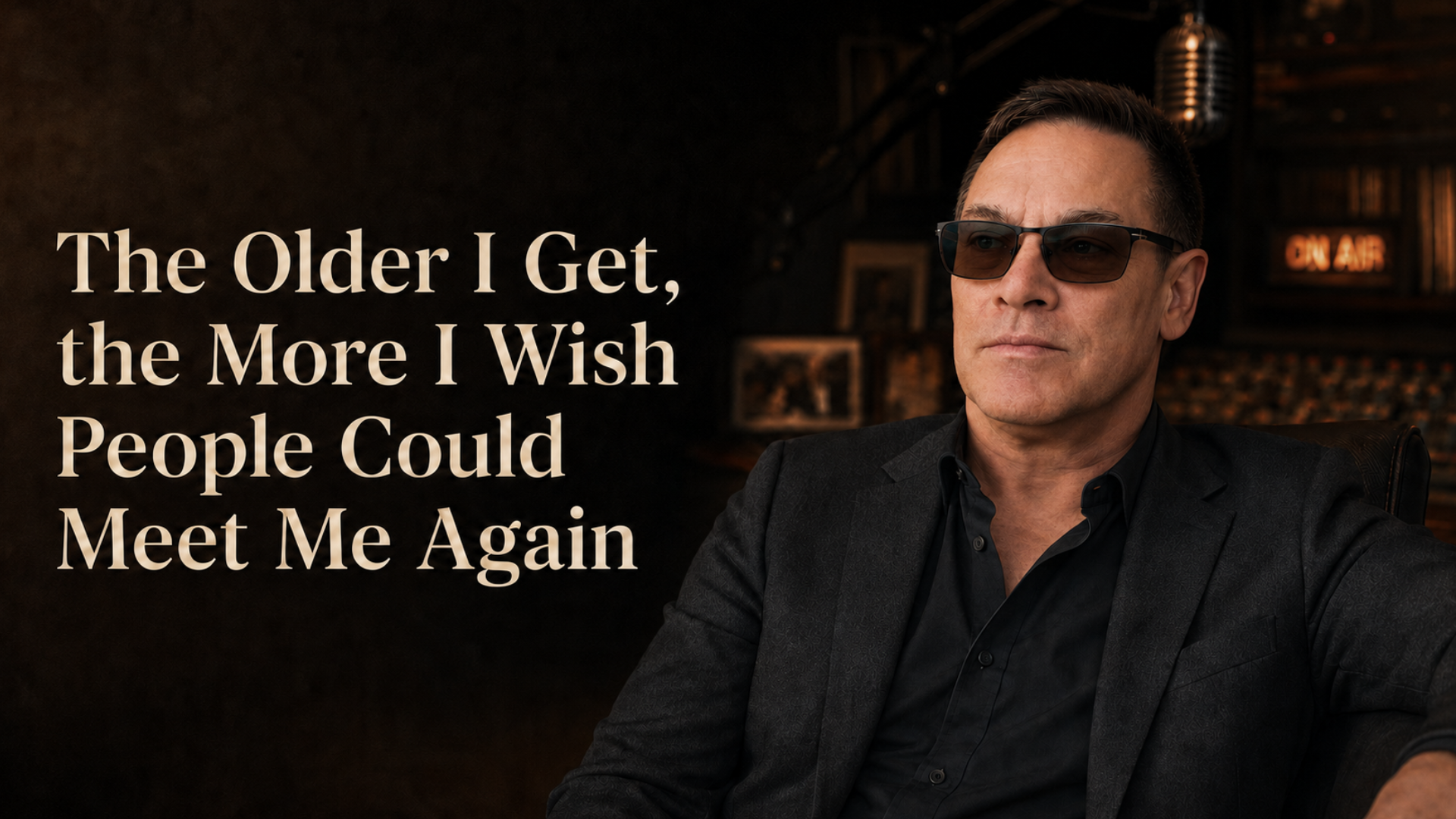
On aging, second chances, hard-earned wisdom—and why our best work may still be ahead of us.
One of the unexpected gifts of building SonicAttention.com has been reconnecting with people I worked with years ago—some of them nearly 30 years ago.
There is something genuinely special about being able to work with someone again after that much time has passed. We may be in different cities, working for different companies and dealing with an industry that looks very different from the one we knew, but suddenly we are creating something together again. A voice, a melody, a commercial or a new idea can close a 30-year gap surprisingly fast.
But those reconnections have also made me think about the person some of those people may remember.
Like most of us, I would like to believe I have become a better person as I have gotten older. I know I have become a different one.
When I was younger, I was very opinionated. I was not always the consummate team player. I frequently thought I knew more than everyone else in the room, and I was not shy about letting people know it. I complained too much. I could become angry too quickly. I did not always stop long enough to hear what someone else was trying to tell me—especially when I had already decided I was right.
At the time, I probably called that passion. Some of it was passion. Some of it was also immaturity.
As I worked my way into management and began confronting challenges I could not solve with a clever idea or a strong opinion, life started correcting me. Managing people, budgets, expectations, ratings, revenue and constant change has a way of showing you how little you really know. Decisions that once looked easy from the other side of the desk were no longer easy when the consequences belonged to me.
I learned that the person disagreeing with me was not necessarily working against me. Sometimes that person knew something I did not. I learned that listening is not simply waiting for the other person to finish so you can explain why you are right. I learned that leadership has far more to do with understanding people than commanding them.
I wish I could say I learned every one of those lessons immediately. I did not. Most of the lessons that matter take time, and some of them arrive through circumstances we never would have chosen.
Three years ago, my mother suffered a stroke. I was determined that I would not simply force her into nursing care and let someone else assume responsibility for her life. Caring for her changed mine.
Caregiving teaches lessons that a title, an office or a management book never can. It teaches you that another person’s needs do not always arrive at a convenient time. It teaches you patience when you do not feel patient. It teaches you to listen differently—to hear what may not be said clearly and to pay attention to what someone is really trying to communicate. It teaches you that being needed is not the same thing as being in charge.
Most of all, it teaches you to give. That experience has softened parts of me that needed softening. It has made me slower to anger and quicker to consider what someone else may be carrying. I am still opinionated. I still care deeply about the work. I still know I can be stubborn. But I hope I now bring more patience, humility and compassion into the room with me.
That is why reconnecting with people from my past can be both wonderful and uncomfortable. I want them to see the person I am now, not only the person they may remember. I do not say that because I want to erase my past or pretend I never made mistakes. I say it because the person they knew was still very much a work in progress.
I suppose I still am.
There is a strange irony in growing older in this business. By the time many of us have accumulated the experience, judgment and humility to do our best work, there are fewer opportunities to do it. Radio has contracted. Jobs that once required several talented people have been consolidated into one position—or eliminated entirely. Too often, experience is treated as an expense instead of an asset.
In some ways, I am less in demand now than I was when I knew far less, listened less carefully and had much more to learn.
That could make a person bitter. On some days, I would be lying if I said it did not hurt. But something else has happened that I never expected.At a point in life when I thought I might be winding down and focusing on retirement, I am more creatively energized than I have been in years.
The new tools emerging around us—especially artificial intelligence—have opened doors I did not know would exist at this stage of my career. Through Sonic Attention, I can take the experience I have accumulated in radio, writing, production, programming and advertising and combine it with technology that allows me to create in ways that once would have required a much larger staff, a much larger studio and a much larger budget.
I can develop a concept with an old colleague in another market. I can write lyrics, shape melodies, test different approaches, build a campaign and turn an idea into something a client can actually hear. The technology does not replace the years behind the idea. It amplifies them.
That distinction matters.
AI cannot care about a community. It cannot understand a local advertiser simply because it has processed enough words. It cannot substitute for taste, judgment, empathy or the instinct that comes from spending decades learning why one piece of creative connects and another one disappears into the commercial break.
But in the hands of people who possess those things, it can be transformative.
I believe the same lesson applies to radio itself. Our industry has fewer resources than it once did, but fewer resources do not have to mean less imagination, less service or less local connection. The tools available today can help us restore some of what consolidation and shrinking staffs have taken away. They can help talented people produce more, respond faster, create stronger advertising and serve their communities more completely.
The answer is not to use technology to remove every human being from the process. The answer is to use technology to make capable human beings more powerful.Radio does not need to become what it was 30 years ago. Neither do I.
But I believe there are values from that era worth recovering: service, local involvement, personality, creativity, relationships and the understanding that what comes out of the speakers should matter to the people on the other side of them. Today’s tools may give us a chance to provide some of that service again, even with fewer people and fewer resources—if we use them with wisdom rather than simply using them to make things cheaper.
I do not pretend to have every answer for radio. Age has cured me of that. But I believe I understand some of what we have lost, and I believe the experience many of us carry can help determine what should come next.
Perhaps that is one of the gifts of getting older. We finally begin to understand that wisdom is not knowing more than everybody else. Wisdom is knowing how much there is still to learn, being willing to hear the people around us and finding new ways to use what life has taught us in service of something beyond ourselves.
And there is something else I want to say.
If you knew me then and we have not talked in a long time, reach out. I would like the opportunity to know you as you are today, and I would be grateful for the chance to let you know me as I am today.
Maybe we can share some old stories and create some new ones. Maybe we can laugh about the experiences that once seemed so serious. Maybe there is even something creative waiting for us to build together.
And if you need an apology from me before that process can begin, please take this as one.
I know I did not always listen as carefully as I should have. I did not always respond with patience, and I may not have treated every relationship with the care it deserved. I cannot go back and handle those moments differently, but I can acknowledge them honestly. I can tell you that I am sorry. And I can meet you now with more humility than I had then.
The door is open.
So when someone from 20 or 30 years ago gives me the opportunity to create with them again, I am grateful for more than the project.
I am grateful for the chance to meet them again as the person I am now.
I am grateful that, after all these years, I am still excited by what can be created next.And I am grateful to discover that neither my story nor radio’s story has to be finished simply because both of us have gotten older.
We are still becoming.