
Radio: Where Does This All End?
The Audience Is Still Here. The Humans May Not Be.
By Joe “Crash” Kelley
I have written before that radio needs people who still care. I have asked whether the people being eliminated in the latest rounds of corporate cuts will find enough new jobs elsewhere in the industry. I have argued that radio is not dead, but that parts of it are being stripped for parts by companies trying to preserve margins in a business that no longer produces money as easily as it once did.
Those questions now seem like pieces of a much larger one: Where does all of this end?
What happens when a medium that still reaches almost everybody becomes increasingly unwilling—or financially unable—to employ the people who made that reach valuable? What happens when artificial intelligence becomes capable of delivering a competent music show, inserting local information, changing its voice for different markets, mentioning the weather, reading a sponsor message and sounding convincingly enthusiastic about a festival it has never attended?
Does radio eventually automate almost everything? Does iHeartMedia—or another large company following the same economic logic—eventually create one morning show, one midday show, one afternoon show, one night show and one overnight show for every major format, then distribute those shows across the country with market-specific information inserted between songs? If that is where the economics are leading, what happens to the thousands of people who once built careers around being the recognizable voice of one station in one town?
Those questions are no longer science fiction. They are becoming business-plan questions.
The Great Radio Contradiction
The first thing we have to get straight is that radio’s audience has not disappeared. Nielsen data continues to show that AM/FM radio reaches the overwhelming majority of American adults, including a substantial percentage of younger adults. Depending on whether the measurement is weekly or monthly, radio still reaches somewhere between the high 80s and low 90s as a percentage of the adult population.
Radio also continues to command an enormous portion of the listening that advertisers can actually buy. During the fourth quarter of 2025, Americans spent nearly four hours a day with audio, and AM/FM radio accounted for approximately 61% of ad-supported listening time. Podcasts received roughly 21%, ad-supported streaming music received 15%, and satellite radio received about 3%.
The car remains one of radio’s strongest defenses. Edison Research reported that AM/FM received more than half of all in-car audio time during the first quarter of 2026. Even among listeners between 13 and 34, radio remained the largest individual in-car audio choice.
That does not mean there are no warning signs. The dashboard is changing quickly. More vehicles now include Apple CarPlay or Android Auto, and radio’s share of listening declines noticeably when those systems are available. Radio remains strong, but every year the listener is offered an easier path to Spotify, YouTube, podcasts, satellite radio and other alternatives.
This creates the central contradiction at the heart of radio’s future. The audience is not collapsing at the same speed as radio employment. The product can remain in heavy demand while the factory employs fewer people.
We have seen versions of this throughout the economy. Banks process more transactions while closing branches. Newspapers attract millions of online readers while employing a fraction of the reporters they once employed. Airlines move enormous numbers of passengers while using technology to reduce staffing and automate portions of the customer experience.
Radio can continue reaching most Americans while employing far fewer Americans. That may be the most uncomfortable possibility of all.
Reach Is Not the Same Thing as Health
The radio industry loves its reach numbers, and it should. Any product used by nearly nine out of ten adults in a typical week has an extraordinary competitive advantage.
But reach is essentially a yes-or-no measurement. Someone who hears a station for a few minutes can be counted as reached. Reach does not automatically tell us how important that station is to the listener, how long the listener remained, whether the listener remembers the personalities or whether the station is a first choice rather than a default setting in the car.
It also does not tell us whether the station can convert that audience into enough revenue to support a full local staff.
A station can continue reaching a large number of people while becoming less essential to each of them. That distinction helps explain why radio companies can present impressive audience numbers while simultaneously eliminating many of the people speaking to that audience.
The reach is still there. The revenue generated from each portion of that reach is under pressure. The company responds by trying to preserve the scale while reducing the cost of producing the product. National programming, voice tracking, automation and eventually AI are designed to accomplish exactly that.
Radio’s immediate problem is not that nobody listens. Its problem is that enormous reach no longer automatically produces enough profit to support the structure built when listeners and advertisers had fewer alternatives.
What the iHeart Numbers Really Tell Us
It is easy to reduce the iHeartMedia story to villains and victims. The victims are real. People with decades of experience have lost their jobs. Families have been disrupted. Stations have lost voices that listeners knew, and some markets have been left with little or no locally based air talent.
But the corporate decisions are being driven by numbers, and those numbers tell us where the company believes its future lies.
During the first quarter of 2026, iHeartMedia generated approximately $884 million in revenue, an increase from the previous year. Its Digital Audio Group grew rapidly, and podcast revenue also posted strong gains. At the same time, adjusted earnings declined, the company used cash during the quarter and its broadcast-heavy Multiplatform Group experienced a substantial reduction in profitability.
The company also carries billions of dollars in debt. That creates relentless pressure to produce more content, reach more listeners and serve more advertisers with fewer recurring expenses. Salaries are recurring expenses. Health insurance is a recurring expense. Local studios, program directors, producers, promotions employees and market-specific air staffs are recurring expenses.
Technology, once adopted, can be distributed across hundreds of stations without requiring hundreds of separate salaries.
The trend did not begin this summer. Over the past several years, iHeart’s reported employee count has declined while the percentage of part-time workers has increased. The company has also announced significant annualized cost-saving plans and has cited reduced employee compensation associated with modernization initiatives.
That is corporate language for a simple reality: technology and structural consolidation are being used to reduce the number and cost of people required to operate the company.
I do not believe the people running iHeart hate radio personalities. I believe they love scale. One successful personality serving one market is talent. The same personality serving 50 markets becomes an asset. A personality serving 200 markets while also producing podcasts, endorsements, social video, appearances and advertiser integrations becomes a platform.
That is the direction the economics reward.
Will the Industry Absorb the People Being Cut?
Some of the people losing jobs will be hired elsewhere. Good talent always has a chance to find another path. Smaller operators may see an opportunity to hire someone with a recognizable name, an established audience and valuable advertiser relationships.
Others will move into podcasts, video, production, sales, public relations, sports, digital marketing or independent voice work. Some may build businesses outside traditional radio while continuing to use the skills radio taught them.
But the traditional radio industry is unlikely to absorb everyone into comparable positions at comparable salaries.
The Bureau of Labor Statistics counted approximately 52,000 jobs at radio broadcasting stations in its most recently published detailed industry data. Only a portion of those positions were announcers and radio disc jockeys. Radio stations also employed advertising sellers, producers, directors, technicians, engineers, managers and a surprisingly small number of news reporters.
The government’s employment outlook for broadcast announcers and radio DJs projects continued decline over the next decade. Openings will occur, but most will result from people retiring, leaving the workforce or moving into different occupations rather than from the industry expanding the total number of jobs. The Bureau specifically identifies consolidation, stations operating without live DJs and the potential use of AI personalities as forces limiting employment.
The industry will have openings. It will not have enough growth to reconstruct every eliminated local air staff.
The jobs that remain will also look different. The surviving radio employee will increasingly be expected to host a show, produce audio, shoot video, post social content, record endorsements, participate in events, help develop sales ideas, understand analytics and use AI tools to multiply output.
The old model was one person, one station and one shift. The emerging model is one person, multiple stations, multiple platforms and multiple revenue responsibilities.There will still be radio careers. There will simply be fewer careers that resemble the radio careers many of us remember.
Is the Five-Show National Radio Network Coming?
My theory has been that iHeart will eventually have one morning show, one midday show, one afternoon-drive show, one night show and one overnight show for each format, with those shows distributed to stations across the country.
After looking closely at the evidence, I believe the theory is directionally correct but probably too tidy.
I do not expect every Country, CHR, Urban AC, Classic Rock or Adult Contemporary station in America to carry exactly the same five shows. Some major-market morning shows generate too much local revenue to eliminate. Certain heritage personalities are valuable precisely because they belong to a specific city. Sports, news and talk programming depend more heavily on geography. Time-zone differences, music preferences, regional culture, advertiser relationships and competitive conditions will prevent one perfectly uniform national grid
.What I do expect is something more flexible and, from a corporate perspective, more powerful: a national programming spine.
A large company may develop several primary shows for each major format instead of one. Those programs could be selected according to market size, geography, demographics or advertiser needs. Music, entertainment content, contests, celebrity interviews and recurring features could be produced nationally, while local station IDs, weather, traffic, community announcements, sponsor messages and promotional information are inserted into the network feed.
Some of those local elements will be recorded by a human serving dozens of markets. Others will be assembled automatically from approved information. Eventually, some may be generated by AI using either a synthetic personality or a licensed digital version of a real personality’s voice.
The result will not sound like an old-fashioned satellite network. It will sound local enough to avoid immediate rejection.
The listener in Albany may hear the temperature in Albany. The listener in Toledo may hear about a Toledo road closing. The listener in Corpus Christi may hear a mention of a local festival. The same underlying show can appear to belong to all three places.
That is the real technological breakthrough corporate radio is moving toward—not eliminating every local reference, but manufacturing local relevance at scale.
A single show could contain hundreds of interchangeable local elements. An AI system could rewrite the same break for different cities, adjust pronunciation, update weather, substitute a sponsor, change a contest deadline and render each version in seconds.
It would not need to fool every listener into believing the host is sitting inside the local studio. It would only need to prevent enough listeners from caring that the host is not.
Where Automation Will Strike First
Automation will not arrive everywhere at the same time. Overnight programming is the easiest target because the audience and revenue are generally lower. Nights and middays follow because they are often considered less essential to a station’s identity than mornings.
Afternoon drive becomes vulnerable when national talent can deliver a more polished show at a fraction of the combined cost of local hosts across dozens of markets. Morning radio will likely be the final major battlefield because morning shows tend to have the deepest listener relationships, the strongest endorsements, the most advertiser integration and the greatest ability to create local conversation.
Even mornings will not be protected everywhere. A local morning show that produces revenue and ratings will survive longer. A local morning show that merely exists because stations have traditionally employed local morning shows will not.
The same principle will apply to human talent generally. Corporate radio will not eliminate all people. It will concentrate its investment in the people who can be scaled.
The superstar becomes more valuable while the competent middle-class broadcaster becomes more vulnerable.
That is already happening throughout entertainment. Streaming platforms spend enormous sums on a handful of stars while filling the rest of the catalog with cheaper content. Social media rewards a small percentage of creators with enormous audiences while millions of others produce content for little or no compensation. AI will intensify that winner-take-most structure.
Radio’s future may contain fewer personalities, but the personalities who survive at the highest level may be heard in more places than any radio personality in history.
What Happens to “Guaranteed Human”?
iHeartMedia’s current public position is clear. Its “Guaranteed Human” campaign says the company intends to use AI as a tool while keeping people in control. The public message is essentially to automate the pipes, not the personality.
I understand the reasoning. In a world filling with synthetic content, “Guaranteed Human” creates a point of difference. It reassures advertisers that their messages will be delivered by recognizable people and attempts to turn humanity itself into a premium feature.
But I have always believed the promise answers the wrong question.
A human being is not automatically entertaining, authentic, prepared, locally involved or worth hearing. We have all heard human personalities who sounded more robotic than an automation system. We have heard rushed voice tracks with no connection to what happened before or after them. We have heard people mispronounce the city they were supposedly broadcasting from. We have heard generic breaks that could have aired in any market.
At the same time, AI will eventually be capable of producing audio that is smoother, more responsive and more customized than weak human radio
.The more meaningful promise would not be Guaranteed Human. It would be Guaranteed Worth Hearing.
I do not expect iHeart to announce next year that it has abandoned people and turned its stations over to robots. That would contradict its current marketing, alarm advertisers and create an unnecessary public-relations problem. I expect the definition of “human” to become progressively more flexible.
First, AI will research, schedule, edit and distribute content while a person speaks. Then AI will write more of what that person says. Licensed human voices may eventually be used to create additional material that the personality never physically recorded. The company could still describe that material as human-led, human-approved or created from an actual human performance.
Eventually, if research shows that listeners accept a fully generated personality and advertisers continue buying the product, the slogan will face the same pressure as every other promise that conflicts with profit.
I do not know whether iHeart will abandon “Guaranteed Human.” Nobody outside the company can know that. But I would not build the future of my career around the assumption that a marketing position will remain unchanged after the technology and economics behind it have changed.
Companies rarely preserve philosophical boundaries when crossing those boundaries becomes profitable and customers do not object.
Will Listeners Object to AI Radio?
Some will, but probably not in the way radio people hope.
Listeners do not generally choose a station because they have verified that a person is sitting inside the studio at that exact moment. They choose it because they like the song, the information, the mood, the personality, the companionship or the convenience.
If an AI-generated show is funny, fast, musically compatible and useful, many listeners will accept it. Some will never know. Others will know and will not care.
The resistance will become more visible when the station fails at something that requires genuine presence. A tornado is moving toward the city. A child is missing. A local employer has closed. A high school team has won a championship. A beloved community figure has died. A charity needs help. A listener arrives at a remote and wants to meet the person who has been talking about the town all week.
An advertiser may also need someone who understands why people in one market respond differently from people somewhere else. AI can provide information about a community, but information is not the same thing as a relationship.
AI can know what happened in a city. It cannot have a history with that city.
It can retrieve the score of the high school football game, but it did not stand on the sideline in the rain. It can pronounce the mayor’s name correctly after being trained, but it did not challenge the mayor when citizens needed answers. It can promote the food drive, but it will not look into the eyes of the family receiving the food.
That difference matters, but only when the station puts real people in positions where their humanity can be heard and seen.
A human reading generic liner cards between songs is not an effective defense against AI. A human who knows the audience, has opinions, creates ideas, helps businesses, responds during emergencies and participates in the life of the community is much harder to replace.
Radio will not beat AI merely by employing humans. It will beat AI by employing humans who do things AI cannot convincingly reproduce.
The Two Radio Industries That Are Emerging
I believe radio is dividing into two different businesses.
The first will be national utility radio. It will be inexpensive, technically polished, predictable and widely distributed. It will feature nationally scalable personalities, familiar music, large contests, syndicated features, programmatic advertising and increasingly sophisticated local inserts. It will provide an easy soundtrack, quick information and broad reach.
There is nothing inherently evil about that product. It may be entertaining and may generate strong ratings. National personalities can be talented, funny and emotionally meaningful. Syndication has been part of radio for generations.
But national utility radio will not truly belong to the cities where it airs. The local frequency will function primarily as a distribution outlet for a larger content system.
The second business will be premium local radio. That radio will not necessarily be live and local every minute. Few small operators can afford that anymore. It will use automation, syndicated programming and AI tools where those tools make sense, but its identity will remain rooted in a place.
Its people will be visible. Its news will matter locally. Its promotions will involve real businesses. Its programming decisions will reflect the community. It will know the high schools, churches, festivals, arguments, weather patterns, roads, accents and personalities that define the market.
It will sound like somebody cares whether the station succeeds in that particular town, not merely whether a national format performs across an entire portfolio.
The most endangered product will be the middle: stations that are not polished enough to compete with national entertainment and not local enough to offer a meaningful alternative.
Generic radio is in the greatest danger. A station cannot eliminate its local identity, fill the schedule with ordinary voice tracks, run long clusters of poor commercials, contribute little to the community and then expect listeners to remain loyal simply because the transmitter is nearby.Being geographically local is not the same as being emotionally local.
Can Local Radio Still Make Money?
Yes, but the successful local radio company will increasingly make money from more than radio spots.
Industry forecasts still project billions of dollars in annual local advertising revenue for over-the-air and digital radio. That describes a mature business, not a dead one. Traditional radio may not be generating explosive growth, but substantial revenue remains available to operators that can produce results for local advertisers.
The more revealing trend is how companies are expanding beyond the transmitter. Several radio groups now generate significant portions of their revenue and profit from digital advertising, marketing services and other nontraditional products.
That does not mean the stations are irrelevant. Their brands, audiences, sales relationships and community presence help create the foundation from which those digital services are sold.
The transmitter becomes the front door. Behind that door is a much broader local marketing operation that may include websites, search marketing, social media, video, events, podcasts, email, lead generation, creative production and programmatic advertising.
That may be the survival model for many local operators: not abandoning radio, but using radio’s reach and trust to build a broader local marketing company.
The best local salespeople will no longer sell only schedules. They will diagnose business problems and assemble solutions. The best personalities will no longer create only four hours of audio. They will create community attention across radio, video, social media, podcasts and events.
The best production people will no longer merely assemble commercials. They will build audio identities, campaigns, jingles, branded content and digital assets.
Radio still has enormous value. Radio by itself, however, may no longer support all the people and infrastructure it once did.
What the Next Ten Years May Look Like
Nobody can predict the transition precisely, but the economic and technological direction allows us to make several educated guesses.
Over the next few years, large radio groups will continue consolidating programming responsibilities. More personalities will serve multiple stations and markets. AI will be used primarily behind the scenes for research, scheduling, editing, transcription, commercial production, data analysis, social media and local-information gathering.
Companies will continue publicly emphasizing human personalities while using technology to reduce the labor required to support them.
The next stage will likely involve AI-generated local elements becoming commonplace. Weather, traffic, community calendars, contest information, sponsor messages and promotional updates can be created separately for hundreds of stations. Licensed voice models may allow recognizable personalities to deliver market-specific breaks they never personally recorded. Dynamic commercials could change according to the listener, location, time, weather or available inventory.
By the early 2030s, many music stations may be largely automated from a programming standpoint. A small number of human-led national shows could form the primary schedule, surrounded by synthetic or automated local elements.
A local cluster might employ a market manager, sellers, an engineer or regional technical specialist, a promotions or community person, a content supervisor and perhaps one key local personality instead of maintaining separate full-time staffs for every station.
News, talk and sports will retain more people because the content depends on events, opinion, interviews, accountability and local knowledge. Major-market morning shows and personalities with proven endorsement revenue will survive. Small-market operators that deliberately choose local service as their competitive advantage will also retain people.
Radio will not become completely automated. Large portions of it will become automated wherever the audience and revenue do not justify the cost of remaining human.
That is a different prediction, and I believe it is much more likely.
The Future Job in Radio
The traditional disc jockey position is shrinking, but the need for creative people who understand audio, persuasion, personality and community is not disappearing.
The future may include personalities who host one show while creating material for multiple stations and platforms. There may be local content directors who verify AI-generated information and decide what the market actually needs to know, producers who build national shows with hundreds of localized variations and voice talent who license protected digital versions of their voices for approved uses.
Creative strategists may use AI to produce better local advertising rather than merely more advertising. Community directors may create events, partnerships and revenue opportunities that cannot be generated from a national hub. Salespeople will combine radio reach with digital targeting and measurable outcomes, while local journalists distribute their reporting across radio, websites, social media, podcasts and email.
There may be fewer people in the building, but the people who remain will be expected to create more value.
That creates an opportunity for talented people willing to adapt. It also creates a danger that employees will be overloaded until they are no longer capable of doing any portion of the job exceptionally well.
Efficiency has a breaking point. One person can use technology to produce the work of several people, but that does not mean one person can indefinitely absorb the responsibility, creativity, relationships and emotional labor of an entire department without the product deteriorating.
At some point, less really is less.
The Question Radio Companies Must Answer
The question is not whether radio can be operated with fewer people. It can. The question is not whether AI can make a station sound local. It increasingly can. The question is not whether listeners will accept more national programming. They already have.
The real question is what remains after every function that can be centralized, automated, syndicated or synthesized has been removed from the local station.
What does the station still stand for? Why should a listener choose it instead of Spotify, YouTube, a podcast, satellite radio or a national streaming service? Why should a local business spend money with it instead of buying targeted ads directly from Google, Meta or Amazon?
The answer cannot merely be that radio is free and easy to use. Those remain powerful advantages, but they are not permanent guarantees. Technology continues making radio’s competitors easier to use, particularly in the car.
The answer must involve what radio can uniquely combine: mass reach, immediacy, companionship, shared experience, local credibility, human personality, community action and advertising that feels like a recommendation rather than an interruption.
When companies eliminate the people capable of creating those things, they may save money while weakening the reasons the audience and advertisers came in the first place.
So, Where Does This All End?
I do not believe radio disappears. I believe it becomes leaner, more national, more automated and more sharply divided.
The largest companies will continue trying to preserve the extraordinary reach of broadcast radio while eliminating as much duplicated local expense as possible. They will use national talent, centralized programming, artificial intelligence and automated localization to create a product that feels acceptable in hundreds of markets.
Some listeners will love it. Most will tolerate it. Many will barely notice.
At the same time, a smaller group of operators will recognize that national efficiency creates a local opening. They will not be able to beat the large companies on scale, technology or celebrity talent, so they will compete on belonging.
They will answer the phone, show up, know the town and help businesses tell better stories. They will respond when the weather turns dangerous, put real listeners on the air and create moments that could not have been produced in another state and dropped into the log
.Those operators may run fewer stations, and their staffs may still be smaller than the radio staffs of the past. They will use every technological tool available to them, but they will use technology to make people more capable—not to make caring unnecessary.
That is where I believe this ends. Not with the death of radio and not with every human being removed from every station, but with a choice between two very different ideas of what radio is.
One sees radio as a highly efficient national delivery system that can be customized just enough to sound local. The other sees radio as a local relationship that can use national content and technology without surrendering its identity.
Both models may survive.
Only one will still feel like somebody is home.
The mission for those of us determined to create great local radio—and reject the idea that our stations should become little more than outlets for a national delivery system—is to make the local model as profitable as it is meaningful. We must elevate our communities, strengthen local businesses and create such unmistakable value that the national model feels not merely less personal, but less effective.
And we should never remove from the equation the rise of the unexpected visionary: someone who sees emerging technology not as a reason to erase radio’s humanity, but as a way to restore the best of what made radio great in the first place. The next great radio model may not look like the past, but it could recover its imagination, intimacy, local connection and sense of shared experience.
Technology does not have to be the machine that finishes radio. In the right hands, it may become the tool that brings it home.
If we fail to care enough to make this happen we can avoid the real warning in all of this. Radio’s audience may still be there. The transmitters may still be operating. The commercials may still be playing, and the quarterly reach presentation may still look impressive.
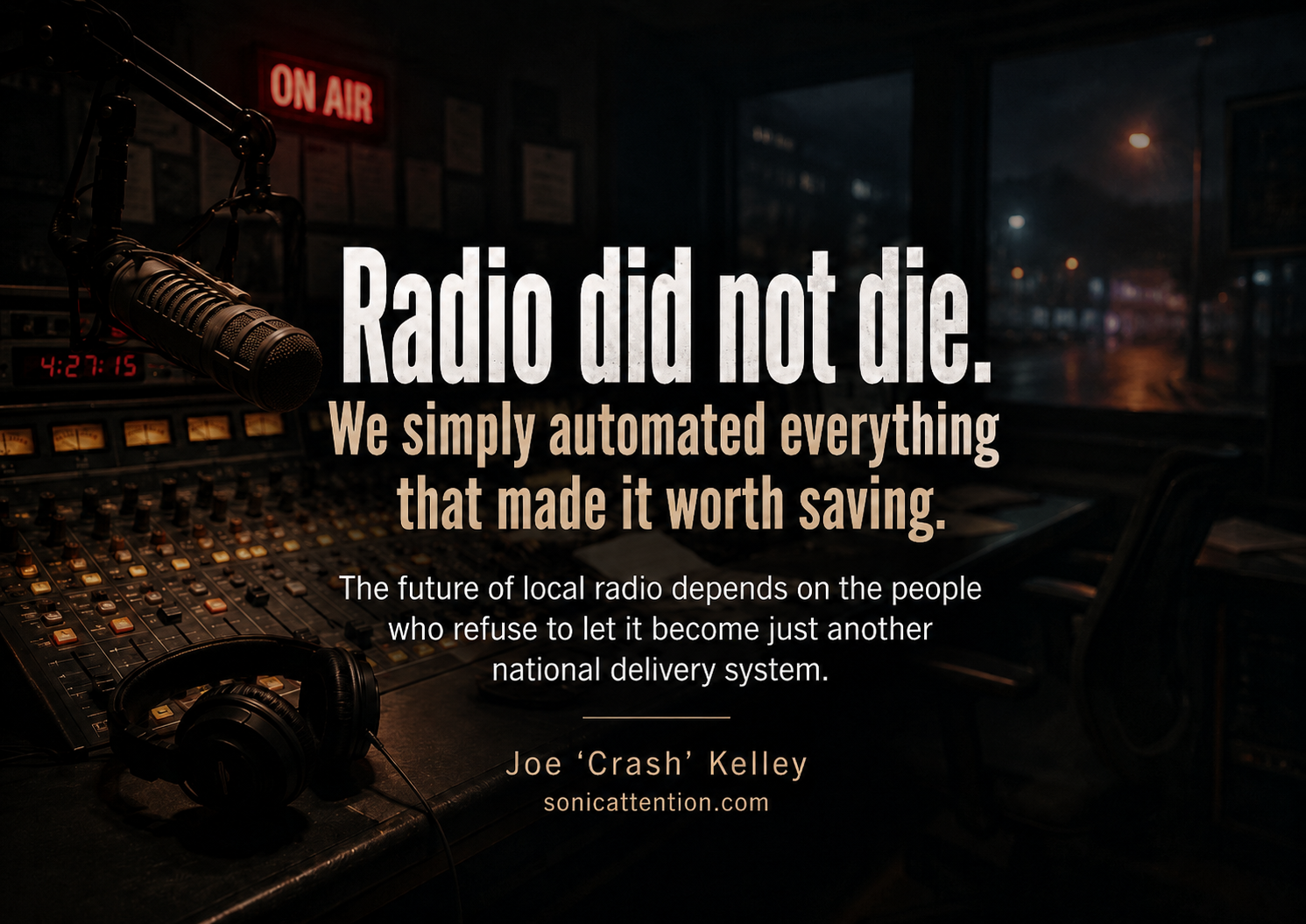
But if we remove everyone who knows the community, challenges the company, creates something unexpected, helps the advertiser, comforts the listener and cares what comes out of the speaker, we may eventually discover that radio did not die.
We simply automated everything that made it worth saving.