
WE HAVE A WHOLE LOT OF IDEAS. BUT HOW DO WE REALLY SAVE LOCAL RADIO?
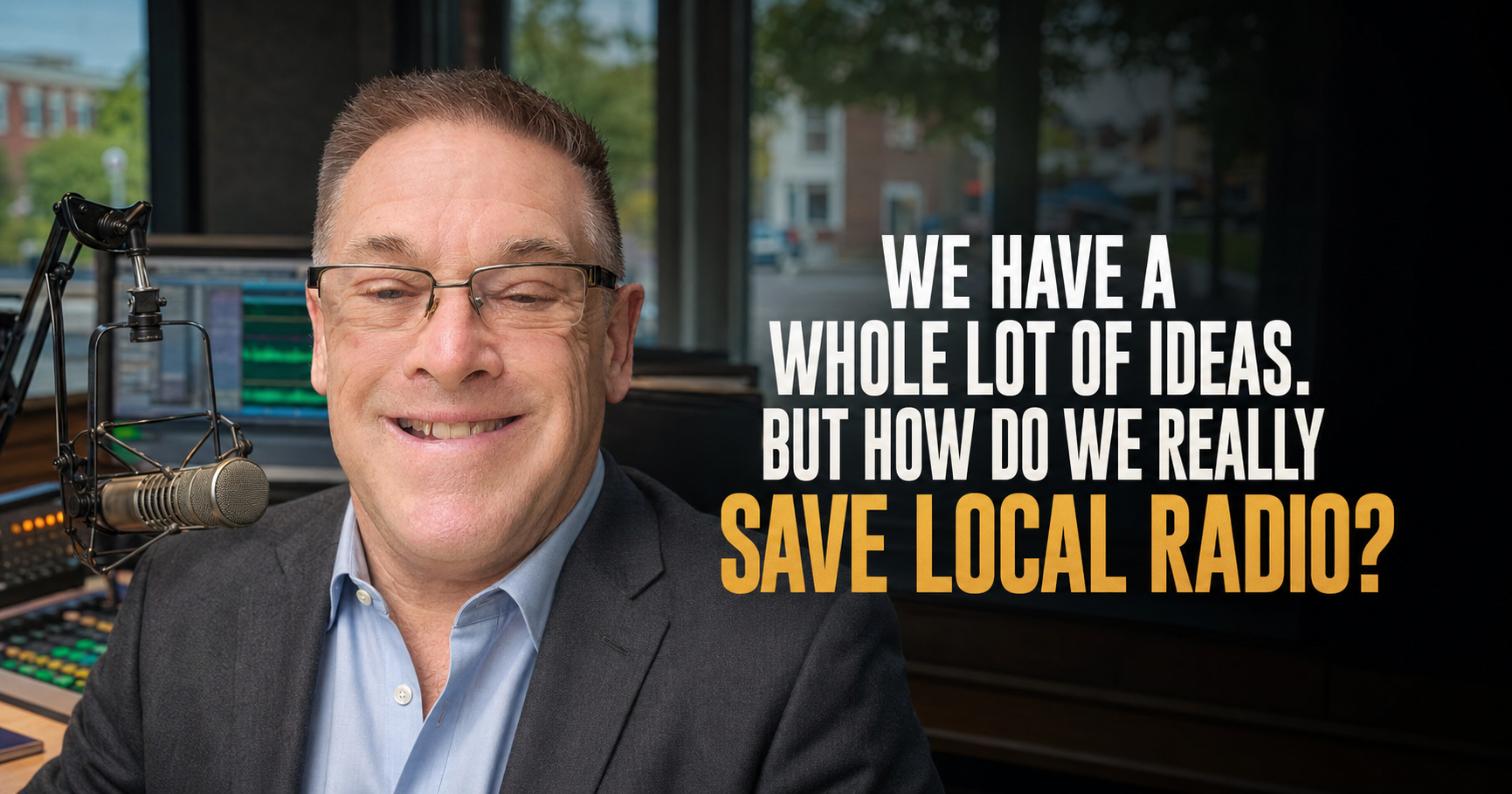
A blueprint for rebuilding local service--and making sure the people who actually do radio have a seat at the table.
By Joe “Crash” Kelley
Radio is not dying because America stopped listening. According to Nielsen’s March 2026 Audio Today report, radio still reaches approximately 242 million American adults in an average month—93 percent of the adult population. Nielsen also reports that radio reaches 89 percent of adults between 18 and 34, the very people we are continually told have abandoned the medium. Those numbers confirm something those of us who have spent our lives in this business already know: radio still has an enormous audience.
What radio is losing is not necessarily reach. It is identity, urgency, community connection and, increasingly, its humanity.
I have spent more than 30 years in this business. I have watched radio survive television, eight-track tapes, cassettes, CDs, satellite radio, the iPod, streaming services, podcasts and social media. Radio has always adapted, but there is a difference between adaptation and abandonment.
Adaptation means using technology to help talented people produce better radio. Abandonment means eliminating the people, emptying the buildings, syndicating nearly every shift and continuing to identify the result as a local radio station.
Radio is the soundtrack of the morning commute. It is the voice from the stage at the county festival. It is the trusted companion in a storm, the place people turn when the power is out, the cell towers are overloaded and something frightening is happening down the road. At least, that is what local radio is supposed to be.
This layoff cycle is different
Layoffs are not new to broadcasting, but the current cycle feels less like periodic belt-tightening and more like the planned removal of locally originated radio.
In its May 11, 2026, first-quarter earnings release, iHeartMedia told investors it was pursuing another $50 million in annualized cost savings beginning during the second half of the year, in addition to $100 million in planned 2026 savings. Weeks later, programmers, producers and on-air personalities were being eliminated in markets around the country.
At KGGI in Riverside, California, the June cuts reportedly removed the station’s remaining local air personalities. In a Los Angeles Times report published June 29, 2026, the newspaper said an internal company message discussed restructuring programming to make greater use of technology.
This is not happening at only one company. Since 2024, major operators including iHeart, Audacy, Beasley, Cumulus and CBS have eliminated jobs, canceled programs or reduced locally produced content. CBS News Radio ceased operations in May 2026 after nearly a century. In its May 22 announcement about the shutdown and layoffs, SAG-AFTRA described the closure as a loss for broadcasters and audiences alike.
Every company has its own balance sheet, debt structure and explanation. I understand that stations must make money. I understand that audience habits and advertising have changed. I am not arguing that every station must recreate 1985, maintain a marble lobby or employ a live personality in every studio 24 hours a day.
But there is something dishonest about calling a station “local” when almost nobody heard on that station lives in, works in or regularly visits the community.
What displaced radio people are telling us
The grievances of laid-off broadcasters are remarkably consistent. Many say their dismissal had little or nothing to do with performance. They had good ratings, strong advertiser relationships, community recognition and years—sometimes decades—of service. Their “position was eliminated,” often without any local replacement.
The show did not go to a younger broadcaster waiting for an opportunity. It went to a syndicated program, a voice-tracked shift originating several states away or a regional employee now responsible for multiple markets.
Writing in Radio Ink on July 7, 2026, veteran consultant Mike McVay explained that many current cuts are about eliminating costs rather than correcting poor performance, with positions disappearing and technology allowing companies to share talent across multiple markets. Read McVay’s complete assessment in Radio Ink.
Veteran talent also describe being asked to do several jobs at once. In addition to hosting a show, one person may produce audio, maintain the website, shoot video, post constantly on social media, record a podcast, appear at station events, assist sales clients and cover breaking news. After accepting all those responsibilities, that person is still described as an expense that can be centralized.
The human consequences are real. People lose health insurance, income and retirement plans. Some are bound by noncompete or confidentiality provisions. Some lose access to decades of their own airchecks. Many are told to disappear quietly after a lifetime spent creating public familiarity for the company that eliminated them.
The community suffers too. The departing personality may have known the school superintendent, police chief, mayor, local concert promoter and families running the Christmas toy drive. That knowledge cannot be downloaded into an automation system. When a tornado warning, chemical spill, missing-child alert or sudden school closing occurs, a national host may not even know how to pronounce the names of the affected towns.
The industry is also destroying its farm system. When experienced broadcasters disappear and entry-level positions are eliminated, who trains the next generation? Where does a young personality learn how to conduct an interview, handle a breaking story, read a legal ID, calm an audience during an emergency or turn a remote broadcast into an event?
You cannot fire the mentors, eliminate the entry-level jobs and then complain that radio cannot find qualified people.
The public-airwaves bargain
Broadcast licenses are not ordinary corporate property. In a public notice released May 28, 2026, the FCC reaffirmed that broadcasters receive free and exclusive access to public spectrum and, in return, are expected to serve the “public interest, convenience, and necessity.” The agency described a broadcast license as a public trust and said programming should respond to the needs and interests of the station’s community.
If that language means anything, it cannot mean that a licensee may eliminate nearly every local employee, originate nearly every program somewhere else and satisfy its obligation with a quarterly file uploaded to a government website.
Any administration serious about saving local radio should offer broadcasters a new compact: meaningful regulatory and financial relief in exchange for meaningful local service. That does not mean more paperwork for its own sake. It does not mean government control of music, programming or political opinions. It does not mean freezing technology in place.
The guiding principle should be simple: The more a broadcaster serves its local community, the more regulatory flexibility and financial relief it should receive.
A note before we go further
This article is not intended to be a finished regulatory package or a list of commandments that must be adopted exactly as written. It is a blueprint for discussion—a starting point for bringing broadcasters, air talent, small and independent owners, advertisers, lawmakers, regulators and listeners to the same table.
Every proposal would need to be tested for cost, legal authority, practicality and unintended consequences. That is especially important for small-market stations already operating with minimal staffs and limited resources. The goal should be to identify and direct resources toward local service—not create another layer of paperwork that takes broadcasters away from serving their communities.
Some ideas may work better as incentives than mandates. Others may need to be simplified, combined or abandoned after broadcasters and their communities have a chance to respond. The important thing is to begin an honest conversation about what local radio is expected to provide, what it will cost and how government and broadcasters can work together to make it possible.
But that conversation will not be honest if the only people invited are corporate CEOs, investment firms, large consolidators and the attorneys and lobbyists they can afford to send to Washington.
Those interests deserve to be heard. They own stations, employ people and invest enormous amounts of money in the industry. But they should not occupy every chair at the table.
Here are some places that conversation could begin.
1. Give working broadcasters a real seat at the table
Before we decide what policies might save local radio, we must decide who gets to participate in writing them.
An open FCC comment period is technically available to everyone, but that does not mean everyone has an equal voice. A morning host, small-market program director, local news reporter or independent station owner cannot easily compete with a corporation employing Washington lawyers and regulatory specialists to prepare hundreds of pages of comments.
Regular broadcasters and radio lifers need organized representation. That includes active and displaced air personalities, programmers, producers, local newspeople, engineers, sellers, small owners and managers who still work inside stations every day. These are the people who understand what happens when the automation fails, the tower goes down, the tornado warning arrives, the advertiser needs help and the public expects someone to answer the telephone. They understand both the value of local radio and the operational burdens that well-intentioned regulations can create.
The FCC should establish a permanent Local Radio Advisory Council with reserved seats for small and independent owners, rural broadcasters, on-air talent, programmers, journalists, engineers, nonprofit broadcasters, emergency officials, local advertisers and listeners.
Large groups and industry trade organizations should also participate, but they should not hold a controlling majority. No single company should be able to dominate the council. Members should rotate, funding relationships should be disclosed and the FCC should respond publicly when it rejects major recommendations.
Participation must also be practical. A broadcaster earning a local-radio salary cannot always afford to fly to Washington, hire substitute talent and spend several days attending meetings. Remote participation, regional listening sessions and reasonable travel assistance would help ensure that the council represents more than the people who can already afford access.
Working broadcasters also need an independent advocacy organization—something like an Alliance for Local Radio—whose leadership and funding are not controlled by any single consolidator or investment interest. Such an organization could retain regulatory counsel, file comments in FCC proceedings, testify before Congress, track local staffing losses, commission research and make certain that the public hears from people who actually create radio.
Corporate interests organize. Ownership groups organize. Investors organize. They have attorneys, lobbyists, research departments and trade organizations ensuring that their arguments reach policymakers. The people who make radio need an organized voice too.
A general invitation to “submit comments” is not the same thing as having a chair at the table. If local broadcasters and listeners are not represented when the decisions are made, they may discover that they—and the service they provide—were what the meeting decided to eliminate.
2. Explore a reasonable local-programming standard
One option worth studying would be a reasonable, market-sensitive local-programming standard. A practical starting point might be 15 hours of locally originated programming per week in major and midsized markets, with a much lower threshold for very small and rural stations.
That number is only an example, not a demand carved in stone. It could become a voluntary standard tied to financial incentives rather than a blanket mandate. The proper level should be determined only after receiving meaningful input from small broadcasters and working radio people who understand the financial and staffing realities of their markets.
A portion of that programming could include local news, interviews, public affairs, emergency information, election coverage, community events or conversations about matters of legitimate local concern.
Great syndicated programs would remain welcome. Voice tracking would remain legal. Artificial intelligence could assist with research, editing, production and routine tasks. But a program produced hundreds of miles away should not automatically count as local merely because a computer inserted the community’s name into a liner.
In January 2024, the FCC proposed giving application-processing priority to stations providing locally originated programming. The proposal remains a useful acknowledgment that local origination matters. Read the FCC’s local-origination proposal.
The agency should continue that conversation, but working broadcasters must be included before anyone decides how many hours are reasonable, what qualifies as local and what exceptions small stations may need.
3. Restore local presence without rebuilding yesterday’s overhead
In October 2017, the FCC eliminated its main-studio rule, partly to relieve broadcasters of maintaining costly facilities that listeners rarely visited. Read the FCC’s announcement of the 2017 decision. The change made financial sense in some situations, but it also helped remove the last physical connection between certain stations and their communities.
The answer is not to force every small station to lease an expensive building with a receptionist and a lobby full of gold records. A modern local-presence standard could be based on capability rather than real estate.
A workable standard might ask whether a station has a publicly reachable local manager or designated employee, a genuine way for residents to contact station personnel and the ability to originate emergency programming from within or near its service area. Stations could also maintain documented relationships with emergency managers and first responders.
Stations in the same market should be allowed to share facilities, emergency resources and news personnel. Rural stations should receive waivers when compliance would create a genuine financial hardship
.The objective is not to dictate where someone’s desk must sit. It is to prevent “there is nobody here” from becoming the operating model for a station licensed to serve a local community.
4. Make license renewal meaningful without creating another paperwork burden
Stations already maintain quarterly issues-and-programs lists, EAS records, political files and other public-inspection materials. For a small staff, these requirements can consume time that would be better spent producing local programming, helping advertisers and serving listeners.
Saving local radio should not mean burying local radio under more forms.
Instead of adding a separate local-service report card, the FCC should consolidate and simplify what stations already file. A brief annual certification could be populated largely from information a station already possesses: automation records, payroll reports, existing EAS logs and quarterly issues-and-programs lists. There should be no return to burdensome daily program logs and no requirement for employees to document every local interview, weather update or community announcement.
Small and rural stations should receive a simplified filing process or safe harbor. More detailed reviews should be reserved for serious complaints, major ownership transfers or repeated evidence that a station is failing to serve its community—not imposed automatically on every licensee.
Technology could also help. The FCC’s online public-file system should be capable of carrying information forward, identifying missing documents and accepting standardized uploads directly from commonly used station systems. A broadcaster should not have to hire a consultant to tell the government that it covered a school-board meeting or carried tornado warnings.
The emphasis should be on incentives. Stations demonstrating meaningful local service could receive expedited application processing, greater regulatory flexibility, hardship consideration and possible fee credits where legally authorized. Regulators should spend their time investigating genuine failures—not making responsible broadcasters prove the same thing repeatedly.
This is exactly why working broadcasters need representation during the rulemaking process. A proposal that looks simple inside a Washington conference room may require hours of work inside a station already being operated by two or three people.
If a local-service policy requires an understaffed station employee to spend hours creating new logs and reports, the policy has failed. The objective is to put more people on the air and in the community—not put the remaining people behind another stack of paperwork.
5. Stop treating further consolidation as the automatic answer
The FCC’s current ownership review asks whether local radio ownership limits should be retained, modified or eliminated. Read the FCC’s September 30, 2025, ownership-review announcement.
In its January 16, 2026, reply comments, the National Association of Broadcasters urged the FCC to eliminate local broadcast ownership rules, arguing that radio needs greater scale to compete with large digital platforms. Read the NAB’s filing.
Broadcasters are right about one thing: radio competes against enormous technology companies that operate under very different rules. Radio should receive relief from unnecessary regulations that prevent it from competing effectively.
But we have already tried consolidation without strong local-service guarantees. We should not automatically assume that permitting one company to own more stations will produce more journalism, more personalities or better emergency coverage. Too often, the promised efficiencies become centralized programming and fewer people.
Ownership waivers could be available when a buyer makes reasonable, measurable commitments concerning local employment, news and programming. Those commitments should be reviewed after the transaction to determine whether the promised public benefits actually materialized.
Before a major ownership decision is approved, the FCC should hear from more than the buyer, seller, investors and attorneys. Local employees, displaced broadcasters, advertisers, public officials and listeners should have a meaningful opportunity to explain what consolidation has already done in that market and what the proposed transaction could mean.
The Justice Department and Federal Trade Commission should also examine large radio transactions as both advertising-market and labor-market issues. A company that controls most of a market’s stations may have enormous power over advertisers—and over the few remaining people who want to work in local radio.
6. Lower fees for stations that provide local service
Regulatory relief should be targeted, not handed indiscriminately to every licensee regardless of size or behavior. The FCC should consider a revenue-sensitive regulatory-fee system with automatic relief for qualifying small stations, rural operators and stations recovering from declared disasters
Congress might need to replace part of the lost revenue because the FCC is generally required to collect regulatory fees sufficient to cover its appropriation. The agency’s 2025 regulatory-fee order and fee schedule illustrate how station fees are presently structured.
Local-service credits could reduce fees for verified local journalism, locally hosted programming, apprenticeship positions and emergency infrastructure. The system should be simple enough that obtaining a credit does not cost a station more in accounting and legal work than the credit is worth.
Music licensing deserves the same balanced approach. Songwriters and recording artists deserve compensation, but local stations should not be forced out of business by a pile of overlapping licenses and minimum fees.
If Congress creates a terrestrial sound-recording royalty, it should include a permanent small-station safe harbor, revenue-based tiers, an aggregate cap and simple licensing procedures. The pending American Music Fairness Act already proposes reduced flat fees for qualifying small broadcasters, although the larger royalty question remains disputed. Read the bill sponsors’ explanation of the proposed small-station tiers.
This does not have to be artists against radio. It can be fair compensation without crushing the stations that still introduce local audiences to music. Broadcasters, artists, songwriters and small-station representatives should all be present before Congress determines what “affordable” actually means.
7. Create incentives for local broadcast employment
If government wants more local news and personalities, it should reward companies that employ them.
Congress could create a refundable payroll-tax credit for reporters, news anchors, producers and local personalities who perform documented community-service responsibilities. Existing local-journalism proposals have suggested credits of up to $25,000 per journalist in the first year and $15,000 in subsequent years. Read Rebuild Local News’ explanation of the Local Journalism Sustainability Act model.
The radio version should be strongest for small companies, independent owners, nonprofit stations, employee-owned stations and broadcasters in news deserts. A large group should receive the credit only if it maintains or increases its net local employment. A company should not be allowed to take a taxpayer-funded employment credit in one department while eliminating local jobs across the cluster.
The program must also be easy to use. A simple payroll designation should be enough. A small station should not have to retain a Washington attorney to receive help intended to support one local employee.
A companion tax credit could help locally owned businesses advertise with qualifying local media. Radio’s local employment problem is ultimately a local revenue problem too. If we want stations to hire people, we must also help those stations generate enough revenue to pay them.
8. Keep free AM—and FM—radio in automobile dashboards
Congress should pass the AM Radio for Every Vehicle Act. The pending legislation would require automakers to provide access to AM broadcast radio in new vehicles without an additional charge. Read the official text of S. 315.
The legislation recognizes AM radio’s continued importance to emergency communication, agriculture, rural areas, foreign-language communities and travelers. Policymakers should eventually consider a broader Broadcast Access Standard.
Drivers should have easy access to both AM and FM without needing a data plan, subscription or cellular signal. Broadcast radio should not be buried behind several menu screens or treated like an optional app. Automakers should also be encouraged or required to address electromagnetic interference that degrades AM reception in electric vehicles.
This is not about preserving a nostalgic dashboard button. It is about maintaining a free, one-to-many emergency distribution system that continues working when cellular networks become congested or fail.
If radio is expected to remain available in the dashboard, however, broadcasters must give drivers a reason to use it. Preserving the receiver without preserving meaningful local programming would save the delivery system while allowing the product itself to disappear.
9. Treat local stations as emergency infrastructure
EAS participation alone does not guarantee useful local emergency coverage. A station can automatically relay an alert while having nobody available to explain what it means, which road is closed or where residents should go.
FEMA and Congress could establish competitive resilience grants for qualifying stations. Eligible expenses could include generators, fuel storage, satellite connections, hardened studio-to-transmitter links, backup internet service and accessible alerting technology.
Stations receiving assistance could participate in local emergency exercises and maintain a reliable way for emergency officials to reach them around the clock. In return, broadcasters should receive priority access to fuel, restoration crews and restricted emergency areas.
A station that expects government recognition as critical infrastructure must accept the responsibilities of critical infrastructure. Government, in turn, cannot expect a financially struggling rural station to purchase generators, backup transmitters and redundant connections without helping identify the resources to pay for them.
Emergency policies should not be written exclusively by network executives and federal officials. The engineers who keep transmitters operating, the personalities who stay on the air during storms and the small-market managers who find fuel for generators understand where emergency plans succeed and where they fall apart. They need to be at the table too.
10. Revisit the Fairness Doctrine—but do it intelligently
The original Fairness Doctrine required broadcasters to cover controversial issues of public importance and provide a reasonable opportunity for contrasting views. In 1969, the Supreme Court upheld the doctrine in Red Lion Broadcasting Co. v. FCC, relying heavily on the scarcity of available broadcast frequencies. Read the Supreme Court’s Red Lion decision.
The FCC stopped enforcing the doctrine in 1987 after concluding that it chilled speech and no longer served the public interest. The agency later removed obsolete related rules. Read the FCC’s published history of the Fairness Doctrine.
I believe the principle deserves to be revisited, but I would not simply restore the old rule word for word.
We should not empower political appointees to count conservative and liberal minutes, decide which opinions are legitimate or punish a host for criticizing the president. A doctrine administered that way would quickly become a weapon against the very freedom it claimed to protect.
One alternative might be a Local Civic Fairness Standard built around opportunity, transparency and community access—not government-approved ideology.
A participating station could periodically identify significant local civic issues after seeking public input. Over the course of a quarter, it could provide reasonable opportunities for materially different local perspectives to be heard. That would not require minute-for-minute equality or obligate a station to present every fringe claim. It could be satisfied through interviews, call-in programs, candidate forums, roundtables, news coverage and public-affairs programming.
Named individuals subjected to serious factual attacks could receive a reasonable opportunity to respond or request a correction. Stations could also provide clearer disclosure of paid sponsorships, the origin of political and issue programming, and material use of synthetic voices or AI-generated presentations.
Enforcement would have to focus on whether a station maintained a fair, published process—not whether the FCC liked its editorial conclusions. Bona fide news judgment must be protected. Any penalties should apply only to repeated and willful failure, and the entire system should receive an automatic public and constitutional review after several years.
Another possibility would be to make participation voluntary and connect it to regulatory or financial benefits. That approach might achieve greater civic access without creating an inflexible federal speech mandate.
Working broadcasters, constitutional experts, community representatives and people from across the political spectrum must help design any such proposal. This is far too important—and far too vulnerable to abuse—to be negotiated only by government attorneys and corporate lobbyists.
A carefully constructed policy might restore the spirit of the Fairness Doctrine without creating a federal truth tribunal. Fairness alone, however, cannot save local radio. A completely syndicated station could present two national political viewpoints and still ignore the city on its license. Civic fairness must accompany local presence, local origination and public accountability.
11. Give displaced broadcasters basic rights
Congress should examine the way consolidated layoffs are carried out.
When a national company eliminates small numbers of employees in dozens of markets, the cuts may escape laws designed around a single large layoff at one location. Federal notice requirements could aggregate coordinated reductions across commonly owned stations while including reasonable protections for genuinely small operators.
Displaced employees should receive reasonable notice, health-insurance transition assistance and severance based on tenure when the financial circumstances of the employer permit it. A company that eliminates someone’s position should not be allowed to enforce a noncompete that prevents that person from earning a living at another station.
Broadcasters should be allowed to retain copies of their airchecks and work samples unless legitimate third-party rights prevent it. A company should not be able to clone a former personality’s voice, name or recognizable performance using AI without specific, time-limited, written consent and continuing compensation.
AI can help a small staff research stories, edit audio, translate emergency information and produce digital content. It should be a tool in the hands of creative people—not a way to make the audience believe a dismissed human being is still in the studio.
Displaced broadcasters deserve representation in these discussions. They understand what the words “position eliminated” mean in human terms, and they can identify employment practices that may never appear in a corporate presentation to regulators.
12. Help local people buy local stations
Government policy should make it easier for local owners, employees, tribes, nonprofits and community organizations to acquire stations that large groups want to sell.
Congress could provide tax deferral or credits when a station is sold to a qualifying local or employee-owned buyer. The Small Business Administration could establish a specialized broadcast-financing program that recognizes the unusual value and collateral structure of FCC licenses.
When a station is placed into a trust, goes silent or is marked for divestiture, local buyers should receive a meaningful opportunity to bid before the license is surrendered or transferred out of the community.
Ownership diversity is not a slogan. A person who lives in the market, shops there and sees listeners at the grocery store makes different decisions from someone examining a spreadsheet several states away.
That does not mean every local owner will be perfect or every corporate owner will be irresponsible. It means our policies should create room for people whose financial success is directly tied to the health of the community they serve.
13. Rebuild support for public and nonprofit local broadcasting
The 2025 rescission of federal public-broadcasting money led to the dissolution of the Corporation for Public Broadcasting in January 2026, leaving rural and small-market stations especially vulnerable. Read the Associated Press report on CPB’s dissolution.
Congress could create a politically insulated Local Information and Emergency Broadcasting Fund. Grants could be awarded through transparent formulas emphasizing rural areas, tribal communities and genuine news deserts.
A strict statutory firewall would have to prevent elected officials from directing coverage. Public support should purchase access, resilience and journalism—not favorable stories about the people appropriating the money.
Commercial, nonprofit and public broadcasters could also collaborate on shared local reporting projects. A rural county does not necessarily need three separate reporters attending the same meeting. It does need at least one qualified reporter whose work can reach the public through multiple local outlets.
Who must act—and who must be heard?
No president can accomplish this entire plan with an executive order. The FCC can address ownership limits, local-service incentives, licensing procedures, emergency capability and some fee policies. Congress is needed for tax credits, workforce protections, stable funding, major fee restructuring and any new civic-fairness statute.
The Department of Transportation and NHTSA would implement an automobile receiver requirement. FEMA would manage resilience programs. The Justice Department and FTC would examine consolidation and market power.
Broadcasters must be part of the solution too. Radio companies know which requirements consume time without producing any public benefit. Small-market operators know which ideas that appear reasonable in Washington become expensive or impossible in a two-person station office. Air talent know what communities lose when local voices disappear.
But saying “broadcasters must be represented” cannot mean inviting only the CEOs of the largest companies. A CEO can explain debt, investment, competitive pressure and corporate strategy. Those are legitimate concerns. A working broadcaster can explain what happens inside the studio, on the street and in the community after the corporate strategy is implemented.
We need both perspectives.
We need owners who still unlock the station in the morning. We need managers who sell advertising and then come back to help with the afternoon show. We need programmers, producers, journalists, engineers and air personalities. We need people who have been eliminated from the business and can explain exactly what their former communities lost. We need regular broadcasters and radio lifers who have devoted decades to this medium without ever receiving a corporate title or a Washington expense account.
Organizations representing those people must have the resources to retain attorneys, present research, file comments and remain involved after the hearing ends. Corporate interests do not show up once and go home. They maintain a permanent presence. Advocates for local radio must learn to do the same.
Those people need more than an invitation to speak for three minutes after the major decisions have already been negotiated. They need a chair at the table before the meeting begins.
Radio does not need a museum. It needs a mission.
The way forward is not to preserve every job forever or force every station to sound the same. It is not to ban syndication, turn back the clock or pretend that streaming and podcasts never happened. The way forward is to stop confusing an efficient national distribution network with a local radio station.
Use technology. Share resources where it makes sense. Build podcasts, video channels, newsletters and events. Let AI remove drudgery and help small staffs compete. But keep human beings at the center of the product. Keep someone in the market who knows the streets, the schools, the advertisers, the musicians, the weather and the people.
A broadcast license is not merely permission to transmit a signal. It is a promise to serve a place.
If broadcasters want lower fees, greater flexibility and continued protection of their place in the dashboard, government should help them. In exchange, broadcasters must demonstrate that they are still doing something worthy of that protection.
Radio can survive this moment. It still reaches almost everyone. It still possesses immediacy, familiarity and enormous cultural power. But we cannot save local radio by eliminating everything that makes it local.
We have a whole lot of ideas. Some will work, some will need to change and some may never get beyond the discussion stage. The first step is to stop pretending the current direction is inevitable and begin building a blueprint that broadcasters, regulators, lawmakers and communities can actually afford to follow.
The second step is making sure the blueprint is not written exclusively by the people who benefited from tearing the old structure down.
People like me need to be at that table—not because we have all the answers, but because we have spent our lives living with the decisions made by people who never asked us the questions.
Corporate radio has advocates. Investors have advocates. Consolidators have advocates.
Now local radio needs advocates too.
I still care.
That is why this fight matters.
Sources and further reading
The factual statements in this commentary are supported by the original reports, regulatory documents and legislation linked throughout the article. Key sources include:
- Nielsen, Audio Today 2026: How America Listens
- iHeartMedia 2026 first-quarter earnings release
- Los Angeles Times: iHeartMedia’s June 2026 programming cuts
- SAG-AFTRA: Closure of CBS News Radio
- Mike McVay in Radio Ink: “Grappling With Radio’s Layoff Reality”
- FCC: Broadcaster public-interest obligations, May 28, 2026
- FCC: Priority-review proposal for locally originated programming
- FCC: Broadcast ownership-review proceeding
- NAB reply comments concerning broadcast ownership rules
- Official text of the AM Radio for Every Vehicle Act, S. 315
- Red Lion Broadcasting Co. v. FCC
- FCC history of the Fairness Doctrine