
Radio’s Dolly Parton Debate Is Asking the Wrong Question
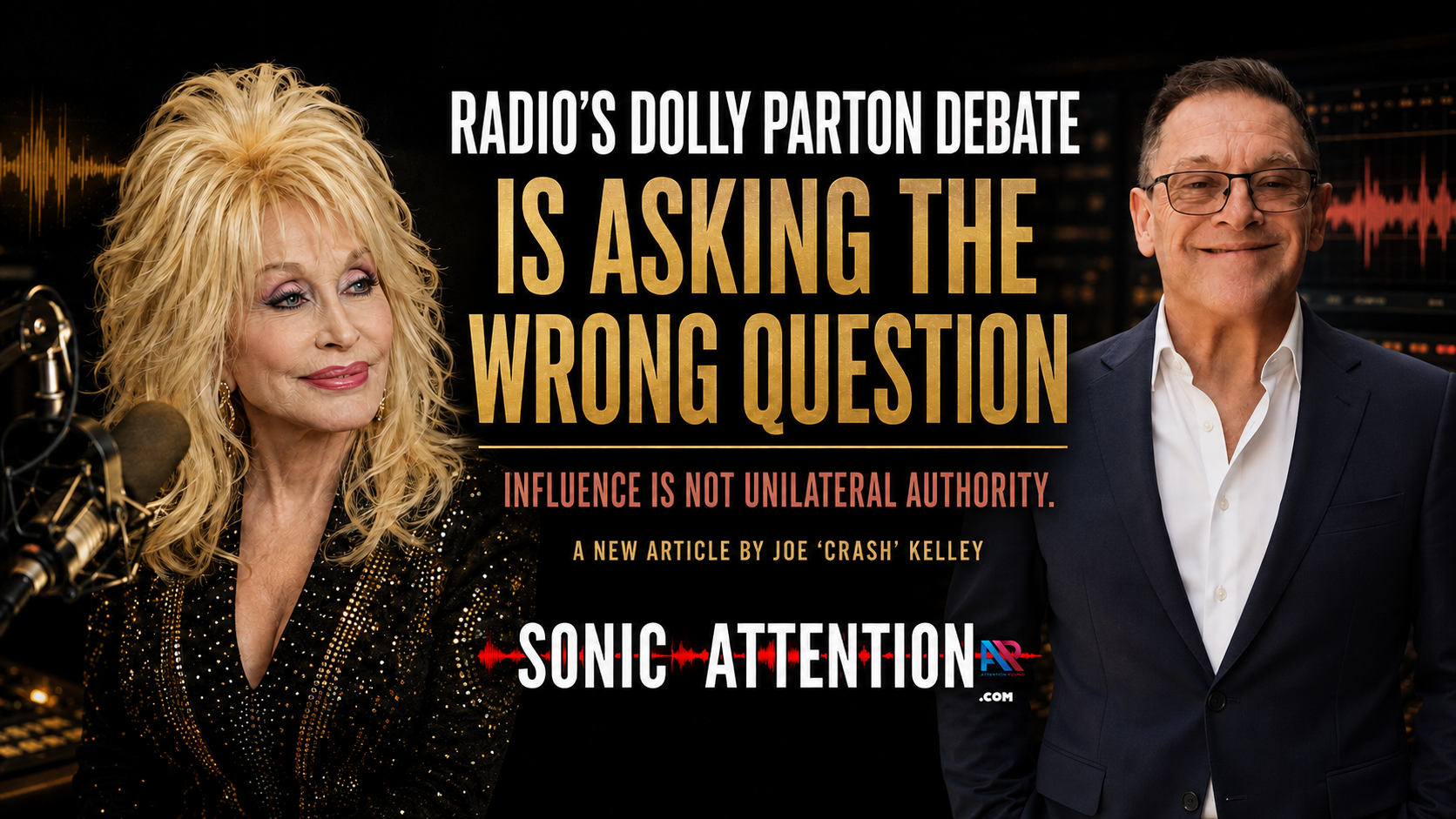
Mike McVay was right that radio should have responded better. The real issue is whether many stations have been left enough people to do it.
Unless you follow radio-industry message boards, you may have missed the debate that followed Dolly Parton’s death.
Two days after her passing, respected programmer and consultant Mike McVay published a column in Radio Ink titled “Dolly’s Passing Exposed a Weakness of Today’s Radio.” McVay wrote that after the news was announced shortly before 2 p.m. Eastern, he sampled Country stations around the country. Some reacted quickly with Dolly’s music, memories and special programming. Others apparently took hours even to acknowledge what had happened.[1]
McVay’s concern extended beyond whether every Country station should have immediately gone all-Dolly. He saw the response as a test of radio’s ability to react when something important suddenly happens.
If stations could not mobilize for the death of a beloved cultural icon, he asked, would they be ready for severe weather, terrorism, war or another emergency?
His conclusion was simple: “We should be better than this.
”That criticism struck a nerve.
Some broadcasters agreed completely. Others argued that the industry had spent years eliminating local personalities, consolidating programming responsibilities and asking fewer employees to oversee more stations. One response beneath McVay’s column summarized that frustration in nine words: “Hard to have a reaction with no local staff.”[2]
Some of the criticism became personal because McVay served in senior programming leadership at Cumulus Media from 2011 until 2019, eventually overseeing content across hundreds of stations and Westwood One.[3] Critics questioned whether decisions made during that period helped create the staffing conditions he now finds troubling.
I also worked for Cumulus during some of those years, and I remember something else.
Mike McVay always appeared to champion the people who worked there.That does not mean McVay’s position was insignificant. During the years I worked for Cumulus, programming was an important part of corporate decision-making—seemingly more important than it is in many broadcast companies today. McVay had a seat at that table, and with that came genuine influence and responsibility. From what I observed, however, he used that influence to champion both the people and the product.
Influence is not unilateral authority. The final decisions about budgets and staffing are ultimately made by the corporate executives, financial officers and ownership interests responsible for the company’s bottom line. We cannot know how many reductions McVay supported, opposed or tried unsuccessfully to prevent. His critics were not present for those conversations, and neither was I.
Perhaps the more revealing issue is how much less influence programming appears to have in corporate radio today. When the people who understand the audience and the product have a weaker voice in financial decisions, we should not be surprised when a company becomes more efficient on paper while its stations become less capable of reacting like living, local brands.
It would therefore be unfair to turn this debate into a trial of Mike McVay. In fact, his column did not ignore the staffing problem. He specifically identified unmanned studios, a lack of staff, skeleton programming departments and programmers stretched across multiple formats and markets as reasons some stations could not respond effectively.[1]
That acknowledgment is important.
It does not make his central argument wrong. It makes the argument more complicated.
I currently work across five radio stations, soon to be six. When the news about Dolly broke, we got it on the air as quickly and responsibly as we could. What we could not do instantly was transform every station into a fully produced tribute experience.
Consider what that would require: verifying the news, writing updates, recording and producing them, locating appropriate music and archival audio, changing music logs, creating imaging, contacting talent, updating websites, posting to multiple social platforms and continuing to handle the normal programming and operational demands of five stations.
That is not one assignment. It is the work of a content department.
In many radio buildings, that department has been reduced to one person—or has disappeared altogether.
The RTDNA/Newhouse School’s most recent staffing survey found that the median American radio news operation had only one full-time news employee. Average staffing declined across nearly every category measured.[4] That survey specifically concerns news operations, but anyone working in commercial radio will recognize the larger pattern.
Cumulus is hardly the only company that has reduced staffing, but its public filings offer one illustration. The company reported 4,732 employees at the end of 2019 and 3,106 at the end of 2024.[5] Those figures include every type of employee, and changes in station holdings and business operations make them an imperfect measure of local programming capacity. They should not be presented as proof that any one executive eliminated a particular number of local jobs.
They do, however, demonstrate the direction in which the business has traveled. Recent rounds of cuts have continued to affect programming departments across multiple companies and markets.[6]
Radio has removed much of what accountants might call redundancy.
The problem is that during an extraordinary event, redundancy becomes resilience.
None of this means stations should simply shrug and accept being unprepared. McVay is right that technology, remote access, communication and a defined chain of command can help a small staff respond more effectively. Fred Jacobs has suggested that stations maintain advance files containing music, interviews, audio and response plans for significant artists—the broadcasting equivalent of the advance obituary material maintained by major newsrooms.[7]
That is an idea every station should adopt.
A breaking-news plan should identify who has authority to alter programming, who can access automation remotely, which station receives attention first, where important archival material is stored and who serves as backup when the primary decision-maker is unavailable.
Preparation could have improved some responses to Dolly’s passing—including ours.
But a plan does not eliminate the limits of human capacity. Technology can help one person work faster. It cannot make one person become six people.Nor do I believe every station was obligated to make exactly the same programming decision. Going all-Dolly was appropriate for some brands. Others could have responded with carefully selected songs, artist audio, listener memories, local stories and frequent acknowledgment.
The essential obligation was not to follow one prescribed clock.It was to sound emotionally present.
On that point, McVay is right. Radio’s greatest advantage is its ability to be a companion. When listeners are celebrating, frightened or grieving, their station should sound as though it understands what they are feeling.But the people still working inside radio did not create all the conditions under which they are now being judged.Both things can be true:
Radio should have done better.Radio must also provide enough people, authority and preparation to make “better” possible.
The lesson from Dolly Parton’s passing should not be that today’s broadcasters no longer care. Most of the people I know care deeply. They are simply carrying workloads that once belonged to several employees.
Mike McVay should not become the villain in this discussion. His criticism should become the beginning of a more difficult conversation—one that includes consultants, corporate leaders, owners, managers and those of us still trying to make multiple stations sound alive every day.
Before the next defining moment arrives, every station needs a plan.
But the industry must also remember something more fundamental:
The people it eliminated were often part of that plan.
Footnotes
[1] Mike McVay, “Dolly’s Passing Exposed a Weakness of Today’s Radio,” Radio Ink, August 27, 2026.[2] Reader responses accompanying McVay’s Radio Ink column.[3] Radio Hall of Fame, “Mike McVay”.[4] RTDNA/Newhouse School at Syracuse University, “News Staffs Are Shrinking at U.S. Radio Stations,” September 3, 2025.[5] Cumulus Media, 2019 Form 10-K and 2024 Form 10-K, U.S. Securities and Exchange Commission.[6] Cameron Coats, “Layoffs Hit Sales, Programming, and Podcasting at Cumulus Media,” Radio Ink, August 6, 2026.[7] Fred Jacobs, “When Radio Mails It In,” Jacobs Media, August 28, 2026