
Hating AI Isn’t a Career Strategy
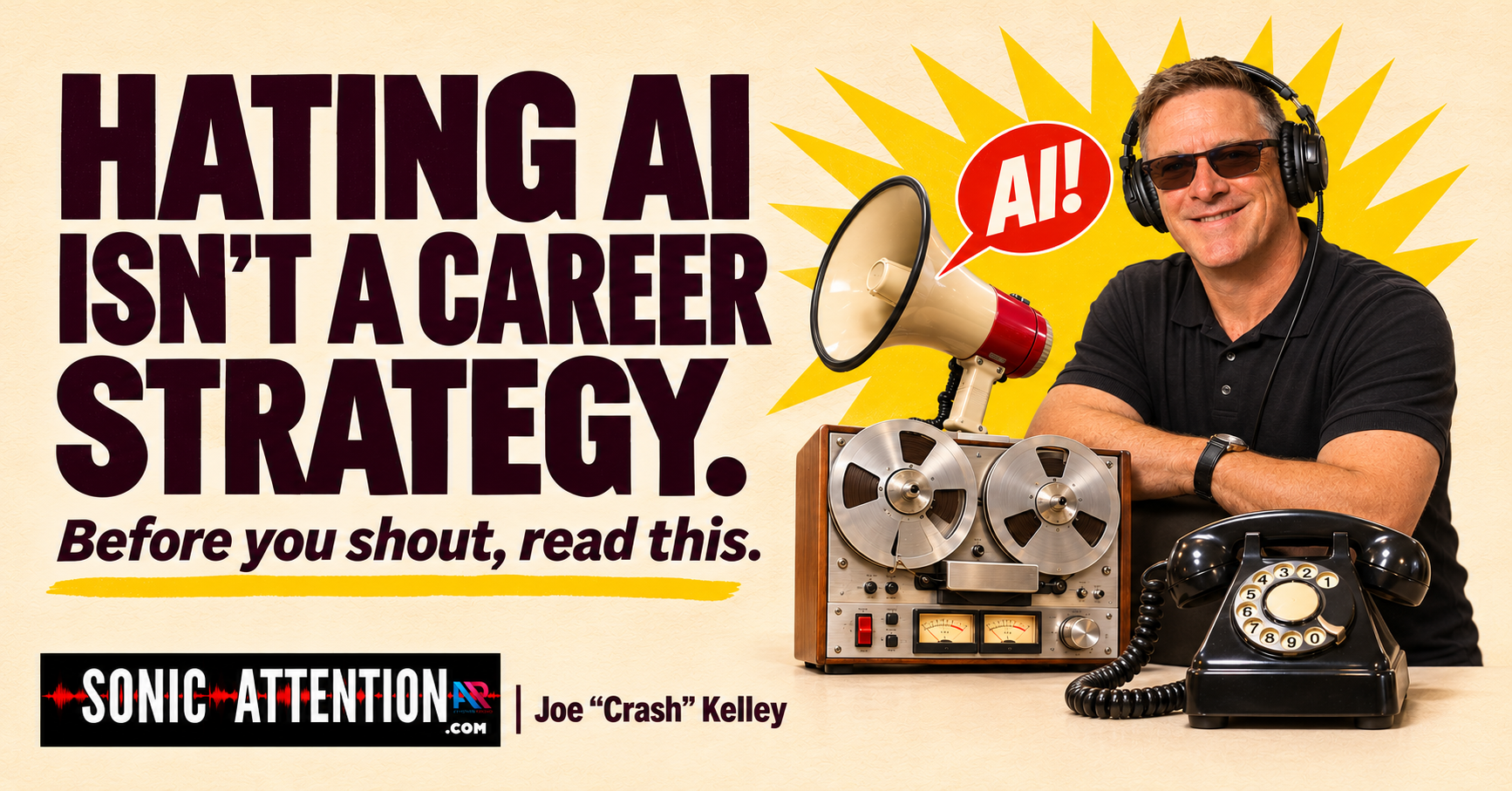
By Joe “Crash” Kelley
Before you announce “AI!” under somebody’s creative work as though you’ve just exposed an international counterfeiting ring, please secure your razor blade and return the Eagles index card to its proper drawer. Yes, you found the label. Excellent detective work. Next week, we’ll investigate the “Contains peanuts” warning on a jar of peanut butter.
I am increasingly fascinated by people who see two letters and immediately lose all interest in evaluating anything else: the idea, the execution, the humor, the message or whether the thing actually works. None of that gets a hearing. The label has spoken, and the comment-section prosecutor is requesting the maximum sentence. Your ability to evaluate creative work remains untested.
Radio people, especially, should recognize the absurdity here. Perhaps you’re still editing reel-to-reel tape with a razor blade. Perhaps your music scheduling system consists of a card catalog, three rubber bands and a stern warning that nobody touches the recurrent drawer. If that makes you happy, enjoy yourself. There is real craftsmanship in those methods.
But I would hate to interrupt your afternoon of locating the word “Saturday” in a pile of tape scraps to explain why the rest of us appreciate an Undo button. The talent was knowing where to cut, what to keep, how to build momentum and what would make somebody care. The razor blade happened to be the tool within reach. Those instincts remain valuable when the equipment changes. Your taste should survive a software update.
And yes, the AI label serves a purpose. Meta describes its labels as providing transparency and context about AI-generated content, based on technical signals or a creator’s disclosure. It has also acknowledged that earlier labeling in 2024 caught some images with only minor AI retouching. A little badge can leave out a considerable amount of nuance. Transparency is useful, and I’m comfortable discussing the tools I use.
But where on that label does it say the person had no idea, supplied no direction, made no decisions, rejected nothing and contributed no talent? It doesn’t tell you who wrote the lyric, sang the original melody or understood the client’s problem. It doesn’t tell you who heard the wrong emotional tone and changed it, or who went through the revisions until the thing finally worked. You still have to listen. Terribly inconvenient, I know.
Now, the people using AI have some responsibility here, too. Some of you are making the critics’ job painfully easy. Type a vague instruction, hit Enter, publish whatever comes back and declare yourself a creative visionary. Apparently, the creative process now includes waiting for the progress bar.
The problem is accepting the output without direction, scrutiny or standards. If the copy says nothing, the image communicates nothing and the music sounds like it was commissioned by the Department of Background Noise, AI doesn’t rescue it, and neither does the speed at which you produced it. Every careless example gives the people waiting to eviscerate anything labeled “AI” another exhibit for the prosecution. The weakest work gets held up as proof that everyone using the tools is equally lazy. That conclusion is unfair, but let’s stop handing it fresh material.
Use AI to enhance your creativity, and bring your own creativity to the process. Give it something worth amplifying. Use it to give a voice and a vision to work you’ve imagined but couldn’t fully realize before. Explore an arrangement, sharpen a presentation, develop an image or give a promising idea the polish and gravity it deserves. Then listen, look closely, question it and revise it. Make choices. Your creative responsibility continues after the output appears.
In my work, I can start with a melody I sing, explore arrangements and harmonies, reshape the production and keep refining the result. I still have to know what I’m trying to communicate, hear what’s wrong and decide when something deserves to leave the studio. My name is still on it, and I’m responsible for what it delivers.
If the result is generic, lifeless or badly executed, criticize it. Be specific. Tell me the hook is weak, the delivery misses the emotion or the arrangement fights the message. That is a conversation creative people can actually use. If your contribution is “AI. LOL,” thank you, Professor. Your masterclass has been invaluable.
There are serious arguments to have about consent, compensation, impersonation, employment and disposable content. Those deserve thoughtful discussion. People can also make a considered decision to work without generative AI. But sneering at somebody for experimenting contributes remarkably little to those conversations.
And if you liked something until you noticed the label, take a moment with that. The melody didn’t change, the joke didn’t change and the image didn’t suddenly become less effective. You learned something about the process. You’re entitled to care about that process, so explain your objection. Give us something more substantial than a dramatic fainting spell beside the metadata.
There is also a professional consequence to making resistance your identity. While you’re policing somebody else’s toolbox, another professional may be learning how to deliver stronger work, explore more possibilities and build a more compelling portfolio. That person can bring experience, taste and judgment to the same tools you’ve dismissed without investigation. Refusing to learn doesn’t prevent that competition. It leaves you less prepared for it.
No employer owes your preferred workflow permanent protection. No client is obligated to preserve the exact number of hours a project used to require. You can make a thoughtful case for how you work, but “I refuse to understand that” is a remarkably weak line to put on a résumé.
Experience ought to give you more ways to recognize an opportunity. Years of writing, producing, programming and listening can help you direct a new tool with judgment a beginner hasn’t developed yet. Why surrender that advantage? Why wouldn’t you investigate every useful tool that could strengthen your work? To protect your identity as the last person in the building who knows where we keep the splicing tape? Nostalgia is wonderful. It becomes considerably less charming when you submit it as a business plan.
Intransigence can leave you defending a position long after the work has moved elsewhere. You don’t have to applaud every new technology, but if your professional strategy consists of mocking everyone who learns something new, you’re taking a substantial gamble with your relevance.
I intend to keep learning, experimenting and holding the finished work to a high standard. You are welcome to challenge the work. I might learn something. But if your entire review is “AI,” you’ve told me very little about what I created—and quite a bit about where you stopped thinking.
Keep your standards high and your curiosity alive. The razor blade can stay in the drawer. Your career shouldn’t.
Hear what I mean.
Explore my commercials and imaging and custom jingles, then request a free custom jingle spec for your business or client. There’s no obligation. Pay $100 for the finished jingle only if you choose to use it.