
AI Should Make Radio Better--NOT SMALLER
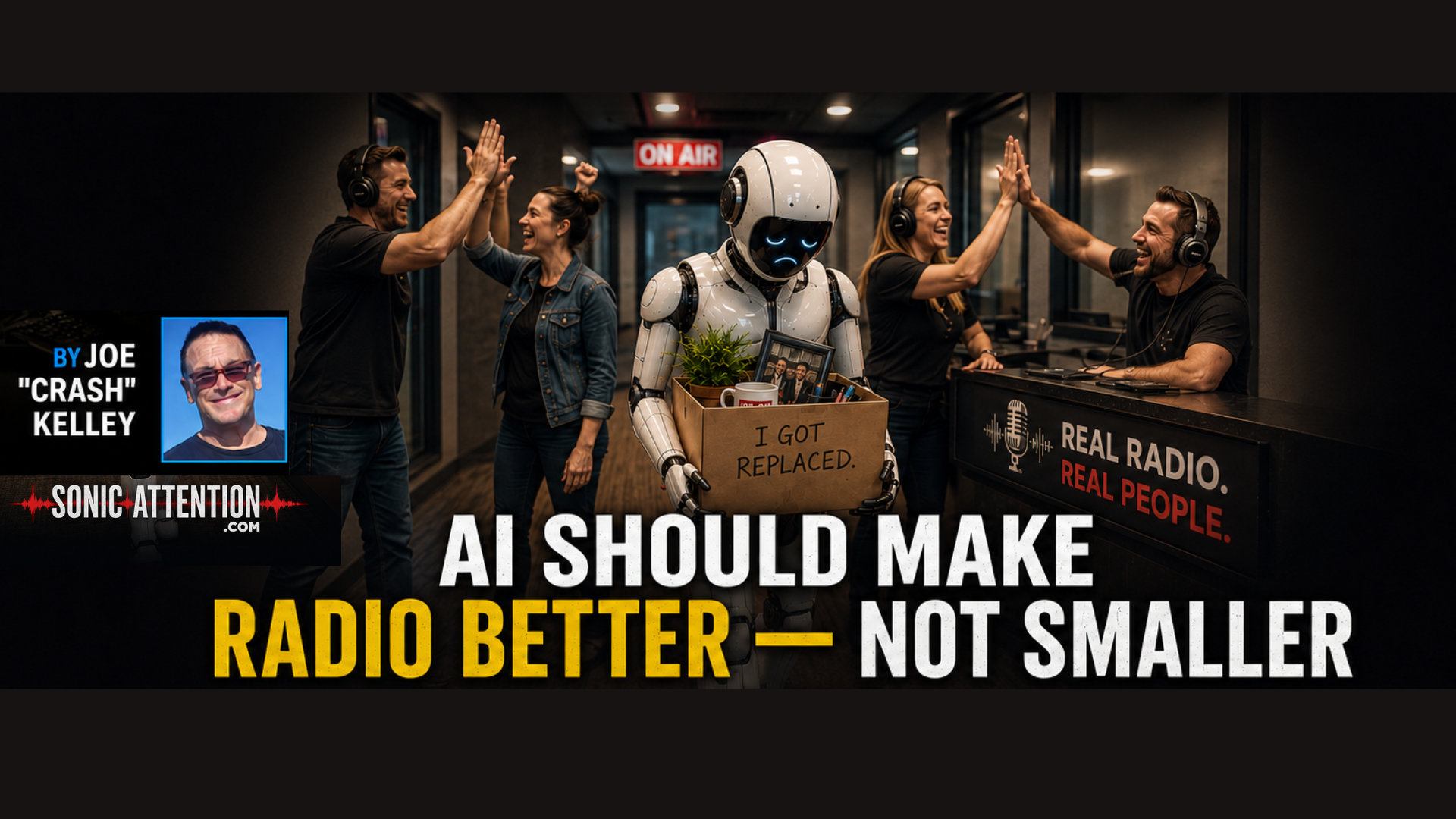
Technology should amplify talent. Not eliminate it.
I have become a pretty aggressive user of artificial intelligence. Not because I’m trying to find a machine that will do my job for me. Quite the opposite. I’ve discovered that, used properly, AI lets me do parts of my job better. It has expanded what I can create, shortened the distance between an idea and a finished product, and made me more proficient in areas where the old barriers were time, manpower or money. I can research faster, write faster, build production faster, experiment with imaging, voices, music and jingles, and chase creative ideas that might once have died somewhere between “that would be cool” and “when exactly am I going to have time to do it?”
■That experience has made me more enthusiastic about AI, not less. It has also made me increasingly skeptical of one particular assumption beginning to creep into the radio business: that if technology enables one person to accomplish more, the obvious next step is to give that person more jobs to accomplish. AI can amplify the creativity and proficiency of a talented broadcaster. What it cannot do is manufacture another copy of the human being sitting in front of the computer.
■There are still only so many hours in a day and only so much attention one person can give away before something gets less of it. At some point, it simply is not possible for one person to properly program five or six stations, serve advertisers, coach talent, produce compelling creative, develop promotions, manage digital content, interact with listeners, analyze ratings, schedule music, handle operational problems and still provide each brand anything approaching the attention it would receive if somebody actually had time to think about it. Technology can eliminate repetitive steps inside those jobs. It cannot eliminate the need to care deeply about the outcome of them.
■That is the distinction I think radio needs to get right, because we are dangerously close to confusing two very different ideas. One is using technology to make talented people more effective. The other is using technology to justify having fewer talented people. The first can make radio better. The second can make a spreadsheet look better while the product quietly gets thinner. ■
The Job Title Hasn’t Changed. The Job Has.
Radio Ink recently asked some of America’s leading Program Directors what their jobs are becoming in the age of streaming, social media and AI. One response captured the opportunity perfectly: AI should remove friction so programmers can concentrate on the creativity, intuition and judgment that machines cannot provide. Another described the future PD as a “brand architect.” That sounds right to me. The problem begins when “brand architect” quietly becomes shorthand for architect, carpenter, electrician, roofer, realtor and the guy sweeping up afterward. [1]
■Look through contemporary radio openings and the pattern becomes obvious. A recent Operations Manager/Program Director posting from a privately owned broadcaster combined daily station operations, automation oversight, imaging, video production, sports broadcasts, livestreams, podcasts, community events, on-air work, digital content, website and social media duties, plus commercial writing and production. Another recent programming opening folded together station strategy, staff management, imaging, sales promotions, website, social media, streaming, digital content, a daily show-producing assignment and appearances. [2][3] ■None of those duties is unreasonable by itself. In fact, I enjoy most of them. That is precisely what makes this
trend easy to rationalize. Versatile people like doing many things, and radio has always rewarded people willing to jump in wherever something needs to be done. Small-market radio in particular has never been a business where everybody sits inside a neatly defined box marked THIS IS MY ONLY RESPONSIBILITY.
■But there is a difference between versatility and infinite capacity. Radio has added an entire digital ecosystem to the station without removing the radio station underneath it. The programmer still has to worry about clocks, music, rotations, talent, imaging, ratings and execution, except now the product also lives on a website, stream, app, Facebook page, Instagram account, TikTok feed, YouTube channel, podcast platform and whatever comes next. Sales increasingly expects custom content. Promotions have become content creation. Personalities are expected to be multimedia brands. The PD isn’t just responsible for how the station sounds at 8:17 Tuesday morning; increasingly, the PD is responsible for what the brand looks and feels like almost everywhere.
■That can be exhilarating when technology gives somebody room to create across all of those platforms. It becomes something else entirely when every new capability is treated as evidence that another human is no longer necessary. ■
We’ve Seen This Movie Before
There is a reason the word consolidation belongs in the title. The Telecommunications Act of 1996 dramatically changed radio ownership. By 2007, the FCC reported that the number of commercial radio owners had declined 39 percent from 1996 levels. In the average Arbitron market, the largest company controlled 46 percent of radio advertising revenue and the top two controlled 74 percent. [4]
■Ownership consolidation was followed by operational consolidation. Multiple stations shared management, programming, traffic, engineering, promotions and production. Voice tracking made it possible for one personality to appear in places he or she had never visited. Syndication became more seamless. Clusters grew while departments shrank. None of that happened because everybody running radio stations was stupid or evil. Consolidation produced real efficiencies, and a business under economic pressure has an obligation to look for them.
■But after thirty years, we ought to be capable of distinguishing between efficiency and erosion. If combining two accounting systems saves money while the listener never notices, wonderful. If moving servers to the cloud eliminates racks of expensive hardware and maintenance, terrific. If software eliminates four hours of repetitive log reconciliation, nobody should demand that the PD keep doing it manually in the name of preserving tradition.
■The problem begins when efficiency consistently migrates toward the parts of the business listeners actually experience: fewer local voices, fewer people developing talent, fewer people thinking creatively about promotions, fewer people producing distinctive audio, fewer news reporters, fewer programmers with enough time to listen critically to the product. Eventually you have to ask whether the cost structure is supporting the radio station or whether the radio station exists to support the cost structure. ■
The Economic Pressure Is Real
This needs to be said clearly because otherwise the rest of the argument becomes too easy to dismiss. Radio has real financial problems.
■Cumulus Media reported second-quarter 2026 broadcast radio revenue down 13.2 percent year over year, with network revenue down more than 21 percent. The company reduced content costs 6.4 percent while working through Chapter 11 restructuring. [5]
■At iHeartMedia, second-quarter Multiplatform Group revenue declined 1.6 percent while segment Adjusted EBITDA fell 39.2 percent. The company’s filing also explicitly reported lower employee compensation costs related to its modernization initiatives, and its full-year guidance included $125 million in 2026 in-year cost savings. [6]
■These are not imaginary pressures cooked up by people in corner offices looking for excuses to ruin radio. Broadcast advertising has been under pressure. Consumption habits have fragmented. Debt is real. Competition is enormous. Local advertisers have more places than ever to spend money, and many of those platforms can show them a dashboard full of clicks, conversions and attribution before the radio salesperson finishes explaining reach and frequency.
■Any serious conversation about staffing has to acknowledge that. But financial pressure does not automatically validate every response to financial pressure.
■A company can cut its way to a healthier operation. It can also cut its way to a less valuable product. The financial statement records the labor savings immediately. The damage to listener attachment, local reputation, talent development and advertiser enthusiasm may show up much later, and it rarely arrives on a line marked THIS IS WHAT HAPPENED WHEN WE MADE THE PRODUCT LESS INTERESTING. That delay is what makes this so dangerous. ■
AI Arrives at Exactly the Right — and Wrong — Time
The technology coming into radio right now is genuinely remarkable.
■Aiir recently introduced automatic music-log scheduling and exporting that can generate and deliver logs to automation on a recurring basis without human intervention. The company specifically says the technology can help stations operate when traditional music-scheduling resources are limited, and its CEO pointed to the ability to create additional stations without adding resources. [7]
■INRIX has introduced an AI traffic system that can take live roadway and connected-vehicle data, determine which incidents matter, write a traffic report and deliver finished synthetic-voice audio directly for broadcast. The company says hundreds of stations in the U.K. are already using AI-generated scripts or audio. [8]
■Radio Workflow has launched technology capable of generating advertiser jingles, station imaging, music beds and spec commercials. Even sellers can sit with a prospective advertiser and create something they can immediately play instead of merely describing what production might eventually build. [9]
■Super Hi-Fi says users of its Voicetrack Fusion platform are reporting more than 70 percent time savings in voice-tracking workflows. Its broader radio operating system can automate scheduling, log management and production — three disciplines that have consumed enormous amounts of human time for decades. [10]
■I look at all of that and see opportunity. Think about what a good Program Director could do with ten hours returned to the week. Aircheck the morning show properly. Develop a new feature instead of recycling one from last year. Meet with an account executive before the pitch instead of after the order. Build a genuinely good campaign for a local advertiser. Spend an hour listening to the station as a listener instead of looking at it as a log. Find and coach the next personality instead of wondering why nobody develops talent anymore. Get out into the community. Think.
■That is the productivity dividend radio should be chasing. Instead, I worry the temptation will be irresistible: if the scheduling system saves ten hours, add another station. If voice tracking gets 70 percent faster, assign three more markets. If AI can write the first draft of commercials, reduce production staffing. If traffic can be generated automatically, eliminate the traffic reporter. If a personality can produce social content faster, add another platform to the daily quota. Eventually the technology that was supposed to remove busywork becomes an extraordinarily sophisticated conveyor belt delivering more busywork to whoever remains. ■
There Is a Name for This Outside Radio
Researchers call it work intensification. A 2024 systematic review examined 74 quantitative studies published over more than three decades. Work intensification commonly showed up as heavier workloads, longer hours and greater time pressure, with both positive and negative outcomes depending on the type of demand and circumstances. The authors’ practical conclusion was not that employees should be protected from challenge; it was that organizations need to manage overload, working hours and time pressure because intensified demands can create significant negative consequences. [11]
■Another study involving 4,582 workers across three occupational groups found an important distinction that should sound familiar to anyone managing creative people. Increased learning and development demands could sometimes be beneficial, but straightforward work intensification was associated with poorer task performance. [12]
■That makes intuitive sense. Ask me to learn a new production tool and I may become better at my job. Ask me to learn that production tool because you have decided I can now do another person’s job in addition to mine, and eventually something gives. Those are both “increased demands.” They are not remotely the same thing.
■Radio should want people stretching creatively. We should want programmers learning AI, understanding digital, making video, thinking about data and developing skills that didn’t appear in a 1997 job description. That kind of expansion can make the individual and the company better. But loading additional stations, additional departments and additional administrative responsibility onto people because software shaved minutes from certain tasks is not professional development. It is arithmetic. ■
Do the Math on Six Radio Stations
Forget AI for a moment and consider something brutally simple: attention is finite. Even if somebody somehow had a pristine forty-hour week and divided it evenly among six radio stations, each station would receive less than seven hours of that person’s week. Of course, nobody actually works that way. Meetings are shared. Air shifts consume fixed blocks. Commercial production interrupts everything. Emergencies don’t respect the allocation. Sales needs answers now. Somebody is sick. A concert announcement changed. A client rewrote the copy. The automation did something bizarre. The GM wants to talk.
■What gets squeezed is almost always the work whose deadline is not today: talent development, long-term strategy, creative brainstorming, competitive listening, building local relationships, developing new features, sitting with the sales department before the proposal is finished, and listening to an hour of your own radio station without multitasking. Those activities are easy to postpone because nobody’s screen turns red when you don’t do them Tuesday. They are also where a disproportionate amount of great radio comes from.
■That is what I mean when I say there is a point where efficiency stops being leverage and becomes dilution. The station may remain technically correct. The clocks fire. The songs play. Spots clear. The legal ID runs. Nothing crashes. Operationally, everybody can point to the green lights and declare victory. Meanwhile, nobody had time to make the station surprising. ■
A Radio Station Can Be Technically Perfect and Creatively Empty
That distinction matters more now than it did twenty years ago because the parts of radio that technology can reproduce most easily are the parts listeners can already get somewhere else. Spotify can play the songs. Apple can play the songs. YouTube can play the songs. An algorithm can build a playlist. AI can tell you the weather. Your dashboard can tell you traffic. Your phone can deliver breaking news.
■If radio’s future strategy is to become an increasingly efficient machine for providing functions that other technology already provides efficiently, I don’t particularly like our chances. The competitive advantages that remain are disproportionately human: personality, companionship, humor, judgment, curation with a point of view, local knowledge, community participation, spontaneity, shared experience and trust.
■The research keeps telling us this. Jacobs Media’s 2026 Techsurvey data, summarized by the Radio Advertising Bureau, found that 60 percent of AM/FM listeners cite DJs, hosts and shows as a main reason they listen. That outranks hearing favorite songs and artists at 53 percent. Eighty-six percent agree that radio’s local feel is one of its biggest benefits, and 56 percent say they feel a connection with local radio stations they don’t feel with other forms of audio. [13] One caveat: Techsurvey is a large online survey of mostly core radio listeners drawn from participating stations’ databases, not a random sample of the public. That matters. But if the question is what people who still choose radio value about it, it is hard to imagine a more relevant group to ask. [13]
■Then look at the advertiser side. Katz Radio Group surveyed 1,600 U.S. consumers in June 2026 and found 63 percent said personalities were very or extremely important to their enjoyment of a favorite station. Fifty-seven percent could name a favorite personality, while 61 percent said they were more likely to consider a brand when it was endorsed by a DJ or personality. [14]
■That last number deserves more attention than it gets. Human beings are not merely an expense attached to the programming department. They are part of the advertising product. ■
Advertisers Get Shortchanged Too
This is where I think the staffing conversation often becomes unnecessarily narrow. We talk about whether listeners notice the cuts. We should also ask whether advertisers notice the lack of attention.
■A salesperson walks in with a local business that desperately needs a good idea. Maybe it is a restaurant trying to distinguish itself from twenty other restaurants. Maybe it is an HVAC company whose entire previous strategy consisted of shouting a phone number over a guitar bed. Maybe it is a nonprofit with an important event that nobody knows how to explain in thirty seconds.
■What they need from radio is not merely inventory. They need creativity. They need somebody to listen to the problem, understand the business, develop the concept, write something memorable, produce it well and perhaps invent a promotion around it. That is one of radio’s great opportunities because Meta and Google can provide astonishing targeting technology, but they do not necessarily provide the local advertiser with the radio team that knows how to make the tire store funny, make the charity matter or turn the furniture store owner into somebody listeners recognize. But creative service takes time.
■When the same person is responsible for five stations, an air shift, the music, imaging, promos, social feeds, remotes and fixing tomorrow’s log, something predictable happens to the advertiser’s commercial. It becomes the thing that has to be finished before the deadline instead of the idea that could have been great with another twenty minutes. That is an invisible cost of understaffing because the commercial still airs. Nobody issues a discrepancy report for mediocre. ■
Even the AI Companies Are Telling Radio Not to Do This
Perhaps the most interesting evidence comes from Super Hi-Fi, a company whose entire business depends on convincing radio to embrace AI-driven operations. Its website describes radio’s decades-old strategy as “consolidate, cut, syndicate, repeat” and calls the cycle a “doom loop.” Its argument is that each round of cuts weakens the product, giving listeners and advertisers less to attach to, which ultimately creates pressure for another round of cuts. [15]
■That is not coming from a union hall. It is coming from the company selling an AI radio operating system.
■More importantly, Super Hi-Fi describes efficiency as the first step, not the destination. Automate scheduling, log management and production, lower costs and create what it calls “breathing room.” Then use that breathing room and better intelligence to reinvest in the product. [15]
■There is a profound difference between that philosophy and simply saying, “Excellent. We saved ten hours. Whose job can those ten hours replace?” Radio Ink’s programmers are saying essentially the same thing from the other direction: technology should remove repetitive friction so humans can concentrate on the creativity and judgment that make programming valuable. [1]
■Even iHeartMedia, which has been very public about its own technology and modernization initiatives, made a remarkably concise statement about AI at CES earlier this year: “Automate the pipes but never the personality.” [16] That is an excellent line. I would simply take it one step further: don’t automate the pipes and then make the personality responsible for the plumbing department. ■
“Guaranteed Human” Raises an Uncomfortable Question
iHeart’s “Guaranteed Human” initiative is based on a legitimate insight. The company says its content will continue to feature real hosts and creators rather than synthetic personalities, and it has repeatedly emphasized trust and human connection as radio’s differentiator. Its own marketing says real personalities build relationships with audiences in ways synthetic media cannot reproduce. [16]
■Then, in June, the company restructured programming and eliminated numerous on-air and programming positions while telling employees it was reorganizing to better leverage technology, move faster and operate with greater precision across markets. Radio Ink reported the cuts in the context of a technology-driven programming shift and a large cost-savings program; the Los Angeles Times documented local stations losing familiar hosts. [17]
■I am not claiming AI directly replaced every one of those people. We don’t have evidence for that, and it would be irresponsible to pretend we do. Companies eliminate positions for many reasons, and the deteriorating economics of parts of broadcast radio are well documented. But the juxtaposition raises a fair question for the entire industry, not simply iHeart.
■What exactly do we mean when we say the future of radio is human? Is it enough that the voice coming out of the speaker was technically recorded by a human being? Or does “human” also mean that person had enough time, local knowledge, support and creative bandwidth to make something worth connecting with?
■A voice track recorded hundreds of miles away can absolutely be excellent radio. Syndicated radio can be exceptional. I have heard local personalities who sounded as though they had never visited their own city and national personalities who understood an audience brilliantly. This is not a geography purity test. It is an attention test. ■
The Message Boards Aren’t Research. They Are Still Telling Us Something.
Recent radio message-board discussions have been full of anger about layoffs and automation. That anger should not be mistaken for scientific evidence. People who post on radio forums are self-selecting, often industry-connected and frequently predisposed to care more deeply about radio than the average listener. But the recurring complaint is interesting.
■In a highly active r/radio discussion following the elimination of an entire station air staff, commenters repeatedly returned to the same idea: when radio strips away local personalities and human involvement, it becomes harder to distinguish the product from streaming. Other participants pushed back with an equally legitimate point — radio revenues have fallen, local advertising has changed and companies cannot spend money they do not have. [18] ■That argument is useful because it exposes the actual question. Nobody gets to wish the economics away. But neither should “the economics are difficult” end every conversation about product quality. If the response to declining revenue is repeatedly to remove the elements research says listeners value, then eventually we should at least consider the possibility that the cure is contributing to the disease. ■
Radio Is Already Forecast to Have Fewer Humans
The Bureau of Labor Statistics released new 2025–2035 projections this year. It expects the number of broadcast announcers and radio DJs to fall from approximately 21,800 to 20,200, a decline of about 8 percent. BLS explicitly identifies continued station consolidation, DJ-free formats and increased use of AI-generated voice technology as factors expected to reduce demand. [19]
■Radio news has already become startlingly lean. The RTDNA/Newhouse School survey found that the median radio news operation in 2025 employed one full-time news person. Average staffing declined across nearly every market-size category the survey examined. [20]
■There is nothing inevitable about every one of those jobs surviving technological change. Some tasks will disappear. Some roles will evolve. Some positions that once required a full-time employee may legitimately become unnecessary because software performs the mechanical portion faster, cheaper and better. I am not arguing for preserving obsolete work. I am arguing for preserving valuable humans. Those are very different propositions. ■
The Wrong Question Is “How Many People Can This Replace?”
Whenever a powerful new technology arrives, somebody eventually builds the spreadsheet that asks how much labor it can remove. That is understandable. Labor is expensive. But in a creative business, I think that is a dangerously incomplete question.
■Suppose AI makes a talented programmer 30 percent more productive. The company can consume every bit of that gain by increasing the workload 30 percent, and management can truthfully announce that productivity improved. Or the company can allow some of that 30 percent to show up on the air: more time coaching, more time creating, more time selling ideas, more time in the community, more time thinking about tomorrow instead of merely surviving today. Both strategies exploit the productivity gain. Only one necessarily exploits it for the listener. ■
There Should Be a Productivity Dividend for the Product
This is where I am willing to take a side. I think radio should automate aggressively. Use AI to do the repetitive research. Let it build first drafts. Let automation resolve mechanical timing. Let technology handle tedious file movement, routine scheduling, metadata, mundane production processes and reports that human beings should never have been spending half a day assembling manually.
■Give good programmers better information. Give personalities better tools. Give producers capabilities that once required a bigger studio and a bigger budget. Give salespeople the ability to walk into a client with a brilliant idea instead of a rate card. I am all for it.
■But when the technology creates a productivity dividend, some of that dividend has to go back into the product. Otherwise we are not really innovating. We are simply downsizing faster. ■
A Simple Test for Every AI Investment
Before a radio company deploys another AI system, I would love to hear management answer one question: What will our people do better because this exists?
■Not just what will they do faster. Not how many hours will disappear. Not how many stations one person can now theoretically touch. What gets better? Does the morning show receive better coaching? Does the station become more local? Does production improve? Do clients get more creative ideas? Does the PD have time to study the audience? Do personalities have time to prepare? Are we developing talent again? Are sellers walking into businesses with ideas instead of packages? Does somebody finally have an afternoon to invent something competitors aren’t doing?
■If the answer is yes, AI is doing exactly what I believe it can do for radio. If the answer is simply that the same person can now carry twice as much work, we should stop calling that innovation. ■
Versatility Is an Asset. It Cannot Become the Entire Staffing Model.
The radio business needs versatile people more than ever. A programmer who understands music, talent, production, social media, data, AI, digital strategy, sales and community engagement is incredibly valuable. A personality who can create audio, video and social content is more valuable than somebody whose entire contribution ends when the mic turns off. A production person who understands new generative tools can now create things that would have required multiple vendors and far larger budgets a few years ago.
■That should make those people more valuable. Somehow, we have allowed the opposite interpretation to take hold: if somebody can do five things, perhaps we only need one person instead of five. Sometimes that may be true. But capability and capacity remain different words for a reason.
■There comes a point where putting another responsibility onto the most capable person in the building does not produce more capability. It merely divides their attention again. A Swiss Army knife is valuable because it contains multiple tools. That does not mean you should fire the toolbox. ■
The Real Threat Isn’t AI
I don’t think artificial intelligence is the threat to radio. I think bad management decisions made because AI exists could be.
■Used creatively, this technology may be one of the best things to happen to resource-starved broadcasters in years. A talented person can suddenly make better commercials, stronger imaging, more sophisticated research, more compelling digital content and entirely new kinds of audio without asking for capital the company simply does not have. For smaller independent operators especially, that is enormous.
■AI can level parts of the playing field. It can give the six-station owner access to capabilities once available primarily to a corporate production hub. It can help one excellent producer sound like an entire creative shop.
■But that sentence needs an asterisk the size of a transmitter tower: It can make one person capable of producing the output of a larger department in specific tasks. It does not give that person the attention, judgment, relationships and hours of an entire larger department.
■That distinction may determine whether AI helps radio rebuild itself or simply helps radio complete another round of consolidation. ■
AI Is Not an Excuse to Cut Humans
Thirty years ago, radio consolidated ownership. Then it consolidated clusters, departments, programming, production and talent. Now the next stage may be the consolidation of responsibility itself, until programmer, personality, producer, promotion director, digital strategist, social-media manager, client creative director and operations specialist are merely seven bullet points beneath one job title. Technology makes that possible in ways it never was before. Possible does not mean wise.
■The radio companies that win the next decade may not be the ones that discover how few people are technically required to keep transmitters functioning. They may be the ones that understand what technology is actually giving them: the ability to take repetitive, mechanical work away from talented human beings and redirect their time toward the things listeners and advertisers still cannot get from an algorithm — personality, ideas, judgment, local knowledge, relationships, taste, humor, empathy, surprise and trust. Those are not inefficiencies to be engineered out of radio. They are the product.
■I’m excited about what AI can do for us. I am doing things with it today that I could not have done nearly as quickly or affordably a short time ago, and I expect the tools to become dramatically better from here. But I refuse to accept the idea that the natural endpoint of every technological breakthrough is one fewer human being.
■The better question is what those humans can finally accomplish when the machines take some of the drudgery away. Because the most important measure of artificial intelligence in radio should never be how many jobs it can absorb. It should be how much better it allows talented people to do theirs. ■
Source Notes / Footnotes
1. Radio Ink, “The Modern Curator: The Evolution of Radio’s Best PDs,” Aug. 13, 2026. Industry programmers discuss the expansion of the PD role and argue that AI should remove repetitive friction rather than replace creative judgment. https://radioink.com/2026/08/13/the-modern-curator-the-evolution-of-radios-best-pds/
■2. Priority Media Inc., “Operations Manager / Program Director,” DuBois, Pennsylvania. The posting combines daily station operations, automation, imaging, video, sports and community broadcasts, podcasts, on-air work, digital content and commercial production. https://careers.hireology.com/prioritymediainc/2601435/description
■3. Cumulus Media / KTIK, “Program Director & Show Producer,” Boise, Idaho, as archived by Radio Update. The job combines station strategy, scheduling, staff management, imaging, revenue-generating promotions, website, social media, streaming, digital content and a daily 3–6 p.m. show-producing assignment. https://radioupdate.com/job/ktik-program-director-show-producer-boise-id/
■4. Federal Communications Commission, FCC 07-216, media-ownership review. The FCC reported that the number of commercial radio owners declined 39% between 1996 and 2007; in the average Arbitron Metro market, the largest commercial firm held 46% of radio advertising revenue and the top two held 74%. https://docs.fcc.gov/public/attachments/FCC-07-216A6.pdf
■5. Cumulus Media Inc., Q2 2026 Form 10-Q / operating results, filed Aug. 14, 2026. Broadcast-radio revenue fell from $118.4 million to $102.9 million year over year (13.2%); network revenue fell from $27.3 million to $21.4 million (21.5%); content costs fell from $59.4 million to $55.6 million (6.4%). https://www.sec.gov/Archives/edgar/data/1058623/000105862326000042/cmls-20260630.htm
■6. iHeartMedia, Q2 2026 financial results, Aug. 10, 2026. Multiplatform Group revenue declined 1.6% and segment Adjusted EBITDA declined 39.2%. The company cited lower employee-compensation costs related to modernization initiatives and projected $125 million in 2026 in-year cost savings. https://investors.iheartmedia.com/news/news-details/2026/iHeartMedia-Inc--Reports-Results-for-2026-Second-Quarter/default.aspx
■7. Radio World, “Aiir Introduces Automatic Log Scheduling, Exporting,” Aug. 20, 2026. Aiir says stations can automatically generate and deliver music logs to playout systems on a recurring schedule without human intervention; CEO Ricki Lee said the capability can help launch additional stations without additional resources. https://www.radioworld.com/tech-and-gear/products/aiir-introduces-automatic-log-scheduling-exporting
■8. Radio World, “Inrix Unveils AI Traffic Reporter for U.S. Radio,” Aug. 19, 2026. INRIX can turn traffic data into scripts or AI-voiced audio. The company said about 295 U.K. stations were using AI-generated audio bulletins and another 197 AI-generated scripts. https://www.radioworld.com/tech-and-gear/products/inrix-unveils-ai-traffic-reporter-for-u-s-radio
■9. Radio World, “Radio Workflow Unveils AI-Based Jingle and Imaging Creator,” Aug. 18, 2026. Jingle Buddy generates advertiser jingles, station imaging, original songs and music beds and can be used by sellers to create finished concepts for prospects. https://www.radioworld.com/tech-and-gear/products/radio-workflow-unveils-ai-powered-jingle-and-imaging-creator
■10. Super Hi-Fi, “Voicetrack Fusion 2.0,” June 11, 2025, and “About Us.” Super Hi-Fi says broadcasters using Voicetrack Fusion report more than 70% time savings, while its broader radio operating system takes on scheduling, log management and production. https://www.superhifi.com/newsroom/super-hi-fi-unleashes-voicetrack-fusion-2-0-radios-most-efficient-voice-tracking-workflow and https://www.superhifi.com/about
■11. Niazi et al., “Work intensification: A systematic review of studies from 1989 to 2022,” Work, 2024. The PRISMA review screened 2,823 records and included 74 quantitative studies; workload, long hours and time pressure were among the primary ways work intensification was conceptualized. https://pubmed.ncbi.nlm.nih.gov/37781853/
■12. Mauno et al., “Intensified job demands and job performance: does SOC strategy use make a difference?” Industrial Health, 2020. The study sampled 4,582 workers in three occupational groups and found work intensification associated with poorer task performance, while some intensified learning demands showed different effects. https://pmc.ncbi.nlm.nih.gov/articles/PMC7286708/
■13. Radio Advertising Bureau, citing Jacobs Media Strategies/Inside Radio Techsurvey 2026. Among participating AM/FM listeners, 60% cited DJs/hosts/shows as a main reason they listen, 53% cited favorite songs/artists, and 53% strongly agreed plus 33% agreed that radio’s biggest benefit is its local feel. Separate Techsurvey reporting puts the share feeling a connection with local radio that they do not feel with other audio at 56%. Techsurvey is an online study drawn largely from participating stations’ databases and is designed to reflect core radio listeners rather than the general population. https://www.rab.com/WhyRadio/mfdetailsUpdate.cfm?theCat=Radio and https://jacobsmedia.com/coming-soon-techsurvey-2026-registration/
■14. Katz Radio Group, Sound Answers 126, June 2026. In a custom online survey of 1,600 U.S. consumers, 63% said personalities were very or extremely important to enjoyment of a station, 57% could name a favorite personality, and 61% said they were more likely to consider a brand endorsed by a DJ or on-air personality. https://insights.katzradiogroup.com/katz-radio-group-sound-answers-126-favorite-radio-stations
■15. Super Hi-Fi, “About Us.” The company describes radio’s longstanding “consolidate, cut, syndicate, repeat” playbook as a “doom loop” and says efficiency should create “breathing room” before operators use greater control and intelligence to reinvest in the product. https://www.superhifi.com/about
■16. iHeartMedia, “Guaranteed Human at CES 2026: Real Voices Drive Real Outcomes,” Jan. 22, 2026. The company’s guidance says to use AI as a tool while keeping humans in the lead and summarizes the approach as “Automate the pipes but never the personality.” https://www.iheartmedia.com/advertise/insights/articles/guaranteed-human
■17. Radio Ink, “iHeartMedia Layoffs Hit Programming Hard in Cost-Cutting Push,” June 24, 2026, and Los Angeles Times, “iHeartMedia lays off on-air personalities nationwide,” June 29, 2026. Reporting documented programming restructuring, technology-driven operating changes and numerous on-air/programming exits while iHeart pursued additional cost savings. https://radioink.com/2026/06/24/iheartmedia-layoffs-hit-programming-hard-in-cost-cutting-push/ and https://www.latimes.com/entertainment-arts/business/story/2026-06-29/iheartmedia-is-cutting-dozens-of-on-air-radio-personalities-nationwide
■18. Reddit r/radio discussions following the elimination of station air staffs in Southern California, August 2026. These discussions are used only as anecdotal reaction, not representative audience research; commenters argued both that staff cuts reduce differentiation from streaming and that deteriorating radio economics constrain staffing. https://www.reddit.com/r/radio/comments/1vhrhat/this_iconic_california_radio_station_just_fired/
■19. U.S. Bureau of Labor Statistics, Announcers and DJs, Occupational Outlook Handbook, updated Aug. 27, 2026. BLS lists about 21,800 broadcast announcer/radio-DJ jobs in 2025 and projects about 20,200 in 2035, an 8% decline. BLS cites continued station consolidation and the possibility of more stations operating without live DJs or with AI DJs. https://www.bls.gov/ooh/media-and-communication/announcers.htm
■20. RTDNA/Newhouse School at Syracuse University, 2025 Radio Staffing Report. The typical (median) radio news operation reported one full-time news employee; RTDNA also reported average staffing declines across nearly every market-size category examined. https://www.rtdna.org/products/2025-radio-staffing-report and https://www.rtdna.org/news/staffing-is-decreasing-among-radio-stations ■