
Devil’s Advocate: Australia Says Disclose AI Hosts. But Are We Asking the Right Question?
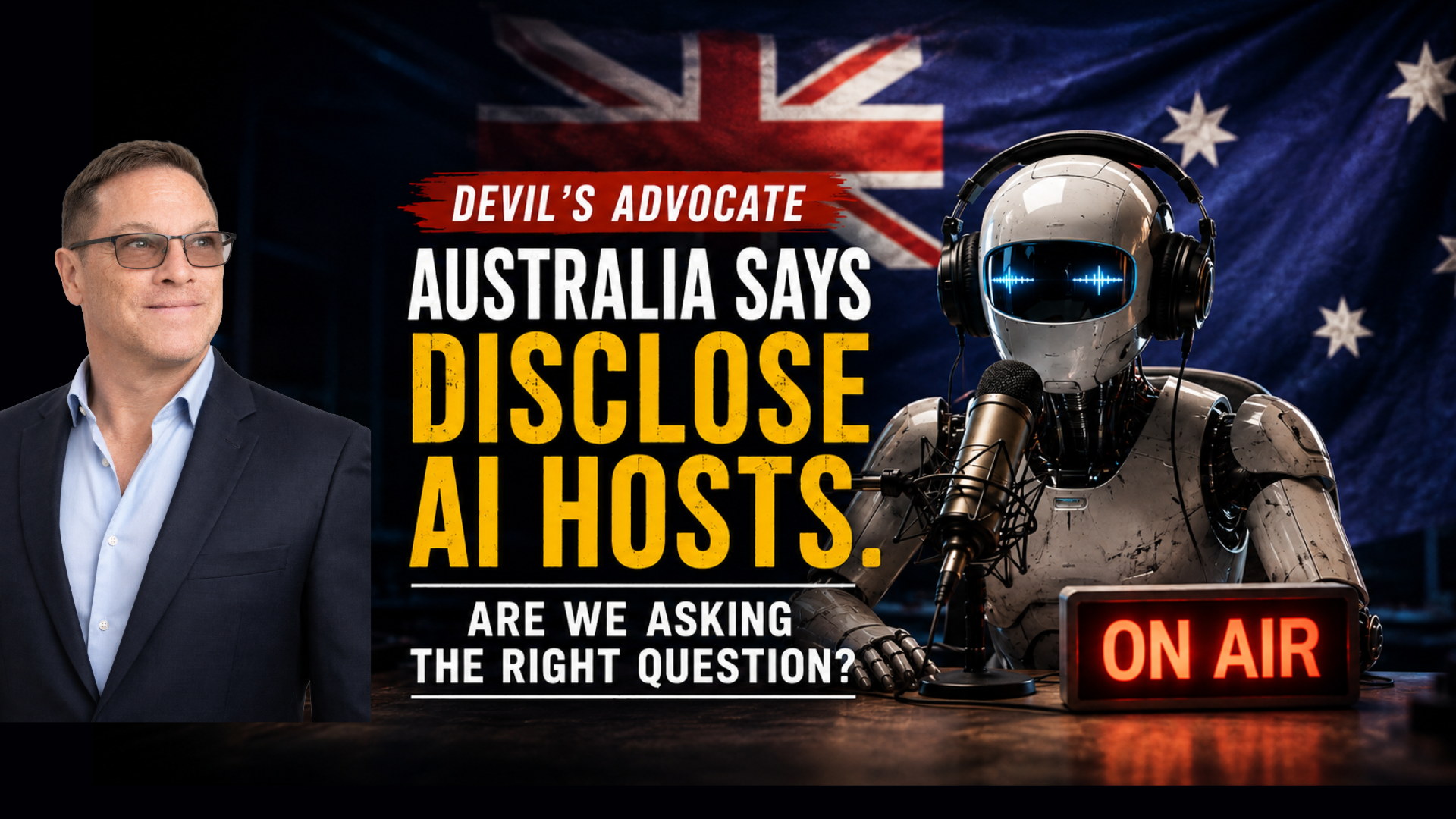
Let me play devil’s advocate for a minute. Australia has officially stepped into something the rest of the radio business has mostly been arguing about over lunch, on LinkedIn and probably at the bar after conventions: AI personalities.
Beginning July 1, Australia’s new Commercial Radio Code of Practice requires commercial stations to disclose when a synthetic voice generated by artificial intelligence is hosting a regularly scheduled program or news program. And before anybody starts throwing rocks at me, let’s establish what I am not saying.
I’m not arguing that radio should replace its personalities with machines. I’m not arguing that listeners don’t deserve transparency. And I’m certainly not arguing that every use of AI in programming is a good idea. I’ve heard enough bad AI already to know better.
I’m asking something narrower and considerably more interesting: If a human being is still making the creative decisions, at what exact point does using AI make the result no longer human? Because I’m not sure we’ve thought that one all the way through.
First, Australia Didn’t Ban Anything
This is important. Australia did not ban AI personalities. The new rules don’t say synthetic voices shouldn’t be on commercial radio. They don’t prohibit broadcasters from experimenting with them. They don’t even require disclosure every time an artificial voice comes out of the speakers.
The disclosure requirement is aimed specifically at a synthetic voice hosting a regularly scheduled program or news program. Weather, traffic, music, commercials and other content within the program aren’t treated the same way under this particular requirement. In other words, Australia hasn’t said, “AI doesn’t belong on the radio.” It has essentially said, “If AI is sitting in the host chair, let people know.”
Fair enough. In fact, I think transparency is probably the easiest part of this argument. What gets considerably more complicated is what we’re supposed to conclude from that disclosure.
So What Exactly Makes Something “Human”?
I’ve already seen some of the industry conversation begin moving toward a comfortable conclusion: AI is terrific behind the microphone. Let it write. Let it produce. Let it edit. Let it generate imaging. Let it make 47 versions of something before lunch. Just don’t let it become the personality.
Maybe that’s exactly where the line belongs. But why? Seriously. That’s not a rhetorical trick. I think it’s a question worth answering.
Consider 2 completely different radio stations. Station A buys an AI system and tells it, “Give me 4 breaks about today’s entertainment news.” The machine finds the stories, writes the material, voices the breaks, drops them into automation and everybody goes home early. Okay. That’s pretty easy to describe as automated radio.
Now let’s try Station B. A personality wakes up, looks around the market, reads what’s happening, finds something interesting and decides what he wants to talk about. He develops the premise, gives the AI his observations and gets something back.
It stinks.
So he rewrites it. The joke doesn’t work, so he changes it. The local reference isn’t local enough, so he fixes it. The performance sounds like a GPS unit trying to sell mattresses, so he generates another one. Nope. Another. Better.
He adjusts the direction, edits the timing, fixes a pronunciation, changes a line at the last second and finally puts it on the air. The final voice happens to be synthetic.
Who created that break? That’s where this gets a little more complicated than HUMAN GOOD. ROBOT BAD.
The Microphone Was Never the Talent
Radio has been separating human beings from the precise moment listeners hear them for decades. We call one version of it voice tracking. We’ve syndicated personalities into hundreds of markets. We’ve prerecorded interviews. We’ve moved breaks around. We’ve edited pauses. We’ve pitch-shifted voices. We’ve compressed, limited, EQ’d and processed announcers until I’m reasonably certain no naturally occurring human throat has ever sounded quite like that.
And we’re okay with all of it. A personality can record a break Tuesday afternoon that sounds perfectly spontaneous when somebody hears it Wednesday morning. A nationally syndicated host can magically appear between 2 songs in a town he couldn’t find on a map. Nobody runs a disclaimer afterward saying, “The preceding personality was not actually sitting in this building when you heard him.”
Why? Because somewhere along the way we decided that presence and authorship aren’t necessarily the same thing. And I think that matters.
The microphone was never the talent. The person making the decisions was.
Australia Is Actually Being Pretty Reasonable
When you get past the scary headlines and look at what Australia actually did, the rule isn’t particularly hysterical. The Australian Communications and Media Authority says the purpose is transparency. Listeners should have enough information to make informed choices about what they’re hearing.
Hard to argue with that. And stations don’t necessarily have to stop every few minutes and announce, “ATTENTION! THE FOLLOWING PERSONALITY DOES NOT POSSESS VOCAL CORDS.” Disclosure can occur during the program, in another episode, on the show’s website, through station websites or social channels, or through another reasonable method.
So let’s give Australia some credit. It isn’t banning experimentation. It’s essentially saying: Experiment. Just don’t deliberately fool people. I can live with that.
What I don’t think we should do is turn a reasonable transparency requirement into a philosophical declaration that anything performed by a synthetic voice somehow stops being human-created content. That’s a much bigger leap.
And Here’s Where Radio May Tie Itself Into a Pretzel
This is the part I find fascinating. AI writing copy? Innovation. AI producing commercials? Innovation. AI generating music? Innovation. AI building jingles? Innovation. AI creating station imaging? Innovation. AI generating 14 versions of a promo so somebody can test which one works? Look at all that efficiency!
But let AI generate the final voice of something conceived, written, shaped, directed and edited by a human and suddenly: WHOA, WHOA, WHOA. HAVE WE LOST THE SOUL OF RADIO?¶ Why? I’m being serious. Well...mostly.
There are technology providers already advancing variations of the argument that AI is terrific when it improves everything happening behind the personality, but the personality itself should remain human. I understand the argument. I even understand the instinct behind it.
But there’s something awfully convenient about drawing the ethical boundary around the precise collection of AI tools we already feel comfortable selling and using.
Maybe that’s still the correct boundary. But comfort isn’t proof.
Maybe We’re Measuring the Wrong Thing
Instead of obsessing exclusively over whether the final voice originated in lungs or software, maybe we should ask some different questions. Who decided what to talk about? Who had the idea? Who understands the market? Who knew that mentioning that road, that restaurant, that high school, that coach or that ridiculous thing everybody in town is talking about would instantly mean something to the listener?
Who decided the first joke wasn’t funny? Who caught the factual error? Who realized the tone was wrong? Who said, “Nope. Do it again”? Who made the final decision about what reached the transmitter?
And here’s the big one: Who is responsible when it goes wrong?
Those questions tell me considerably more about whether a radio show has a human behind it than whether somebody physically pushed a microphone fader open.
We Should Probably Talk About “Authenticity,” Too
¶ Radio loves this word: authenticity. We need authentic personalities. Authentic connections. Authentic localism. I agree with every bit of that.
But having a pulse doesn’t automatically make something authentic. We’ve all heard painfully generic voice tracks recorded by actual humans. We’ve heard personalities reading liner cards they didn’t write about promotions they barely understand in communities they don’t live in. We’ve heard nationally distributed material awkwardly disguised as local.
Every bit of it was created by genuine, breathing, carbon-based human beings. Was it authentic?
Now imagine somebody who actually knows the community, understands the audience, chooses the subjects, develops the ideas, injects a point of view, makes the editorial decisions and then uses an artificial voice as one part of the production process.
Which one is more human?
I don’t think the answer is nearly as obvious as we’d like it to be.
Trust Still Matters. A Lot.
This is where I think Australia gets it right: Don’t deceive people. If you’ve invented a completely fictional personality and you’re deliberately encouraging listeners to believe that person is walking around town, going to restaurants, attending Friday night’s game, taking the kids to school and living a life that doesn’t actually exist, then we’ve entered an ethical conversation worth having.
Transparency matters. Accountability matters. Trust absolutely matters.
But disclosure shouldn’t automatically become a scarlet letter attached to content saying: THIS WAS MADE BY A MACHINE. Because increasingly, that statement may not even be accurate.¶ It may have been made by a person using a machine. That’s an enormous distinction.
Photoshop didn’t remove the photographer from photography. Pro Tools didn’t remove the producer from music. Digital editing didn’t remove the filmmaker from filmmaking.
And spellcheck didn’t write this article. At least I don’t think it did.
Now Comes the Experiment
Australia got to this regulatory question before most of the rest of us. Other countries will follow. Regulators will debate it. Radio groups will debate it. Technology companies will debate it. Consultants will absolutely debate it. And lawyers with extremely expensive watches will eventually explain all of it to us.
Fine. We should have the conversation.
What I don’t think we should do is pretend we already know how listeners are going to respond to technology that is changing almost weekly. Maybe listeners will reject AI personalities. Maybe they’ll embrace them. Maybe they’ll care deeply about disclosure. Maybe they’ll shrug and ask us to play another song.
Maybe the winning model will remain entirely human. Maybe somebody will eventually build a completely artificial personality compelling enough to develop a real audience.
My money, however, is on something much messier: a talented human being with a ridiculous new collection of tools.
Which brings me back to the question I can’t shake. If a human chooses the subject, develops the premise, provides the point of view, understands the audience, writes and rewrites the material, directs the performance, edits the result and ultimately decides what reaches the transmitter...
At what exact point did that stop being human creativity? Australia hasn’t answered that question. Neither have I. And that’s the point of playing devil’s advocate.
Before radio draws a permanent line between human and AI, maybe we should make sure we’re drawing it around the thing that actually matters.
Because I still believe radio desperately needs human beings.
I’m just no longer convinced that “human” and “human voice” are necessarily the same thing.